Sheinbaum orders Morena: campaign is house to house

The president recommends to her coordinators the most basic and personal strategy to win elections.

Sheinbaum’s campaign manual: tennis, backpack and a lot of walking

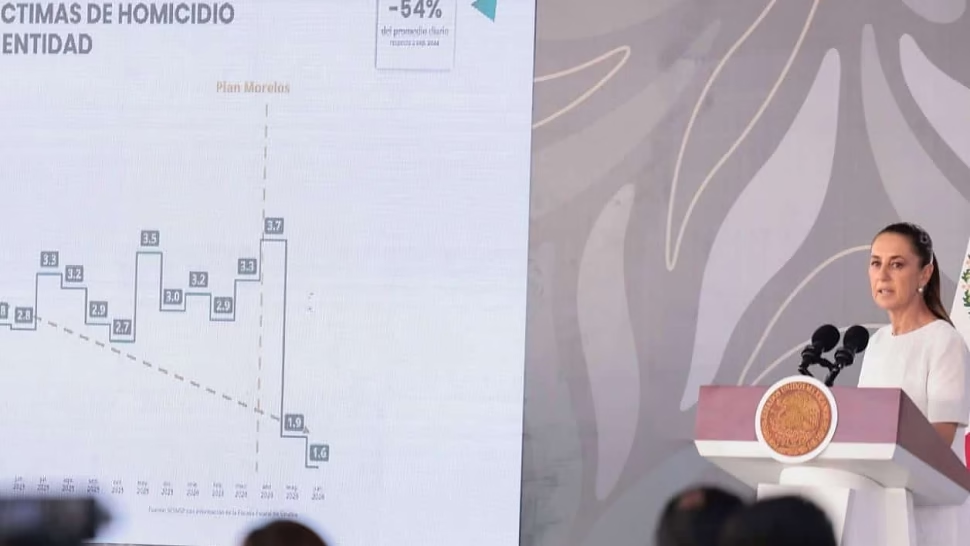
While Morena defines who will lead the electoral battle in the key states for 2025, Claudia Sheinbaum gave a single instruction. One that sounds like a neighborhood council, not a palace strategy.

This Thursday morning, the president recalled López Obrador’s old advice. The magic formula according to the former president: “good tennis shoes for walking and a backpack for the drivers”.

“My only orientation is: the best way to promote yourself in a territory is house to house,” said Sheinbaum with the conviction of someone who has lived it. “Not even the big spectaculars, it’s house to house.”

There is no room here for complicated theories or sophisticated digital campaigns. The message is earthly, almost primitive. Sheinbaum speaks from raw experience.

RelatedSheinbaum announces that Salud Casa por Casa will change medical history

He recalled his own campaign for the delegation leadership in Tlalpan in 2015, when Morena debuted at the polls. Their knowledge of the territory was minimal, barely 3%. The solution was as simple as it was exhausting.

“I toured on foot, and it is the largest delegation in the city on foot,” he said. “I was first promoting Morena because I couldn’t promote myself personally.”

That image says it all: an unknown candidate, a new party, and miles of asphalt ahead. There were no shortcuts.

Now, ten years later and as president, he repeats the same recipe to his troops. It is as if time had not passed, as if surveys and communication teams did not exist.

Why this obsession with the basics? Because in politics, what wins elections is still direct human contact. The greeting, the look, the hand that knocks on a door.

Sheinbaum knows it. He lived it in his worn out shoes. And now he demands that his coordinators replicate that sweaty formula.

In the Mexican political theater, where each movement is calculated to the millimeter, this instruction seems anachronistic. But perhaps that is precisely its strength: remembering that in the end, politics is made with people. One by one.
SEP rejects militarized education after tragedy in Tamaulipas

The SEP clarifies that militarized education is not authorized after the death of a minor in Tamaulipas.

SEP reiterates ban on military education

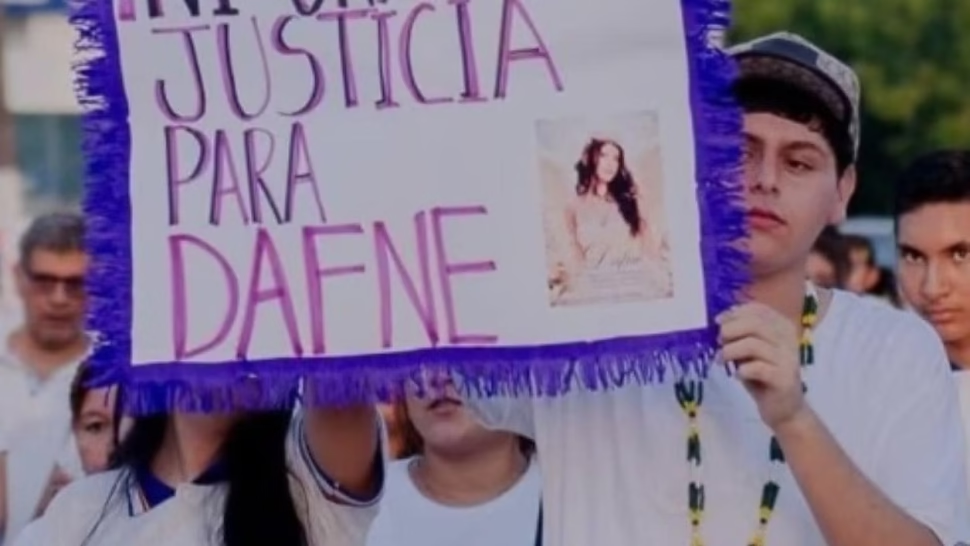
The Ministry of Public Education (SEP) stated that education under military or military modalities is not permitted in Mexico. The statement came after the death of a teenager at a summer camp with military characteristics in Ciudad Madero, Tamaulipas.

The head of the SEP, Mario Delgado Carrillo, condemned attempts to justify acts of violence or mistreatment with the argument of a supposed military education. He pointed out that these practices are not training methods and violate the human rights of children and adolescents.

Through a statement, the agency clarified that no basic education institution is authorized to teach teachings labeled as military or military. He explained that military education is exclusive for personnel of the Armed Forces and the National Guard.

Regarding the incident, state educational authorities will take measures to protect the rights of minors. According to family testimonies, the teenager entered the camp on July 13 in good health and days later she was reported fainted after a fall. The minor died inside the facilities.

The SEP reiterated its rejection of any practice of abuse or degrading treatment against minors. The case has generated a call to review supervision mechanisms in extracurricular activities.

Continue reading

Imports of Mexican cattle to the US resume

Following a health agreement, the US will reopen the port of Douglas, Arizona, for Mexican cattle.

President Claudia Sheinbaum reported that the United States will resume importing Mexican cattle starting the last week of August. The decision came after an official communication from the US Secretary of Agriculture, Brooke Rollins.

Reopening schedule

The reopening will begin at the border port of Agua Prieta, Sonora, linked to the Douglas crossing, Arizona. August 24 will be the first date of operation. Later, two additional points will be enabled in Chihuahua, subject to compliance with the Joint Action Plan against screwworm.

Sheinbaum instructed federal agencies to accelerate coordination with US authorities. He highlighted the work of the Secretary of Agriculture, Julio Berdegué, and the director of Senasica, Columba López, to strengthen health measures.

  • The animals will enter with complete inspections to verify that they do not show signs of the plague.
  • Later, the opening of the ports of Santa Teresa and Columbus, in New Mexico, will be evaluated.

The president described the news as positive for Mexican ranchers, who for months contained the spread of the screwworm. He appreciated Rollins’ willingness to maintain an institutional relationship.

Rollins, for his part, stated that the protection of the US livestock industry remains a priority and that the temporary closure of crossings was necessary to reduce risks. The reopening is possible thanks to binational collaboration.

Continue reading

More than eight million apocryphal cigarettes seized in Manzanillo

Joint operation in Manzanillo detected shipment of counterfeit cigarettes.

Operational in the port of Manzanillo

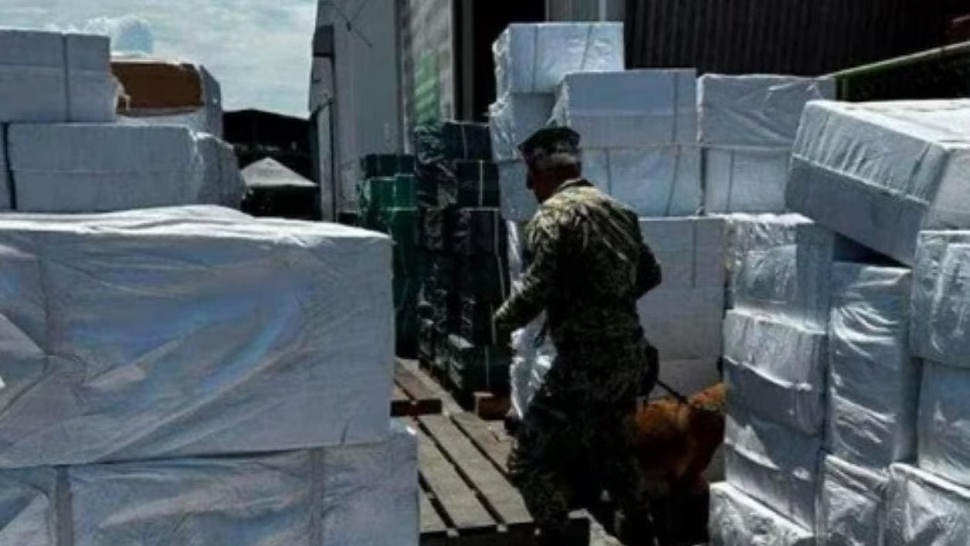
Federal authorities seized more than eight million allegedly apocryphal cigarettes in the port of Manzanillo, Colima. The operation was coordinated by agencies of the security cabinet and the National Customs Agency of Mexico (ANAM).

Personnel from the ANAM and the Administrative Unit of the Manzanillo Customs detected inconsistencies in an operation to import cigarettes from abroad. This led to a specialized review.

As a result of the inspections, the authorities located 8 million 436 presumably counterfeit cigarettes. The merchandise was insured with the support of the Secretary of the Navy (Semar).

The ANAM reported that this type of operations are part of the permanent mechanisms of operational intelligence, risk management and strategic analysis. The objective is to strengthen security in foreign trade operations and detect documentary irregularities or goods of illicit origin.

The comprehensive analysis of the operation made it possible to reinforce documentary traceability, operational review and validation of commercial profiles. The authorities maintain surveillance at entry points into the country to combat illegal trade.

Continue reading