Political context and strategic deployment
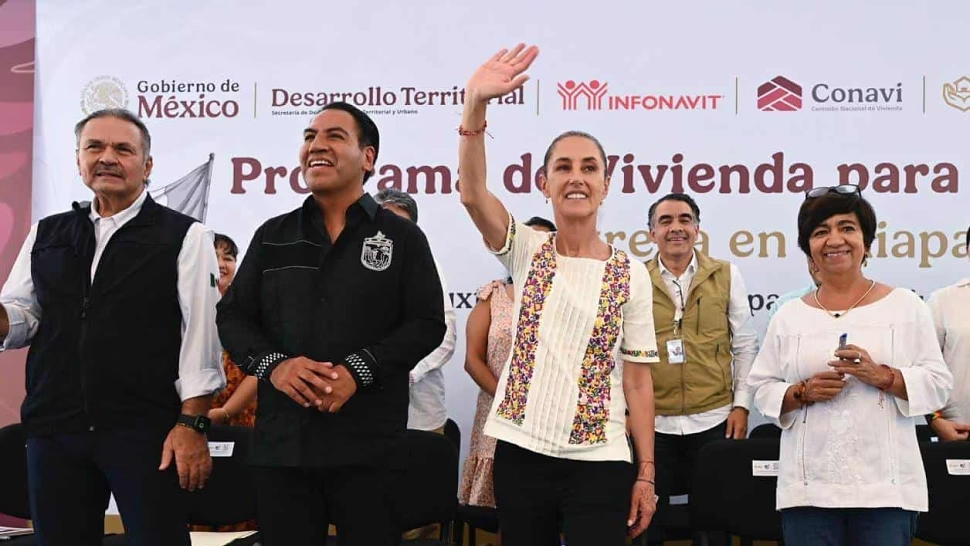
In an electoral scenario tense by violent incidents in Veracruz, the national president of Morena, Luisa María Alcalde, made a key visit to the municipalities of Orizaba and Córdoba. Its objective: to consolidate support for the candidates of the Fourth Transformation (4T), Igor Rojo and Manuel Alonso Cerezo, respectively. This deployment occurs in the final stretch of the campaign to renew 212 city councils, where the safety of the contenders and the integrity of the process are priorities.
Mobilization strategy and warnings
Mayor emphasized two critical tasks in his speech: promotion of the vote and protection against irregularities. “Let’s guarantee that citizens go to the polls on election day. There is no room for excuses,” he declared in Orizaba, a municipality historically dominated by the PRI and PAN. He stressed the need to monitor possible practices such as the purchase of votes, attributed to opposition parties (“the PRIAN”), according to his narrative.
Despite not directly addressing the murder of Yesenia Lara – a Morenista candidate in Texistepec – nor the attacks on party headquarters in Xalapa, its implicit message was clear: internal cohesion and discipline are vital to counteract political violence. He highlighted that, although Morena leads the polls in the region, confidence could be a strategic error.
Proposals and vision of the candidates
In Córdoba, under the Morenista administration since 2021, Alonso Cerezo outlined three pillars for his government: infrastructure and security, administrative simplification, and the creation of the National Independence Museum. “We are looking for a functional city, with efficient services and a preventive security strategy,” he stated. This approach seeks to capitalize on the local historical legacy—the Treaties of Córdoba—as an axis of identity and tourism.
In parallel, Rojo promised to turn Orizaba into a model of sustainable development, with priority attention to older adults and young people. The Mayor reinforced this message by linking it to the national project of Claudia Sheinbaum and Governor Rocío Nahle: “We will open the way to hope,” he assured.
Analysis of the electoral climate
The tour occurs in a context where Veracruz registers 12 candidates murdered so far in the process, according to data from the Mexican Electoral Observatory. Experts point out that the violence reflects disputes between local power groups and organized crime, which requires parties to adjust tactics. Morena, despite its advantage in voting intention, faces the challenge of guaranteeing minimum security conditions for its supporters.
The absence of specific statements on the recent attacks could be interpreted as a strategy to avoid further polarizing the environment. However, civil organizations demand concrete actions to protect political actors.
What’s next? The next 10 days will be decisive in measuring the parties’ ability to mobilize voters in an adverse environment. Morena is betting on its territorial structure and narrative of change, while the opposition seeks to capitalize on discontent over insecurity.
Explore more about the impact of political violence on local elections and share this analysis on your social networks.