Sheinbaum supports voice actors in the regulation of artificial intelligence
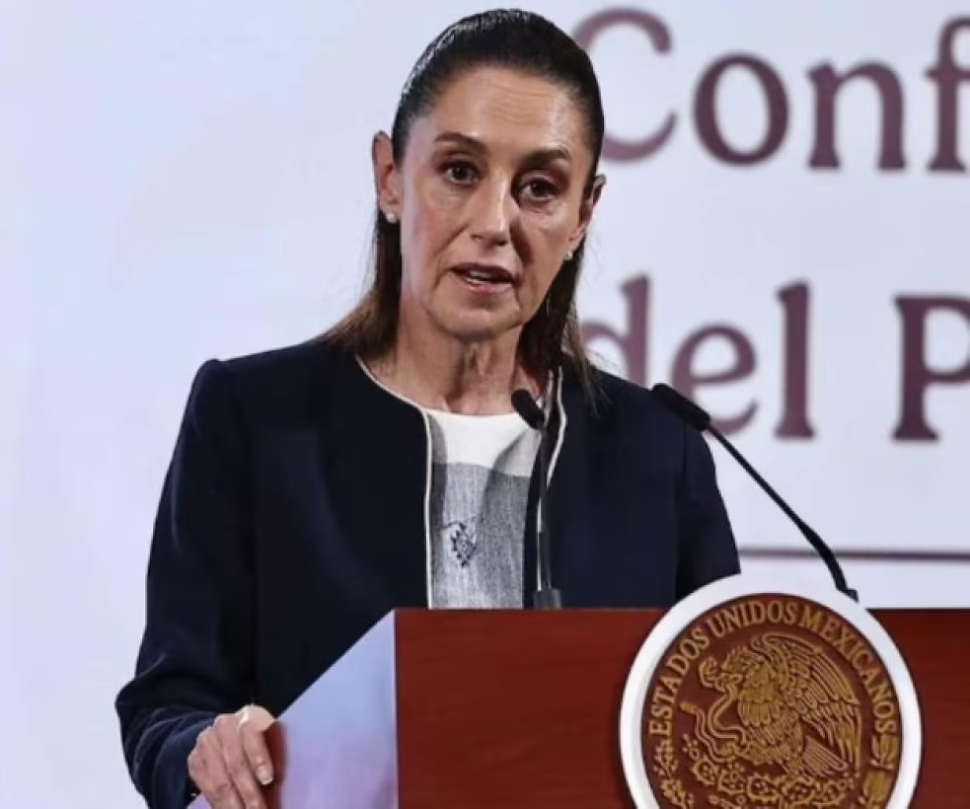
President Claudia Sheinbaum Pardo expressed her support for dubbing actors, announcers and filmmakers who demand urgent regulation of the use of artificial intelligence (AI) in the reproduction of voices. During a meeting with the media, the federal president stated that “they are right” to point out the risks of this technology, especially after the complaint that the INE used the voice of the deceased actor José Lavat in an institutional video without authorization.
Concrete actions to protect the work of dubbing artists
Sheinbaum announced that he instructed the Legal Department of the Federal Executive (CJEF) and the Secretary of Culture (SC) to establish dialogues with the representatives of the union. The objective is to design a legal framework that safeguards their labor rights and their vocal assets. “It is a fundamental profession in Mexico, internationally recognized for its quality. We must prevent tools like AI from violating its work,” he stressed.
The conflict arose after a protest in front of the Monument to the Revolution, where the actors demanded measures against the non-consensual use of their voices through vocal synthesis systems. The president highlighted the ethical paradox of reviving voices of deceased people, as happened with Lavat: “It is not correct to commercialize or manipulate what constitutes your professional identity.”
Legal and technological challenges in the digital era
The debate raises questions about the classification of the voice as biometric data and its protection under intellectual property laws. Sheinbaum mentioned the need to analyze whether this resource should be equated to other unique features such as fingerprints or facial recognition. Experts consulted agree that Mexico needs to update its legal framework to include:
- Moral rights over digital vocal reproductions
- Limits to training algorithms with unlicensed recordings
- Economic compensation for commercial use of replicas generated by AI
The Mexican dubbing industry, a pioneer in Latin America, thus faces an unprecedented challenge. According to data from the Mexican Institute of Cinematography, the country produces more than 4,500 hours of dubbed content annually, generating employment for nearly 1,200 specialized professionals.
What’s next? The technical meetings will begin this week, with the participation of trade associations such as ANDA and the National Chamber of the Film Industry. The proposals are expected to include modifications to the Federal Labor Law and the Copyright Law.
Share this information to make visible the challenges of creators in the digital age. Explore more content on technology and labor rights in our specialized section.