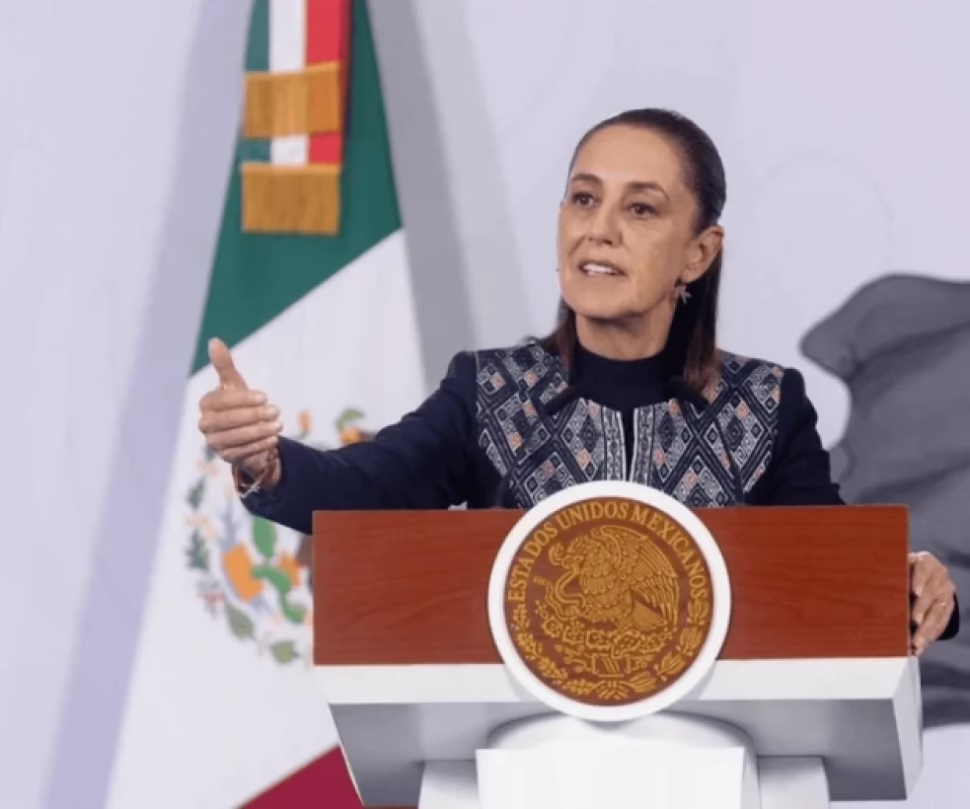
Sheinbaum rules out espionage in telephone line records

Sheinbaum denies espionage and asks to register lines to combat extortion. More than half have already complied.

President Claudia Sheinbaum announced that next Thursday, José Merino, head of the Digital Transformation and Telecommunications Agency, will report on the progress of the mandatory registration of telephone lines. The initial deadline expired in June and, according to Sheinbaum, more than half of the lines are already registered.

“It is very important for people to know, because there is a lot of campaign that the objective is to spy on people. It is absolutely and totally false,” he declared from the National Palace. “The registry helps strengthen security and combat telephone extortion and other crimes.”

Sheinbaum highlighted that Mexico is one of the few countries where mobile lines are not associated with a person. He reiterated that it is the telephone companies who safeguard the data, not the federal government.

RelatedRegistration of telephone lines in Mexico: steps and date

Registration details

When asked about possible cancellations or extensions, the president responded: “We do not want to affect people, but we do want them to register. It is a short time, it is done quickly and we help each other.”

However, risks remain. Last week, EL UNIVERSAL reported that the irregular trade in chips that were allegedly already registered continues. Experts warned that the registry could encourage identity theft and asked to postpone the deadline.

As of Friday, June 5, the Telecommunications Regulatory Commission (CRT) reported 56 million 797 thousand 762 registered lines. The government hopes that Thursday’s announcement will clarify doubts and speed up the process.

Controversy over an interview with Monsiváis reaches the Senate and the Palace

The republication of a 1999 interview unleashes accusations between the Executive and legislators.

The republication of an old interview attributed to Carlos Monsiváis climbed to the center of the Mexican political debate this Wednesday. The issue was discussed both in the Senate and in President Claudia Sheinbaum’s morning conference.

The original text was written by journalist Edmundo Cázares in 1999 and recently republished by El Universal. It contains statements about the then head of Government Andrés Manuel López Obrador. Its veracity and context have been questioned, generating conflicting positions.

Sheinbaum describes the content as “grotesque”

During her conference, the president harshly criticized the publication. He described the content as “grotesque” and accused the medium of generating a controversy that distorts the tribute to the Mexican intellectual.

Reactions in the Senate

The issue also reached Congress. Senator Lilly Téllez read fragments of the text on the platform. In response, Gerardo Fernández Noroña rejected its use and maintained that it was a false publication with the intention of political attack.

The exchange reflects the polarization around the figure of López Obrador and the use of historical documents as partisan weapons.

Continue reading

PRI demands urgent action against violence in Guerrero

They denounce an incursion of armed civilians in Coyuca de Catalán; party calls for state intervention.

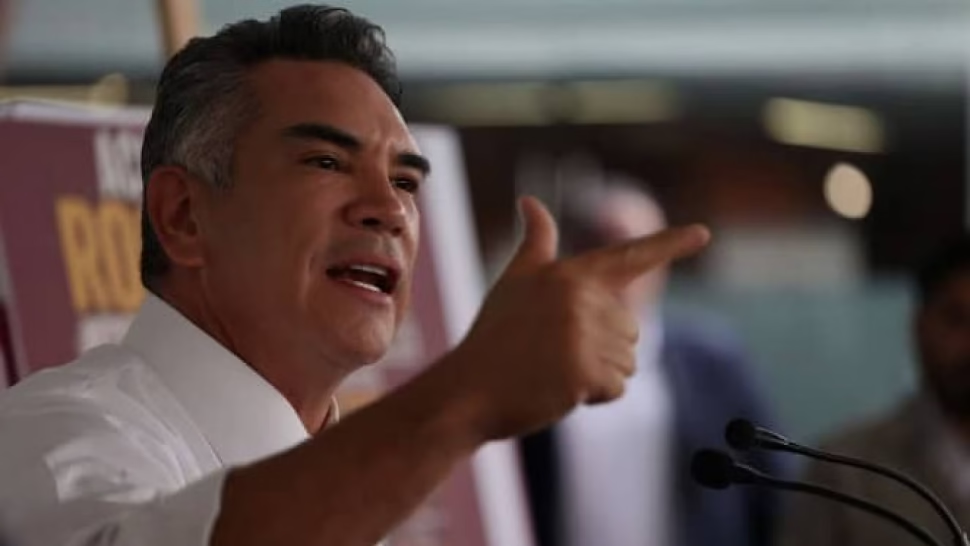
The national leadership of the PRI demanded that the Mexican State intervene urgently in response to the complaint by inhabitants of the Guajes de Ayala ejido, in Coyuca de Catalán, Guerrero. The residents reported the incursion of armed civilians into their community in the Sierra.

Call for safety

Alejandro Moreno Cárdenas, president of the party, asked the authorities to guarantee the safety of the families. He warned that these events should not be normalized due to the risk they represent for the civilian population.

The leader pointed out that in various communities in Guerrero they live under siege by armed groups. This has caused displacement, confinement of inhabitants and a constant climate of fear and uncertainty. He considered an immediate response from the State necessary.

Moreno Cárdenas also criticized the federal government for minimizing the situation of violence in the country. He affirmed that the population faces conditions of insecurity that require priority attention to restore the rule of law in the region.

Continue reading

Inflation in Mexico slows down and remains at Banxico’s goal

Inflation drops to 3.55% in the first half of June, within Banxico's target range.

Inflation in Mexico continues to decline. According to Inegi, it stood at 3.55% annually during the first half of June. This represents a drop of 0.11 percentage points compared to the second half of May.

With three consecutive months of deceleration, the indicator remains within Banxico’s target range (3% plus/minus one point). This level is key for purchasing power.

Pressures on core inflation

However, pressures remain. Core inflation—which reflects medium and long-term trends—was at 4.12%, with a biweekly increase of 0.19 points. Within this category, merchandise rose 3.65% annually and services, 4.57%.

Non-core inflation and seasonality

In contrast, non-core inflation slowed to 1.61% annually, driven by the drop in agricultural prices. Products such as tomatoes, eggs and poblano peppers recorded significant decreases.

The report also reflected seasonal movements in tourist services, related to the summer and the Soccer World Cup. Air transportation, hotels and tour packages increased. Despite this, analysts foresee a favorable trend towards the end of the year.

Continue reading