Sheinbaum declares tranquility after the dejection of El Mencho

The president claims that the country is calm after the death of the criminal leader, but questions arise about the details.

Tranquility or official narrative?

Claudia Sheinbaum went out this Wednesday to sell calm. After the operation that ended with Nemesio Oseguera Cervantes, ‘El Mencho’, the president painted a picture of total control. “The entire republic and particularly Jalisco is calm,” he assured from the National Palace.

But between lines, the gaps in the story are more eloquent than the statements. The president herself did not know one basic fact: whether the remains of the leader of the Jalisco Nueva Generación Cartel had already been claimed by his family. “We would have to ask the Prosecutor’s Office,” he said with a vagueness that makes noise.

“We would have to ask the Prosecutor’s Office what would happen if they were not claimed”

While talking about coordination and burned vehicles collected, the security reinforcement speaks another language. He announced the sending of 2,500 more elements of the National Guard to the metropolitan area of ​​Guadalajara. Reinforcements for an already existing tranquility? Logic suffers.

RelatedGovernment announces dejection of El Mencho, leader of the CJNG

The narrative is classic: successful operation, close collaboration with Governor Pablo Lemus, normality restored. Even classes resume. The script is well rehearsed.

But memory is stubborn. These episodes usually have less photogenic later chapters: reckonings, shifts of power, violence that mutates but does not disappear. Declaring premature peace smacks more of image management than a forensic analysis of reality.

Sheinbaum closed with the promise of constant coordination “for any problem.” A tacit recognition that problems will surely come. The announced tranquility seems like a wish more than a diagnosis.

Sheinbaum and Greer hold key meeting on T-MEC

Meeting at the National Palace advances in the review of the T-MEC and bilateral agreements.

Meeting at the National Palace

At the National Palace, President Claudia Sheinbaum Pardo received the United States trade representative, Jamieson Greer, this Thursday. The meeting lasted an hour and a half.

According to Sheinbaum, they made progress in the review of the T-MEC and in bilateral agreements. “At the National Palace, we met with the United States trade representative, Jamieson Greer; we advanced in the review of the T-MEC and bilateral agreements for the benefit of both peoples,” he wrote on social networks.

For Mexico, the Secretaries of Economy, Marcelo Ebrard, attended; of Foreign Affairs, Roberto Velasco; Undersecretary Luis Rosendo Gutiérrez; the coordinator Julio Berdegué; and the coordinator Altagracia Gómez. The U.S. delegation included Deputy Representative Jeff Goettman, Ambassador Ronald Johnson, Chief Negotiator Julie Callahan and Chief of Staff Sam Mulopulos.

Sheinbaum stated in his morning conference that his government has done “everything humanly possible” so that Mexico faces the trade review in the best conditions. He added that they will continue to defend national interests against unilateral decisions by Washington.

“We don’t know exactly what the United States is going to do; what we do is our best work to find the best conditions for our country,” he said.

He recalled that the United States unilaterally imposed tariffs on various countries and that a new round is approaching under Section 301. Therefore, Mexico remains attentive.

The president also rejected statements from US legislators about an alleged failure to deliver water. He described that statement as false.

The meeting is part of the T-MEC negotiation rounds, in a complex trade context due to Washington’s protectionist measures.

Continue reading

México Canta 2026: 16 thousand young people seek peace through music

16 thousand participants registered for the 2026 edition of the binational México Canta contest.

A contest that bridges borders

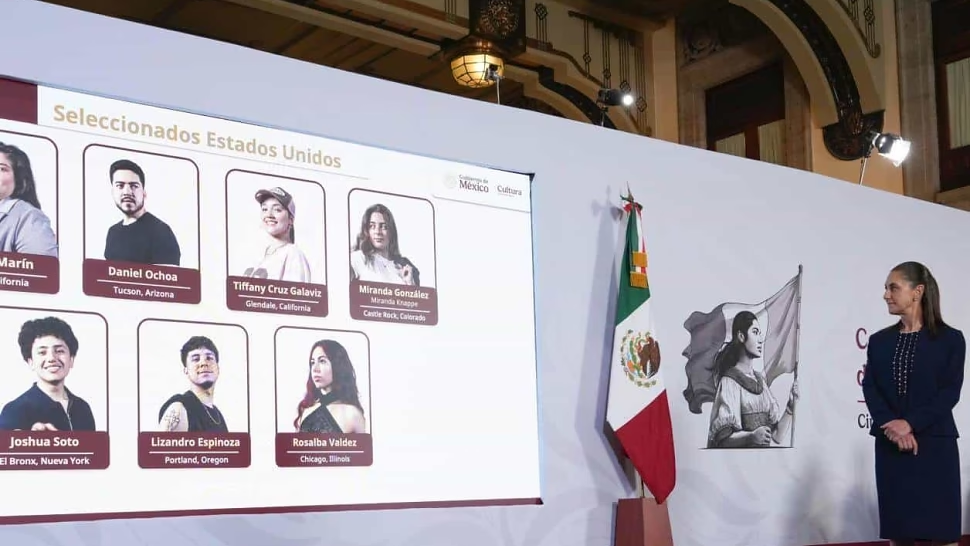
President Claudia Sheinbaum Pardo presented the seven Mexican-American semifinalists of México Canta 2026. She highlighted that the contest promotes values, love for Mexican music and the bond between families on both sides of the border.

“That bond is never broken, it is part of fraternity, love, solidarity,” he stated during the morning conference.

Sheinbaum stressed that the initiative transcends politics: it is a cultural defense that puts love above all.

Figures and stages

The Secretary of Culture, Claudia Curiel de Icaza, explained that in the first stage (May 11 to June 10) 16,289 participants were registered: 10,528 from Mexico and 5,761 from the United States. After in-person auditions, the Mexican Music Council selected 14 semifinalists: seven Mexicans and seven Mexican-Americans.

The seven selected from the other side of the border are:

  • Grecia Marín (Perris, California)
  • Daniel Ochoa (Tucson, Arizona)
  • Tiffany Galaviz (Glendale, California)
  • Miranda González (Castle Rock, Colorado)
  • Joshua Soto (The Bronx, New York)
  • Lizandro Espinoza (Portland, Oregon)
  • Rosalba Valdez (Chicago, Illinois)

The semifinals are broadcast on 45 public media on Sundays from 7 to 9 p.m. The live performances will be on August 23 at the Million Dollar Theater (Los Angeles) and August 30 at the Ángela Peralta Theater (Mazatlán). The public will choose six finalists in real time. The grand final will be on September 13 at the National Auditorium, and the winners will be presented on September 15 at the capital’s Zócalo.

The singer Armando Toledo Rosas “El Bogueto” celebrated the contest as a sign that young people can get ahead with talent and work. Grecia Marín, representing the semifinalists, thanked the president for opening spaces that carry messages of hope. Joshua Soto added that México Canta shows that music inspires and unites.

Continue reading

FDA recognizes false positive in Taylor Farms lettuce

Cofepris analysis rules out contamination; FDA admits error in initial sample.

Analysis results

The Ministry of Health reported that tests carried out on lettuce and water samples from the Taylor Farms Mexico plant were negative for the parasite Cyclospora cayetanensis —which causes severe diarrhea— and also for fecal coliforms. The analyses, carried out by Cofepris, confirmed that the product complies with the physicochemical parameters established in national standards.

Traceability and false positive

Taylor Farms has a traceability system that allowed United States authorities to identify the origin of the product and track a batch held at customs in Laredo, Texas. That batch never entered US territory.

The sample obtained from that batch returned a false positive, a situation that the United States Food and Drug Administration (FDA) recognized in an update published on July 19. The Ministry of Health emphasized that the product is suitable for human consumption.

Continue reading