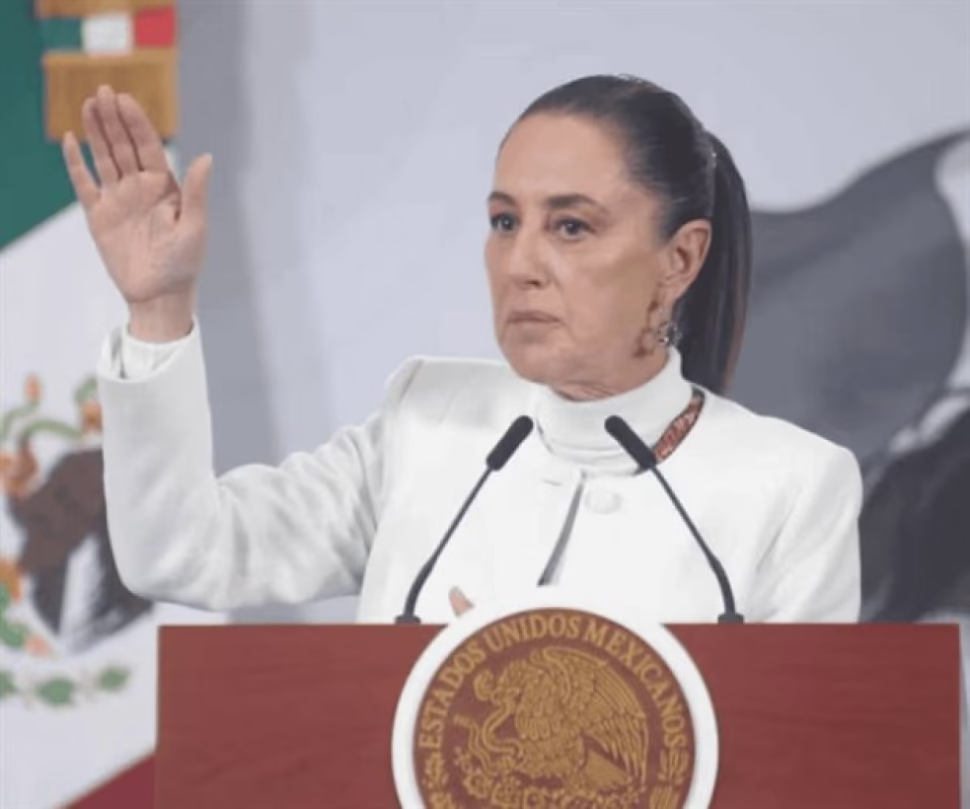
Sheinbaum confirms an increase in homicides in southern Sinaloa

The president confirmed a violent spike over the weekend, promising a detailed analysis of the security landscape for next month.

A Grim Weekend: Violence Breaks Out in Sinaloa

In the cold morning light, from the heart of Mexico City, shocking news pierced the air like a sinister bolt of lightning. President Claudia Sheinbaum, with the weight of the nation on her shoulders, was forced to utter words that no leader wants to say: there was a brutal spike in murders in the state of Sinaloa. It wasn’t just any increase; It was an eruption of violence concentrated in one weekend that left a deep scar. However, in a twist that only fueled the intrigue and collective anxiety, the president withheld the crudest details, promising that the Security Cabinet would reveal the complete balance sheet, the definitive report, until January 2026. The wait seemed like torture, an unbearable suspense for a population crying out for answers.

The President’s Words: A Recognition Full of Mystery

What exactly did Claudia Sheinbaum declare about this wave of homicides? His words, spoken with the gravity of an oath, painted a terrifying picture. “Yesterday there were, particularly in the south of Sinaloa, in Escuinapa, these blockades and there had been an average of around 3.5 homicides per day, and it was a weekend where homicides increased.” Each syllable resonated like a hammer blow. Southern Sinaloa, a region with a complex history, once again became the epicenter of chaos. The base figure, heartbreaking in itself, had been surpassed by a wave of crimes that broke all schemes. His commitment, “Let’s go, next time you come, in January, to do an evaluation,” sounded more like a challenge thrown to fate than a mere appointment on the agenda. It was the promise of a confrontation against the lurking shadow.

RelatedMexico ranks second in homicides of LGBT+ people in Latin America

Blockades and Declarations: A High Tension Backdrop

The setting of this drama was not limited to homicides. The blockades in Escuinapa wove a web of terror on the roads, paralyzing life and sowing panic among the inhabitants. It was the perfect prelude, the sign that dark forces were moving with impunity. And while the smoke from the burning tires still rose, another ghost emerged from afar to complicate the plot. The statements made by Ismael “El Mayo” Zambada from the United States fell like a bomb with incalculable implications. Faced with this development, President Sheinbaum, with the astuteness of someone who knows the intricate labyrinths of power and justice, delegated the floor. “The Attorney General’s Office (FGR) will be in charge of discussing the matter,” he stated, adding that the institution “can report in more detail.” It was a master move, shifting the focus to a legal battle being fought on two fronts, suggesting that the threads of this tragedy extend far beyond the borders of Sinaloa.

This is not a simple safety report; It is the chapter in a national saga where the fight against organized crime is lived with one’s heart in one fist. Each piece of information is a piece of a larger puzzle, where the violence in Escuinapa and the statements of a boss intertwine to define the future of peace in Mexico. Sheinbaum’s administration faces a litmus test, where its security strategy will be dissected under the magnifying glass of a citizenry that can no longer tolerate empty promises. The announcement of a balance sheet in January is not a final point, but rather the cliffhanger of a season where everything is at stake. The nation will count the days, hoping that the 2026 report is not another report of war, but the first step towards a different outcome.

Do you think this analysis reflects the complexity of the security challenge? Share this article on your social networks to expand the conversation and explore together more content on the crucial topics that define our present.

Sheinbaum announces border reopening for Mexican cattle

Gradual reopening of the US border to Mexican cattle at the end of August.

New stage for national livestock farming

President Claudia Sheinbaum confirmed that the United States border will gradually reopen at the end of August for the export of Mexican livestock. The measure represents economic relief for the country and for thousands of families dedicated to livestock farming.

Both nations suffered losses during the shutdown, caused by the presence of the screwworm. Sheinbaum acknowledged that the coordinated work between governments and producers for more than a year made it possible to contain the pest.

“You know that we have been working on the issue, both with all the livestock organizations and with the governors, to contain the screwworm,” said the president from Cuautla, Morelos.

As part of the strategy, a plant to produce sterile flies is already operating in Chiapas. In addition, Cofepris is analyzing a new strain that would make the process more efficient.

Sheinbaum explained that the effort is carried out in conjunction with the governments of Mexico, the United States and Panama. This articulation created the conditions for the US authority to authorize the opening of the border.

Continue reading

Del Valle residents propose law against property dispossession

After four days of sit-in, neighbors demand legal protection and a table with a prosecutor.

Proposed neighborhood law

Neighbors of the Del Valle neighborhood, in the Benito Juárez mayor’s office, announced that they will promote a bill to strengthen the protection of property owners. The proposal is inspired by the case of Doña Carlota, who in Chalco, State of Mexico, used a weapon to defend her home and caused the death of two people.

After holding a four-day sit-in at the intersection of Matías Romero and Coyoacán Avenue, where they reported alleged looting, the neighbors obtained a work table. The meeting will be next Wednesday in the Bunker of the Attorney General’s Office of Mexico City (FGJ CDMX) with the prosecutor Bertha Alcalde Luján and the Secretary of Government, César Cravioto.

Alicia Camp, member of the Community Participation Commission (Copaco) of Valle Centro, stated that they will present files from affected neighbors throughout the capital.

“This is not a unique and isolated case as the prosecution wants to believe; it is a recurring event, not only in Benito Juárez, but throughout the City,” he declared.

Camp called on those who have investigation files for invasion or dispossession to join the table to demonstrate the magnitude of the problem. He warned that, if there is no concrete progress, the next protest will close the intersection of Insurgentes Sur and Eje 6 Sur.

“I want to believe the word of the people who govern us, but if this is not resolved satisfactorily, we will go out again to demonstrate,” he said.

Regarding the initiative, Camp explained that they seek to avoid extreme situations to recover properties and strengthen legal mechanisms. The reform would contemplate the Public Property Registry and notaries to make fraudulent operations more difficult.

In June 2025, the Congress of the State of Mexico toughened the penalties for dispossession: from five to 10 years in prison, and up to 25 years and six months if public servants or notaries participate. The law considers aggravating factors such as physical violence, breaking locks, or when the victim is over 70 years old, a minor, a pregnant woman, a disabled woman, or belonging to an indigenous community.

Continue reading

Doctor faints in Fresnillo operating room

Alleged heat stroke due to lack of ventilation in the operating room of the Fresnillo General Hospital

Incident in the operating room due to high temperatures

A doctor at the Fresnillo General Hospital, belonging to the IMSS-Bienestar, lost consciousness while performing surgery. The incident occurred this Friday, and since Saturday, videos recorded by workers at the hospital began to circulate.

According to medical personnel, the fainting was caused by a suspected heatstroke. They point out that the operating rooms lack adequate ventilation and that the air conditioning conditions are insufficient. Complaints about this problem have spread on social networks.

The workers demanded that the hospital authorities urgently review the air conditioning systems. So far, the IMSS-Wellbeing has not issued an official statement about the incident or the measures that will be taken.

The hospital unit serves a population of more than 200 thousand inhabitants in the Fresnillo region. This type of failure in critical infrastructure puts both health personnel and patients at risk.

Continue reading