Sheinbaum closes the door to foreign fracking in Mexico

The president rules out giving resources to foreign companies and promises community consultations on gas exploitation.

“How do you think we are going to deliver the oil!”

The setting was the National Palace, but history wrote the script. Claudia Sheinbaum, with that mixture of genuine indignation and political calculation that characterizes her, drew a line in the sand this Wednesday. Fracking, that issue that divides waters and fractures communities, will not be a back door for large international oil companies to enter Mexico.

“How do you think that we, who have fought so hard, are going to hand over the oil to transnational companies! Well, we are not Calderón, we are not Peña!”

The phrase was not just a coup d’état. It was a direct message to those who hoped that, under the review of the T-MEC, the key to massive exploitation would be opened. Sheinbaum immediately connected with the most sensitive nerve of the Fourth Transformation project: energy sovereignty.

“We are not going to hand over our natural resources abroad, as you think! Imagine, if it is the essence of the transformation!”

But here’s the detail that many are overlooking. The president did not say a resounding ‘no’ to fracking. What it did was set conditions that were almost impossible for any company to meet.

RelatedThe opaque dance of millions for fracking in Mexico

The battle will be played in the communities

Sheinbaum announced that any project will have to go through the filter of community consultations. And he did not talk about quick procedures.

“We have to see if it is a national consultation or a consultation in the area… because in the end the communities are going to be affected. So, we go one by one, one by one.”

He recalled cases such as the Wellbeing Poles where the communities themselves have rejected projects. The message to environmental groups was clear: they will be heard, but the final decision will be “responsible.” Responsible for whom? Therein lies the mystery.

Meanwhile, on the real board, Sheinbaum revealed concrete moves:

  • The contracts with Repsol are cancelled
  • Pemex focuses on recovering flared gas and exploiting conventional fields
  • There is only one active contract left… and without authorization to expand

The strategy is clear: buy time while Pemex is strengthened and tempers are calmed. But the T-MEC clock keeps ticking, and the United States watches every move.

At the end of the day, Sheinbaum put on stage what he does best: defend the flag of sovereignty while handling an explosive issue with tweezers. Political theater has its new masterpiece… but the public still doesn’t know how it ends.

Pedestrian bridge collapses on Manzanillo beach; two injured

Pedestrian bridge fall on La Boquita beach leaves two minor injuries.

Collapse in La Boquita

Two people suffered minor injuries after the collapse of the pedestrian bridge on La Boquita beach, in Manzanillo, Colima. The incident occurred on the afternoon of Saturday, July 25 and mobilized Civil Protection elements, who came to provide support.

According to the authorities, those affected did not require hospital transfer. The area was cordoned off to avoid risks to other tourists and to allow security checks.

Background and investigation

The same bridge had already collapsed in 2017 and was rebuilt. However, authorities noted that the new structure appeared to have deficiencies. An investigation will begin to determine responsibilities for its construction and maintenance.

Specialized personnel will carry out inspections to evaluate conditions and rule out other risk points. Visitors were asked to avoid the affected area. Municipal and state authorities will maintain surveillance until safe access is guaranteed.

The case revived the debate about tourism infrastructure and the need for periodic reviews in public spaces.

Continue reading

PAN accuses political persecution against Ernesto Ruffo Appel

The PAN leader denounces political use of justice against the former governor of Baja California.

Accusations of political persecution

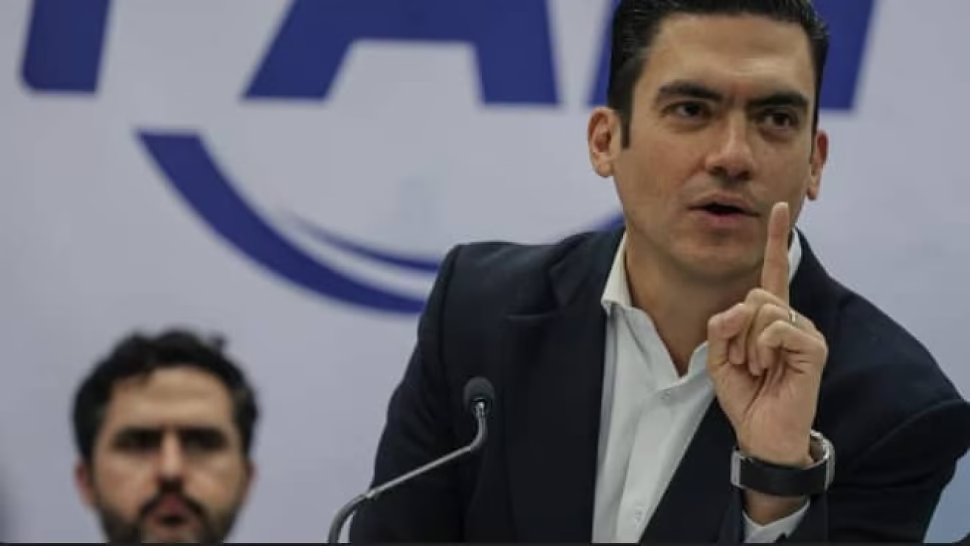
The national president of the PAN, Jorge Romero Herrera, assured that Ernesto Ruffo Appel is a victim of political persecution by the federal government. In a statement, the PAN leader pointed out that the admission of the former governor of Baja California to a maximum security prison responds to a political use of justice institutions.

Romero Herrera stated that there is not enough evidence to support the accusations against Ruffo Appel for an alleged tax evasion network. The PAN member maintained that the government has chosen to persecute opponents while ignoring accusations against Morena figures.

Comparison with Morena cases

The PAN leader mentioned Morenoist politicians such as Rubén Rocha Moya, Enrique Inzunza, Américo Villarreal and Marina del Pilar Ávila. He said that they have faced questions about possible links to organized crime without the authorities acting as quickly.

Romero Herrera insisted that the law must be applied without distinctions. He stressed that anyone who commits a crime must respond to justice, but demanded that the criminal system not be used as a tool of political persecution.

Continue reading

Afore withdrawals and unpaid loans put millions at risk

Moreira and experts warn about the impact of early withdrawals and unpaid loans.

Risk for workers’ assets

Rubén Moreira, coordinator of the PRI in the Chamber of Deputies, warned that the increase in the overdue portfolio of mortgage and consumer loans, along with the increase in withdrawals from Afores due to unemployment, puts the assets and future pensions of millions of Mexicans at risk.

During the program “With Pears, Apples and Oranges”, Moreira pointed out:

The lack of employment has forced many families to stop paying their bank loans and resort to their retirement savings to cover basic needs such as food and medicine.

The legislator criticized the fact that there is not enough information about the consequences of withdrawing resources from the Afores, since this reduces accumulated savings for retirement.

He also warned about the growth of loans granted by fintech and digital banks, some of which can handle high financial costs and represent risks for users.

Mario Di Costanzo, specialist, reported that between January and June of this year more than one million workers made partial withdrawals of their Afores due to unemployment. He added that Infonavit’s overdue portfolio reached 410 billion pesos during the first quarter of 2026, while mortgage and consumer loans in arrears exceeded 110 billion pesos.

Miguel Ángel Sulub, for his part, explained that early withdrawals from Afores not only affect the amount available for retirement, but also the weeks of contributions necessary to obtain a pension.

Continue reading