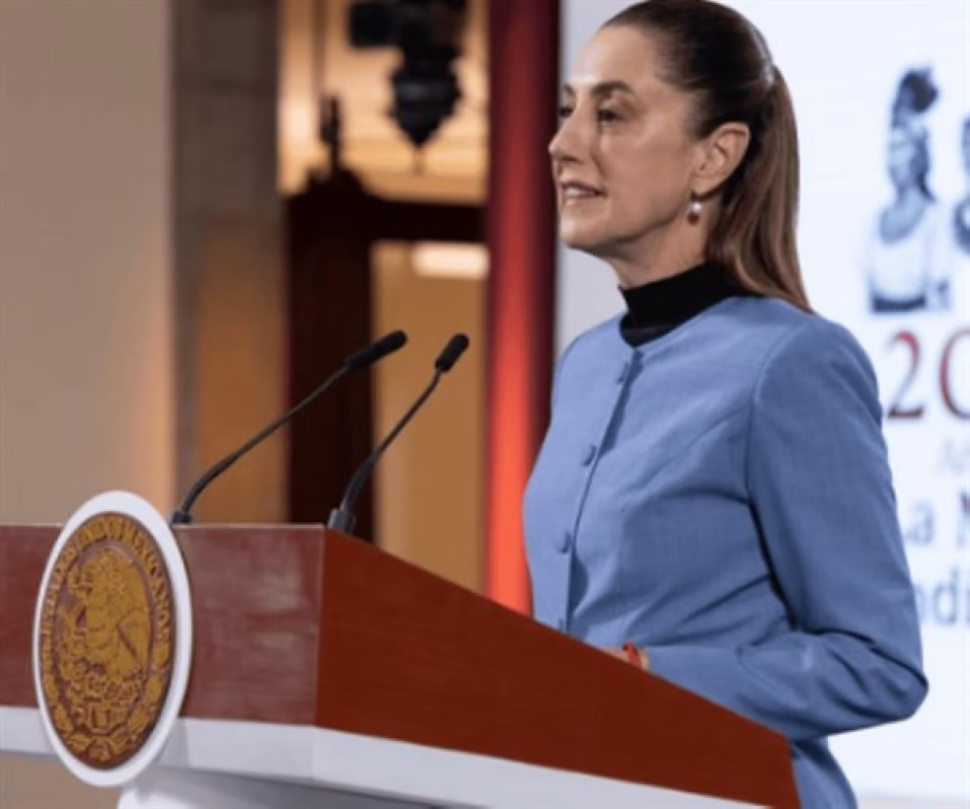
Sheinbaum announces electoral reform proposal for January

The federal Executive is finalizing the details of a proposal that seeks to transform the rules of the democratic game in the country, with structural changes.

Electoral reform moves towards its formal presentation

The presidency of the Republic is preparing to present an initiative for electoral reform during the third week of January, as announced by President Claudia Sheinbaum in a meeting with the media. This announcement marks a milestone in the process of reviewing the legal framework that governs elections and political organization in Mexico, a major issue in the government’s transformation agenda.

A consultation and technical review process

The president explained that next week she will hold a working meeting with the Presidential Commission for Electoral Reform, a technical body headed by expert Pablo Gómez. The objective of this meeting will be to carry out a exhaustive review of the reports and conclusions derived from the consultation forums held in various parts of the country. “We are going to review the forums, and what the reform commission that I appointed is proposing. I believe that by the second or third week of January we would be in a position to present a formal proposal,” said Sheinbaum, underlining the deliberative and well-founded nature of the process.

RelatedThe electoral reform will begin its legislative process in January 2026

This specialized commission was established in August 2025 with the explicit mandate to prepare a comprehensive proposal to modify the electoral system. Its creation responded to the need to channel the discussions of academics, representatives of institutions and civil society into a technical and viable document. The work of this group has focused on diagnosing the areas of opportunity and critical points of the current model.

Central axes of the proposal under discussion

Among the structural changes that have been publicly aired and that are part of the analysis, President Sheinbaum has previously mentioned two of great impact: the reduction of public financing to political institutes and a modification to the integration of the federal Legislative Branch. The latter refers specifically to a possible decrease in the number of legislators who come to office through proportional representation (known as plurinominales).

The possible rationalization of resources towards the parties seeks to generate a debate on the efficiency in the use of public funds and promote greater links between political forces and citizens through alternative fundraising mechanisms. On the other hand, the review of the composition of Congress points to a substantive debate on representativeness, the cost of democracy and agility in legislative processes. These modifications, if materialized, would imply a significant reengineering of the balance and operation of the Mexican political system, with possible effects on the dynamics of powers and the future electoral contest.

The analytical approach suggests that this reform is not an isolated exercise, but part of a broader vision of institutional reconfiguration. Its formal presentation will begin a complex political negotiation process in the Congress of the Union, where it will require the construction of consensus and qualified majorities for its approval. The way in which these technical and highly sensitive issues are addressed will define the tone of the relationship between the powers of the State in the coming period.

Do you think these changes will strengthen the democratic system? Share this analysis on the future of political institutions on your social networks and explore more content about the reform agenda in Mexico on our site.

Machete attack in Ahome leaves young man with serious head injury

Young man injured with machete in Ahome; Authorities investigate assault linked to going out with a friend.

Machete attack in Ahome

In the community of Agua Nueva, municipality of Ahome, a 27-year-old young man suffered a twelve-centimeter wound to the skull after being attacked with a machete. The victim, identified as Víctor Arturo “N”, was admitted to a hospital in Los Mochis.

The events occurred after the attacked person went for a walk with a friend. When he returned her to her home, a relative of the young woman—according to testimonies—pulled out a machete and hit him on the head. Neighbors helped the injured man and took him to the hospital.

The State Attorney General’s Office was notified of this new attack with a knife. In Sinaloa, the use of machetes outside of agricultural hours and areas is prohibited.

Similar background

On June 8, on the beaches of Las Salinas (Higueras de Zaragoza district, Ahome), a minor suffered a similar attack. According to the report, two young men on a motorcycle attacked him with machetes while he was enjoying the beach. Fishermen in the area intervened and prevented major injuries. The minor was transferred to an IMSS hospital in Los Mochis.

The authorities continue to investigate both cases, with no arrests reported so far.

Continue reading

They seize a gun and cell phones in searches of the Culiacán prison after a fight

Two searches in the Culiacán prison after a fight: they seize a pistol, chargers and 13 cell phones.

Weapons and cell phones are seized in two inspections of the Culiacán prison

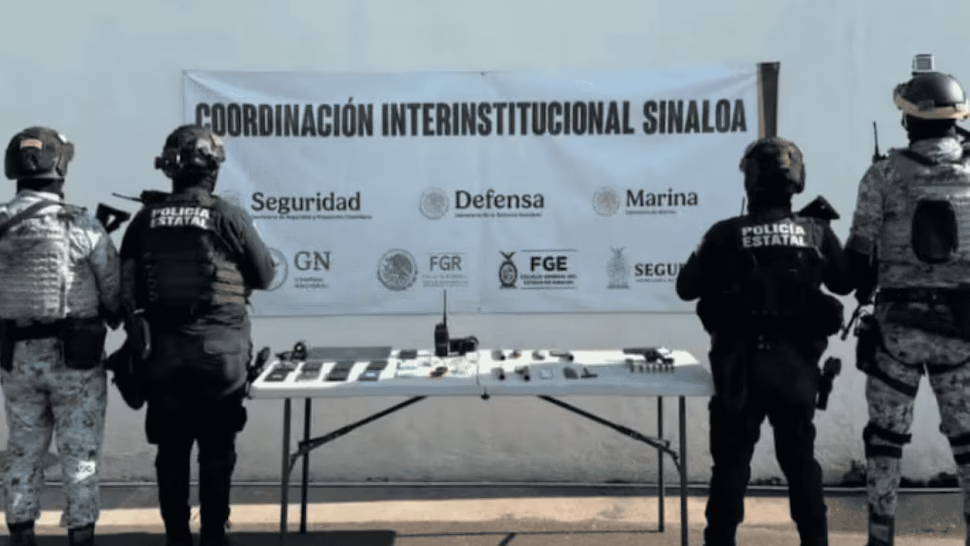
After the fight that left an inmate dead in the Culiacán penitentiary center, authorities carried out two searches in which a pistol, a supplied magazine, 14 useful cartridges and 13 cell phones were seized.

The first of the operations found, in addition to the above, four mobile phone chargers, a radio, a laptop computer with its charger and nine handmade tips. In the second inspection, carried out with the support of guards and state police, only one cell phone, two chargers, a USB cable and four tips were located.

They reinforce external surveillance

Elements of the National Guard, the Army and the Special Operations Group reinforced the perimeter of the prison as a preventive measure. The State Public Security Secretariat reported that in each review the corresponding complaints have been presented to the public ministry.

The events that triggered the searches

On Wednesday, July 22, a fight occurred between several inmates. One inmate suffered serious injuries from a sharp weapon and was taken to a hospital, where he was later confirmed dead. The victim was identified as Jorge Alberto “N”, 41 years old. The reason for his admission to the prison was not revealed.

During the conflict, guards and state police intervened inside, while the outside was guarded by the military and the National Guard, managing to control the situation.

Continue reading

Sheinbaum delivers pension to three million women

Delivery of cards and announcement of works in Guerrero

President Claudia Sheinbaum led the delivery of Women’s Wellbeing Pension cards in Acapulco, a program that benefits Mexican women aged 60 to 64 with bimonthly support of 3,100 pesos.

Nationally, three million women receive this pension. In Guerrero there are about 70 thousand, and in Acapulco 17 thousand 955, detailed the Secretary of Welfare, Leticia Ramírez.

“When women walk together, there is nothing that stops us. Those are Mexican women,” declared Sheinbaum.

Delivery of support and infrastructure announcements

The president also announced works to guarantee the supply of drinking water in Guerrero, such as the rehabilitation of areas damaged by hurricanes Otis and John, and the construction of pumps in towers to prevent flooding. The La Parota dam project is cancelled; In their place, wells and high tanks will be built.

In tourism, it reported a hotel occupancy of 78 percent in Acapulco.

Sheinbaum recalled other actions in favor of women: the distribution of more than 25 million Women’s Rights Booklets, the creation of LIBRE Centers in a thousand municipalities (goal: 2,500) and the integration of 250,000 women into the National Network of Weavers of the Homeland.

Governor Evelyn Salgado called the program transformative. The beneficiary Angelita Nava thanked on behalf of the women of Acapulco.

Continue reading