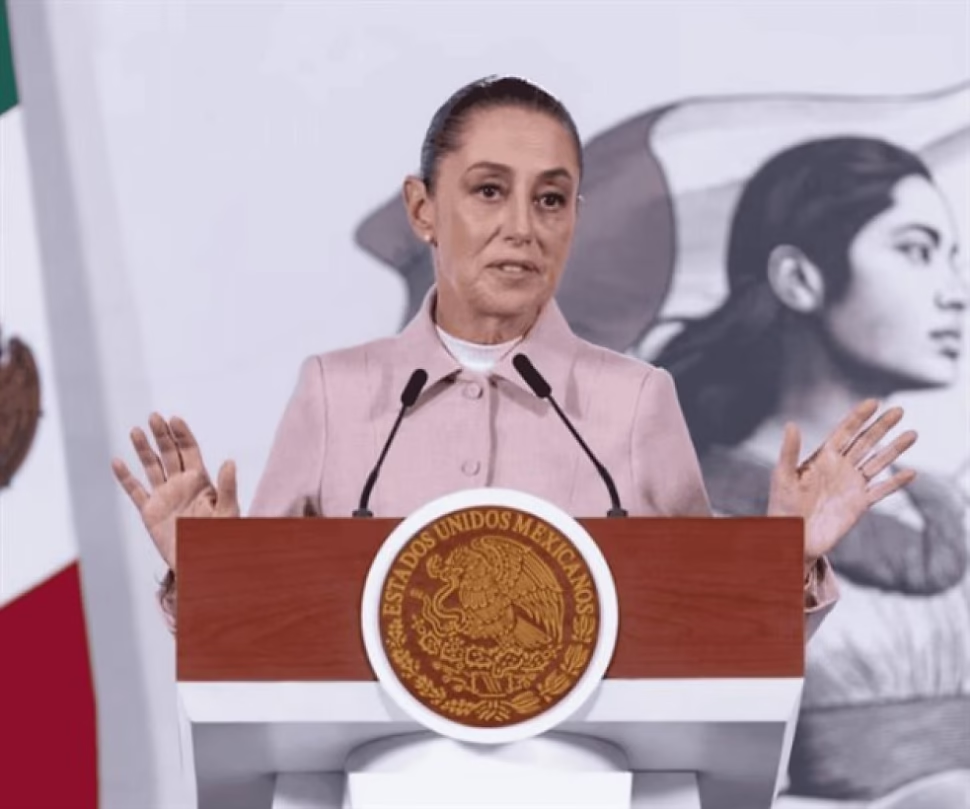
Sheinbaum accuses opponents of flirting with the international right

The president links opposition legislators with the global right after attending a conservative forum in the US.

The scene heats up: Sheinbaum points to the opposition

President Claudia Sheinbaum did not bite her tongue. Upon learning that legislators from opposition parties attended the Conservative Political Action Conference (CPAC) in the United States, he launched a broadside that will resonate in the halls of Congress. For her, this trip is not a simple international meeting. It is definitive proof of a dangerous closeness.

“It’s good for people to know who they are,” Sheinbaum said, putting his finger on the issue. In his vision, these forums represent “positions contrary to democracy and the historical struggles of the Mexican people.”

A historical thread that continues to this day

Sheinbaum did not stay in the present. He took a trip back in time to connect dots. He recalled that in the 19th century, conservatives promoted a monarchical government and supported figures such as Maximilian of Habsburg and Porfirio Díaz. His thesis is clear: the same thought persists today.

RelatedSheinbaum reaffirms the direction of the transformation in the Zócalo

He directly accused sectors that he identified as the “PRIAN” of aspiring to an authoritarian and exclusive model. The words were hard, loaded with emotion:

“They do not want democracy, they seek a repressive government, they use lies to denigrate and are deeply racist, classist and sexist.”.

But here comes the juicy part: he questioned why legislators left their public responsibilities for this meeting. He even proposed that they should be held accountable for the use of resources for such trips. That’s not just a political criticism; It is a gauntlet thrown into the legal field.

On the other side of the ring, he rejected accusations of authoritarianism towards his movement. He assured that his project has always sought democracy as a genuine representation of the people.

His final message was a historical warning: “Today’s conservatism is the same as the 19th century, but the people of Mexico have always defeated them.” Political theater has a new act, and Sheinbaum has just raised the curtain.
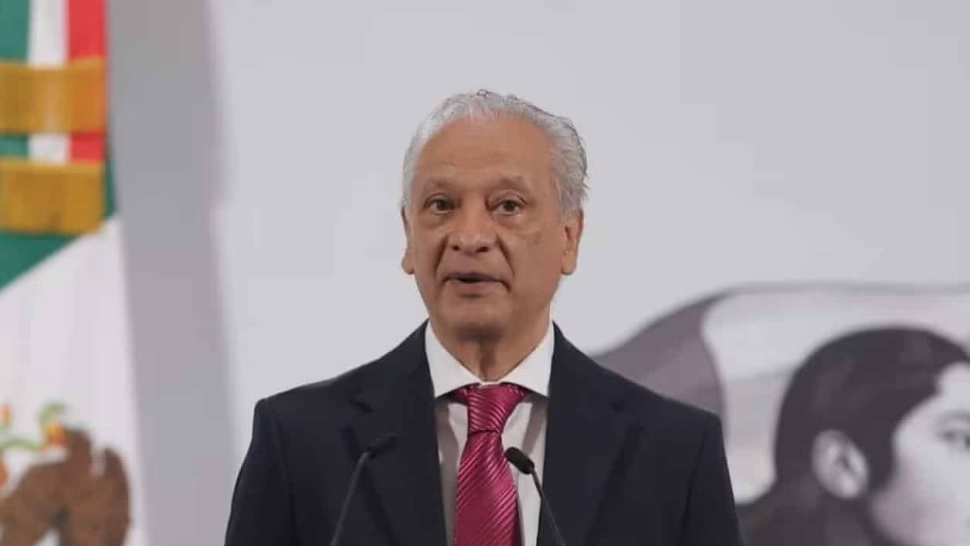
Former director of Pemex leaves prison after revocation of precautionary measure

Judge revokes preventive detention of former director of Pemex due to new address and forgiveness of his wife.

Judge orders immediate release of former Pemex director

The Control Judge, Consuelo Adriana Correa, revoked the preventive detention faced by Víctor Rodríguez Padilla, former director of Petróleos Mexicanos (Pemex). The decision was made after the defense presented a public deed that proves a fixed address in Mexico City.

One of the key factors was that, at the time the measure was imposed, Rodríguez Padilla had not been able to prove permanent residence. That gap was corrected with the new documentation.

In addition, the judge considered the writing of the former official’s wife, María Felicia Jiménez Lavie, who expressed her forgiveness and her intention to seek an alternative solution to the criminal process.

Based on these elements, Correa determined to modify the precautionary measure and annul the justified preventive detention.

Two-hour deadline for release

The resolution included a period of two hours, starting at 10:45 a.m. this Tuesday, for the director of the Morelos Social Reintegration Center to comply with the order and carry out the necessary procedures for the departure of Rodríguez Padilla.

The case continues its legal course, now without the measure of imprisonment.

Continue reading

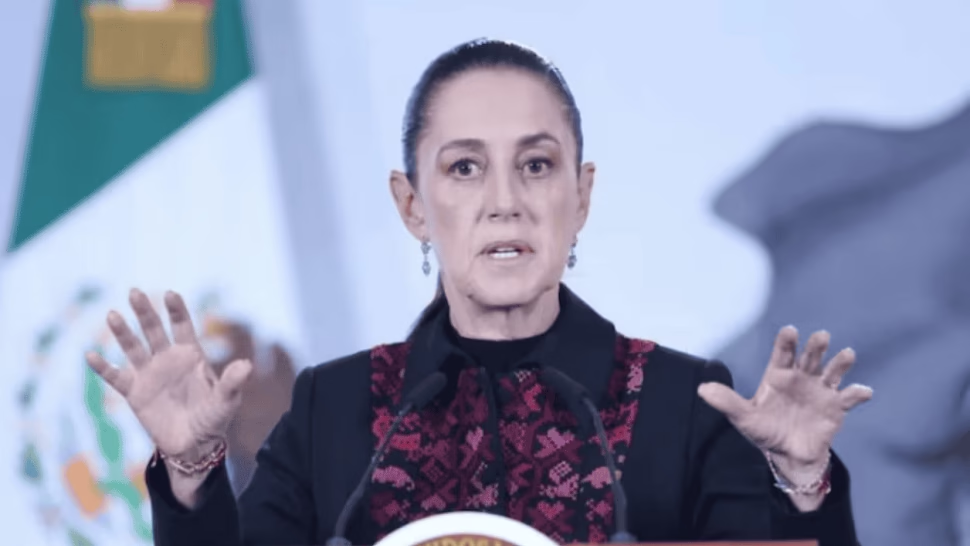
Sheinbaum delimits the federal government from removing the memorial for missing people

President Sheinbaum clarifies that removal of the memorial was not a federal order and details progress in early warning.

Memorial in the Angel: who removed it?

Collectives of searching mothers installed a memorial at the Angel of Independence to make visible the more than 135,000 missing people in the country, among them Ana Amelí, a young woman who disappeared a year ago in Ajusco. The structure was removed less than 24 hours later. President Claudia Sheinbaum assured that the Government of Mexico did not participate in that action.

“This withdrawal was not up to the Government of Mexico,” he stated during his morning conference. She recalled that when she was head of Government of the capital, the installation of a memory space in the Glorieta de los Desaparecidos was respected. Sheinbaum reiterated that his administration maintains constant communication with the groups.

The case of Ana Amelí and the new alert system

Regarding the disappearance of Ana Amelí, Sheinbaum pointed out that the search efforts continue and that since he became aware of it, he instructed the Secretary of National Defense to have the National Guard support the family. He highlighted that, after the legal reforms promoted after the case of Teuchitlán, Jalisco, the early warning mechanism was strengthened.

He explained that when a prosecutor’s office receives a complaint, a National Alert is activated that involves security institutions and other entities such as airports to facilitate location. The Ministry of the Interior has an Early Warning Center that coordinates these actions. Sheinbaum indicated that this mechanism has made it possible to quickly locate people reported missing, either due to a crime or due to voluntary absence.

The president reiterated that the Ministry of the Interior and the National Search Commission (CNB) maintain permanent work with the groups. He recalled that the current head of the CNB was elected with the participation of these groups.

Continue reading

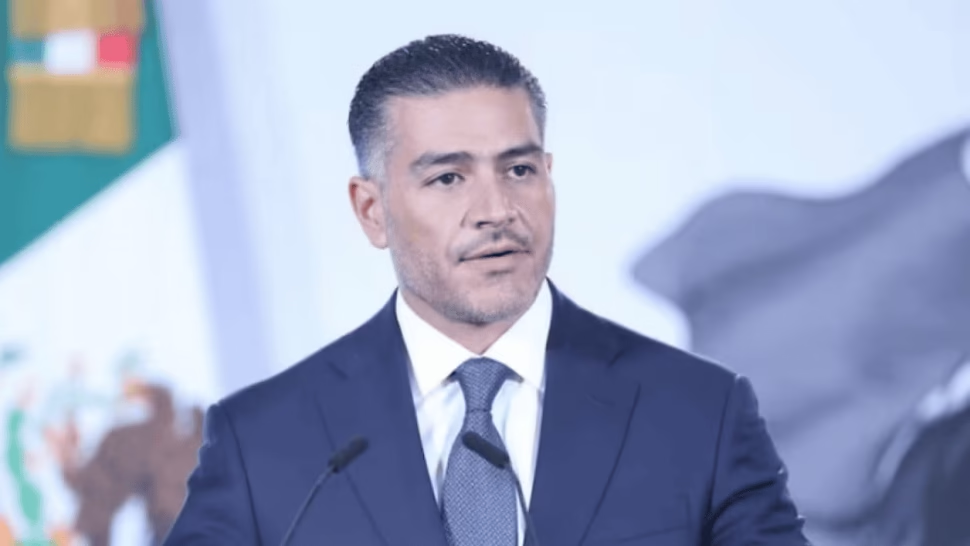
Mexico dismantles 2,627 laboratories and detains 59,582 people

Security Cabinet dismantled more than 2,600 laboratories and seized 498 tons of drugs.

The Mexican Security Cabinet reported strong results against organized crime. Between October 2024 and June 2026, 2,627 clandestine laboratories and methamphetamine concentration areas were dismantled. In addition, 498.98 tons of drugs were seized, including 5 million 546 thousand fentanyl pills. 31,366 firearms were also seized and 59,582 people were arrested.

Results against extortion and during the 2026 World Cup

Omar García Harfuch, Secretary of Security and Citizen Protection (SSPC), reported that since July 6, 2026, the National Strategy against Extortion has managed to arrest 1,674 extortionists. During the 2026 FIFA World Cup, more than 124 thousand security elements, mainly from the Armed Forces and the National Guard, participated in the operation.

“They provided security, guidance and attention to millions of attendees in stadiums, airports, training centers, mobility routes, festivals and public spaces,” he explained.

The Kukulkan Plan, implemented during the tournament, included more than 280 operations in stadiums and Fanfests in Mexico City, Jalisco and Nuevo León. Mexico hosted 13 matches, received 17 teams and hosted seven training centers.

Seizure of cocaine and relevant arrests

In six operations in Chiapas, Colima, Guerrero and Michoacán, the Secretary of the Navy seized more than 5 tons of cocaine. 24 people were arrested and boats, engines and satellite communication equipment were seized. García Harfuch highlighted that since September 2024, the Navy has seized nearly 77 tons of cocaine in maritime operations.

The daily average of intentional homicides decreased 48% between September 2024 and June 2026. Arrests of criminal leaders were reported:

  • At the Tijuana International Airport, 11 people arrested with 165 kilos of cocaine.
  • In Pueblo Nuevo, Hidalgo, Francisco Javier “N”, alleged leader of a cell of the Pacific Cartel, was arrested. Machine guns, grenades and more than 2,000 cartridges were seized.
  • In Mexico City, Alberto “N”, alias “El Virus”, leader of a criminal organization was arrested.
  • In Michoacán, César “N” was arrested for his connection with an attack where five state police officers lost their lives.
  • In Culiacán, Sinaloa, during an operation, Christian Guadalupe “N”, alias “El Texas”, died after attacking military personnel.

Network against extortion in Morelos

In Morelos, 2,200 people have been arrested and 519 firearms and 858 kilos of drugs have been seized since October 2024. A protection network against extortion was formed with more than 1,100 establishments, including businesses and markets. Tours are carried out in 46 neighborhoods to strengthen prevention.

Continue reading