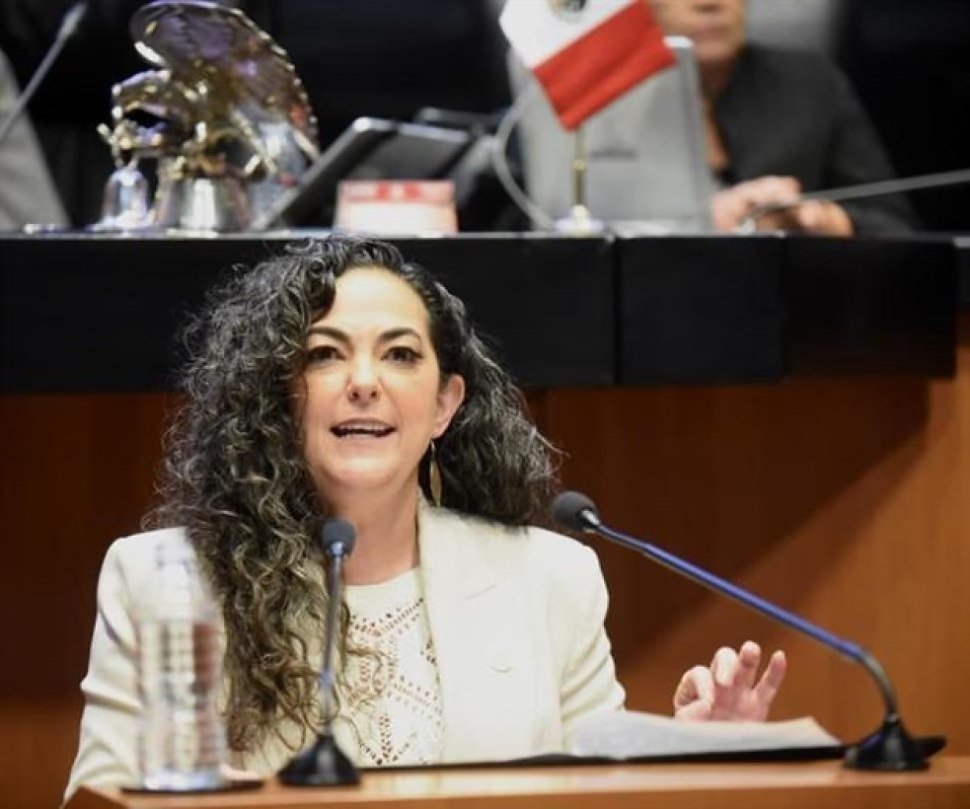
Senator presents law to repeal article 132 of the IMSS

An initiative in the Senate seeks to overturn a requirement considered discriminatory to access this lifelong support.

Farewell to a Controversial Article: The Legislative Move that Seeks to Do Justice

Imagine this: your partner dies, your world falls apart, and then the IMSS tells you “I’m sorry, your marriage did not comply with the six-month premium plan, so there is no pension for you”. Sounds like a very bad joke, right? Well, that was the harsh reality for many people thanks to the now (hopefully) famous Article 132 of the Social Security Law. But it seems that this absurd plot is about to have its happy ending.

Tamaulipec senator Olga Sosa Ruíz, armed with an initiative and probably a good dose of indignation, stood in the Senate to throw away this legal precept that has been the villain of history for many widows and widowers. The initiative is not something that occurred to him in the shower; It is supported by none other than the Supreme Court of Justice of the Nation (SCJN), which had already indicated that this article was basically a product of unconstitutionality. Come on, it had more bugs than a recently updated iPhone.

RelatedThe definitive transition from Law 73 of the IMSS to the AFORE

What was wrong with Article 132?

The article in question was the king of absurd requirements. It conditioned access to the widow’s pension to two things: that the marriage had lasted at least a full semester (as if love and loss had a guarantee period) or that there were common descendants. Basically, it put an expiration date on grief and the right to social security. Did your spouse die after five months and 29 days? Sorry, you don’t qualify. Didn’t they have children? Neither. It was the materialization of bureaucracy in its purest and cruelest state.

Senator Sosa, rightly, called this requirement discriminatory and deeply unfair. In a statement that mixes social commitment with the *main character energy* of those who know they are on the right side of history, he stated: “With this initiative we will continue to deliver for the people of Mexico by protecting the dignity of people and guaranteeing that social justice is tangible in the daily lives of the bereaved.” He doesn’t beat around the bush.

And in case anyone thought this was an isolated move, he connected the dots with the Q4 agenda. He said that this action is part of the route marked by President Claudia Sheinbaum, who promised that the second phase of the transformation would be about expanding rights and combating inequalities. That is, it is not only deleting a bad law, it is writing the source code of a more decent social security system.

A Firm Step Towards Real Social Security

The legislator’s central message was clear: it is about legislating with sensitivity and responsibility. Or, put more simply, to stop making laws that seem designed by a heartless algorithm. The final objective is ambitious and necessary: ​​guarantee that Social Security in Mexico is truly universal, egalitarian and supportive. Let there be no people who are left helpless due to an obsolete rule lacking humanity.

The most interesting thing is that, according to her, this initiative is not from a specific parliamentary group. It is a cause that “corresponds to the Mexicans who have waited for justice in the most difficult moments of their lives.” It is removing the partisan label from something that, in reality, is a simple act of basic justice. Something that, in an ideal world, should not be news, but the norm.

So, in summary, we find ourselves facing one of those rare moments in politics where everything seems to align: a Court that supports, a senator that promotes and a cause that is simply irrefutable. It is a move to break down an archaic barrier and take a small big step towards a country where the system no longer sets traps for you when you are already on the ground.

Do you think it is important that these types of barriers be eliminated? Share this note and let’s make more people aware of these changes that impact real lives. Explore more content about your social rights and how legislation is evolving (slowly, but evolving) to protect citizens.

Semar denuncia mancha de hidrocarburos en Bahía de Manzanillo

Pemex informa que la Marina presentó denuncia por mancha aceitosa en Manzanillo. No hay vínculo directo aún.

La Secretaría de Marina, a través del Departamento de Protección al Medio Ambiente Marino (PROMAM), interpuso una denuncia ante las autoridades competentes por la mancha aceitosa detectada el 2 de junio en aguas de la Bahía de Manzanillo. El objetivo es que se realicen las investigaciones y se determinen responsabilidades, informó Petróleos Mexicanos (Pemex).

Inspecciones sin hallazgos concluyentes

Pemex detalló que tras verificaciones terrestres, marítimas y aéreas no se identificaron anomalías operativas, fugas ni evidencia que vincule su infraestructura con los hechos observados. Los recorridos se realizaron el 4 y 5 de junio con personal de la Semar, Semarnat, Profepa, Agencia de Seguridad, Energía y Ambiente, Asipona Manzanillo, Protección Civil y autoridades estatales.

RelatedPemex niega evidencia de derrame en la Bahía de Manzanillo

Como parte de la atención, se ha recuperado el material observado en coordinación con distintas dependencias. Las actividades se centran en monitoreo y verificación de las condiciones ambientales de la zona.

Mitigación y seguimiento

Pemex ha participado en la limpieza suministrando barreras de contención, cordones oleofílicos y material absorbente, en conjunto con las autoridades que dan seguimiento a las investigaciones para determinar el origen del material. Asimismo, la Asipona Manzanillo estableció recorridos de inspección y vigilancia marítima, así como monitoreos permanentes para identificar cualquier situación que contravenga la normatividad.

La paraestatal reiteró su compromiso con la protección del medio ambiente, la seguridad de sus operaciones y la colaboración institucional para atender este evento.

Continue reading

Tarjetas de búsqueda al estilo del Mundial 2026 en Jalisco

Familiares usan fichas estilo álbum mundialista para visibilizar más de 134 mil desaparecidos en México.

Familias de personas desaparecidas en Jalisco transformaron las fichas de búsqueda en tarjetas similares a las del álbum de jugadores del Mundial 2026. El objetivo: visibilizar los más de 134 mil casos de desaparición forzada en México, a días del inicio del torneo.

Durante la semana, pegaron las fichas alrededor del FIFA Fan Festival y otros puntos turísticos de Guadalajara, una de las sedes mundialistas. Buscan que los turistas —se esperan tres millones— conozcan la crisis que vive el país.

“Es para conectar con todos los fans del fútbol y dar un mensaje de que no está mal el Mundial, no está mal festejar. Lo que está mal es dejar de nombrar a quien hace falta y dejar de buscar”, dijo a EFE Héctor Flores, de la organización Luz de Esperanza.

Rostros con camisetas de la selección

Las imágenes de las personas desaparecidas se editaron con camisetas de la selección mexicana y fondos similares al álbum mundialista. “Cada ‘cartita’ pegada en un muro representa la posibilidad de encontrar a la persona”, afirmó Flores.

RelatedColectivo Luz y Esperanza sticks cards in Zapopan to search for missing people

El colectivo critica que el gobierno de Jalisco y el ayuntamiento de Guadalajara hayan invertido millones de pesos en obras para el Mundial, mientras la Vicefiscalía estatal de personas desaparecidas no contrató personal este año por falta de presupuesto. La Comisión Ejecutiva Estatal de Atención a Víctimas tiene solo 15 asesores para 16 mil carpetas de investigación.

“Esos recursos hacían más falta en otro lado. No estamos pidiendo todo ese dinero, si una parte se hubiera apoyado, un porcentaje para poder ir avanzando”, subrayó.

El colectivo continuará con estrategias de visibilización durante el Mundial, pese a los operativos de seguridad que restringen el acceso a zonas turísticas. “Es apostar por la buena voluntad del turismo internacional y de los medios internacionales para ejercer presión al país y que las cosas puedan cambiar”, concluyó Flores.

Las fichas de búsqueda pasaron de ser un registro impreso a una protesta de familias que llevan décadas buscando, frente al desamparo de las autoridades.

Continue reading

FGR habilita micrositio para turistas en el Mundial 2026

FGR lanza sitio web para turistas durante el Mundial 2026. Denuncias en línea y ubicaciones disponibles.

Nueva herramienta digital para turistas

La Fiscalía General de la República (FGR) puso en marcha un micrositio dirigido a turistas nacionales y extranjeros durante el Mundial de Fútbol 2026, que inicia el próximo jueves.

El sitio, disponible en [https://fgr.org.mx/en/FGR/Mundial2026](https://fgr.org.mx/en/FGR/Mundial2026), ofrece información sobre derechos y obligaciones de los extranjeros, así como el número de emergencia 911. También permite iniciar denuncias en línea y ubicar las oficinas de la FGR más cercanas.

RelatedAntigentrification march in CDMX concludes without serious incidents

Mediante un código QR, los usuarios pueden acceder a datos de la Ventanilla Única de Atención. La FGR destacó que el micrositio facilita la presentación de denuncias por cualquier delito federal. Además, incluye un directorio de embajadas y consulados.

Las sedes mundialistas en Ciudad de México, Guadalajara y Monterrey cuentan con atención presencial o virtual. En la capital, las oficinas están en Dr. Lucio 135, colonia Doctores, y en las Terminales 1 y 2 del AICM. En Guadalajara, en Avenida 16 de septiembre 591, Mexicaltzingo, y en el aeropuerto internacional. En Monterrey, en Carretera Monterrey-Nuevo Laredo km 14.5, colonia Nueva Castilla, municipio de General Escobedo, y en el módulo del aeropuerto internacional.

La FGR recordó que cuenta con oficinas en las 32 entidades del país, con atención las 24 horas los 365 días del año a través del CEDAC.

Continue reading