Mexican Senate rejects foreign military operations without authorization

The Mexican Senate warns of legal consequences in the event of possible unauthorized US military operations in national territory.

Position of the Senate regarding foreign military interference

The Economy Commission of the Mexican Senate issued an emphatic statement after learning of the signing of an agreement by former US president Donald Trump, which authorizes the Pentagon to use military forces against drug cartels in Latin America. The legislative body stressed that, in accordance with Article 76 of the Constitution, only the Upper House can allow the entry of foreign troops into the national territory, highlighting that any contrary action would constitute a violation of international law.

Legal bases and warnings

Senator Emmanuel Reyes Carmona explained that the US directive – which classifies certain cartels as terrorist organizations – seeks to stop the trafficking of fentanyl and other illicit substances through operations in international waters and foreign soil. However, he stressed that such actions require express authorization from the Mexican Senate, after a detailed analysis by specialized commissions such as Foreign Relations or National Defense. “National sovereignty is not negotiable,” he said.

RelatedSheinbaum affirms Mexican sovereignty against foreign interference

In addition, he cited Article 89 of the Constitution, which grants President Claudia Sheinbaum, as Supreme Commander of the Armed Forces, the exclusive power to ensure principles such as non-intervention and the peaceful resolution of conflicts. “Any non-consensual military deployment would result in sanctions and legal responsibilities for the United States, despite our historical security cooperation,” he warned.

International implications and bilateral cooperation

The legislator emphasized that, although the United States has sovereignty over its internal security decisions, the use of military force in another country without consent violates international treaties and could face internal legal obstacles, such as prior approval by the US Congress. “Mexico has always been clear: we reject foreign interference, but we value bilateral collaboration when it conforms to the legal framework,” he said.

Finally, he reiterated the Mexican government’s commitment to regional security and the fight against drug trafficking, but insisted that any joint action must respect established protocols. “President Sheinbaum has already expressed it: there will be no covert operations in our territory without transparency and formal agreements,” he concluded.

Are you interested in geopolitics and national security? Share this analysis on your social networks and explore more content on international law and bilateral relations on our portal.
PRI accuses Morena of links to organized crime

The PRI leader launches serious accusations against Morena for alleged criminal ties.

The national leadership of the PRI intensified its attack against Morena by pointing out alleged links of the ruling party with criminal groups and possible investigations in the United States.

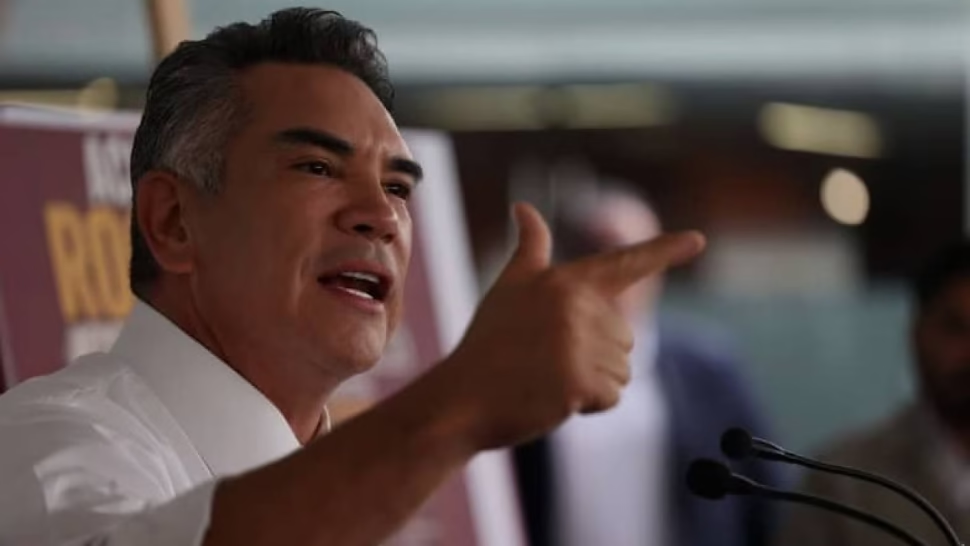
Accusations of Alejandro Moreno

During the XLIII Plenary Meeting of COPPPAL, Alejandro Moreno stated that there are elements that could lead to international actions. The PRI leader maintained that Morena could be considered one:

“terrorist organization that finances organized crime”

He pointed out alleged irregularities in electoral processes in Sinaloa, Tamaulipas and Tabasco.

Moreno also mentioned journalistic versions of alleged investigations by US authorities against Morena politicians. He assured that some party actors would be providing information to agencies in that country, which, he said, anticipates new investigations.

The leader stated that for more than five years he has filed complaints in Mexico and before international organizations for alleged illegal acts by Morena officials, including cases of fiscal huachicol and possible links with organized crime. He assured that these complaints are beginning to have repercussions outside the country.

Continue reading

Citlalli Hernández denies apocryphal list about Morena’s process

The Morenista leader called not to spread false information about the internal process.

Morena’s internal process

Citlalli Hernández Mora, president of the National Election Commission of Morena, denied the authenticity of a list that circulates on the definition of gender for the State Coordinations for the Defense of Transformation and National Sovereignty. He described the document as false and pointed out that it seeks to generate confusion in the internal process of the party.

Through a video broadcast on social networks, Hernández explained that the list dates back to the previous year and is invalid. He reiterated that all official information will be published exclusively through the party’s channels.

“I call on militancy and sympathizers not to share false information and to remain attentive to official statements,” he stated.

The leader indicated that the applicants will be the first to know the next stages of the process, which will then be made known in a transparent manner.

He highlighted that the movement led by President Claudia Sheinbaum seeks to strengthen new ways of doing politics, with dialogue, unity and respect for internal rules. Morena, he said, will continue to make decisions in accordance with its principles and in favor of the transformation project.

He announced that the National Elections Commission will review in the coming days the compliance with the requirements of the 277 candidates registered for the State Coordinations. In addition, a working table is maintained with the Labor Party and the Green Party to discuss the profiles before announcing the next stages.

Continue reading

Mexican banks support those affected by earthquakes in Venezuela

Mexican banks activate support after earthquakes in Venezuela: donations and shipments without commission.

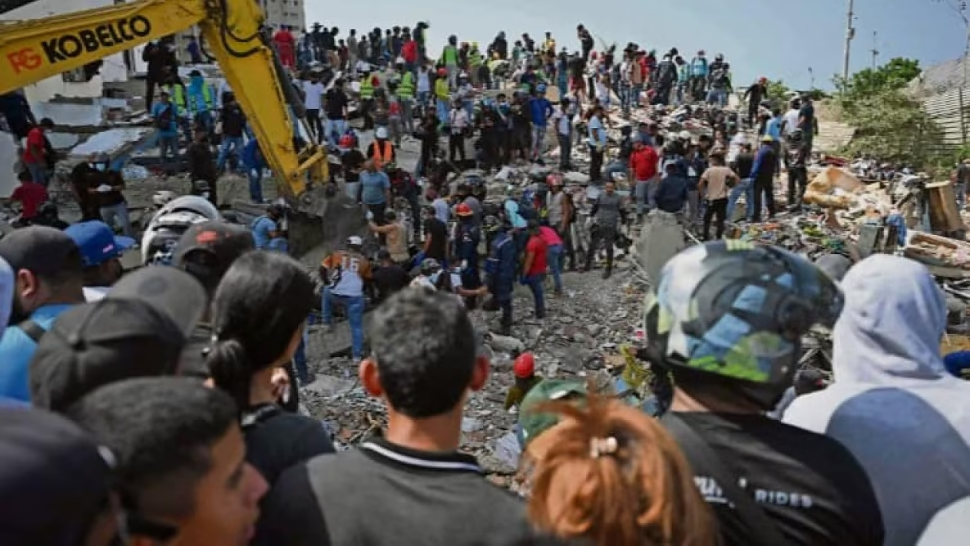
Various financial institutions in Mexico have implemented support measures to address the emergency caused by the recent earthquakes in Venezuela. The earthquakes left damage in several communities in the South American country.

Measures of financial institutions

BBVA México reported that, through its foundation, it made an initial donation of one million pesos to the Mexican Red Cross. In addition, it opened an account to receive contributions from the public. Resources will be channeled towards humanitarian aid work once the critical phase is over.

Banco Azteca announced the elimination of commissions on money transfers to Venezuela until July 10. The measure applies without an amount limit through platforms such as Western Union and MoneyGram, both in branches and in its mobile application.

Santander México announced an extraordinary donation to the Mexican Red Cross for the deployment of the USAR rescue group. This team, made up of specialists and canine pairs, is already in Venezuela supporting search and rescue efforts in collapsed structures.

Continue reading