Analysis of the Approval of the Fiscal Framework for the Next Fiscal Year
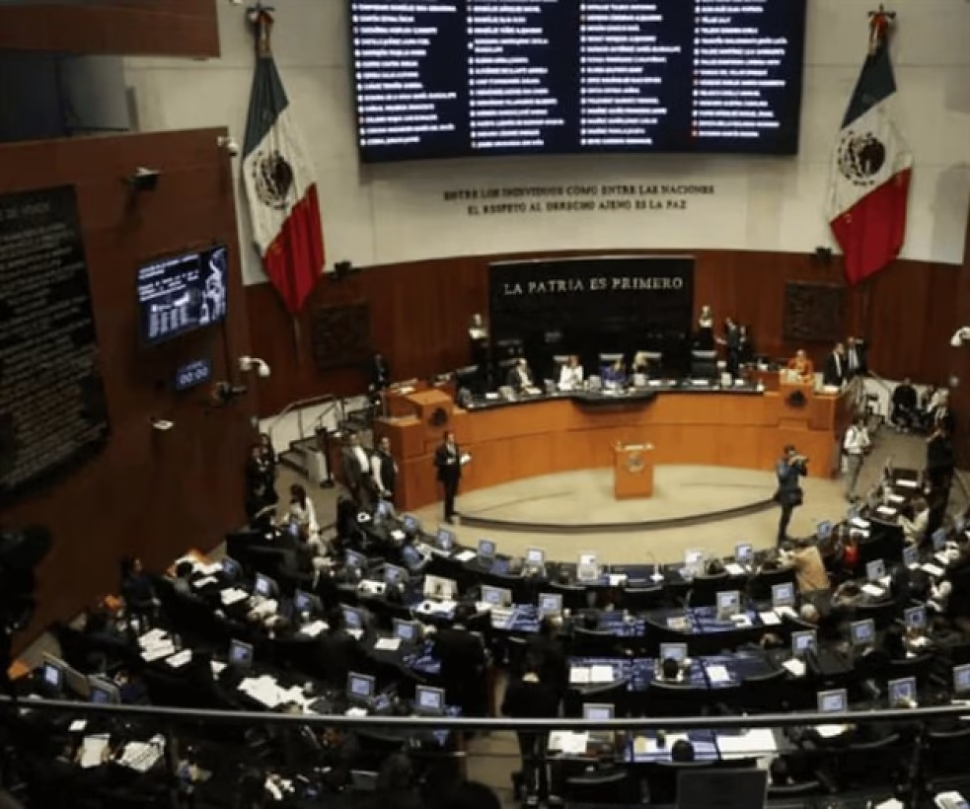
In a legislative process characterized by its speed and absence of amendments, the First United Commissions of Finance and Legislative Studies of the Senate of the Republic have given their majority endorsement to the Income Package for fiscal year 2026. This decision constitutes a ratification of the minutes sent by the Chamber of Deputies, marking a crucial step in the definition of the country’s tax policy for next year. The package, which is made up of the Federal Income Law (LIF), the Federal Tax Code (CFF), the Federal Law of Rights and the Special Tax Law on Production and Services (IEPS), is now moving towards its final phase in the Senate Plenary Session, where a detailed discussion and vote are anticipated. the articles that are subject to reservations by the different parliamentary groups.
The approval scenario was not without dissent. The groups of the PRI, PAN and Movimiento Ciudadano (MC) expressed their opposition to the rulings, arguing that the package is based on unrealistic economic assumptions that, in practice, amount to a strategy to put the country into debt. Their critical stance focuses on the premise that the tax increases contained in the proposal will disproportionately impact lower-income households. A particularly relevant point of friction was the lack of specific labeling of resources that guarantees that the additional revenue generated by the IEPS is allocated unrestrictedly to public health programs designed to combat diseases associated with the consumption of sugary drinks, one of the declared objectives of the tax.
Positions and Projections in the Commission Debate
When presenting the basis for the minutes, Senator Miguel Ángel Yunes Márquez, president of the Finance Commission, explained that the calculations are based on prudent assumptions that project total income of 10.1 billion pesos. Of this figure, it is estimated that 5.8 trillion pesos will come from tax revenues, which would be equivalent to approximately 15% of the Gross Domestic Product (GDP), an unprecedented level in the nation’s collection history. The legislator defended the modifications to the IEPS, emphasizing its reinforcement as a public policy tool with a clear objective of collective health, by discouraging the consumption of products considered harmful. At the same time, he maintained that the adjustments to the Federal Tax Code strengthen the legal framework to combat illicit practices such as operations with invoicing companies, thus promoting greater equity in the tax system and establishing conditions of fair competition for all taxpayers.
For his part, Senator Manuel Huerta Ladrón de Guevara, heading the First Legislative Studies Commission, detailed one of the substantial modifications: the increase in the IEPS rate for games with bets, including digital casinos, from 30% to 50%. This measure seeks to expand the collection base in a sector of exponential growth. However, the opposition found eloquent voices. Senator Luis Donaldo Colosio Riojas (MC) described the increases to the IEPS as a desperate measure to increase income without a clear roadmap for its application, while warning about a possible regression in terms of rights due to the expanded surveillance powers that would be granted to the tax authority through the new CFF.
The polarization of the debate was evident in the remaining interventions. Senator Lizette Sánchez (PT) supported the package for its humanist approach, arguing that it transcends mere financial arithmetic to incorporate principles of social justice. At the opposite extreme, Senator Cristina Ruiz (PRI) accused that the true purpose of the increased collection is to finance the cost overruns and diversions of resources in emblematic megaprojects such as the Mayan Train. Finally, Senator Luis Silva (Green Ecologist) charged against the criticisms of the PRI and PAN, calling them catastrophic and recalling that these parties endorsed increases in the Value Added Tax (VAT) in the past under controversial figures.
This analysis shows that the approval of the 2026 Income Package in committees is only the prelude to a broader and more complex debate in the Plenary, where the fiscal guidelines that will govern the Mexican economy will be defined, with profound implications in collection, tax equity and the destination of public spending.
Are you interested in thoroughly understanding how these tax decisions impact the national economy? Share this analysis on your social networks and explore more specialized content on our platform.