Senate approves the 2026 Income Law for fiscal stability

The economic package reinforces national stability with a 4.6% increase in income, supported by international rating agencies.

Analysis of the Approval of the 2026 Income Law

The Plenary of the Senate of the Republic has achieved a milestone in national financial planning by ratifying the Income Law for Fiscal Year 2026. This decision, supported by 79 votes in favor and 39 against, constitutes the fundamental pillar of the Economic Package and establishes the guidelines for the administration of public resources during the next year. The regulations reaffirm the institutional commitment to responsibility in the management of public finances, a principle that Senator Olga Sosa Ruíz highlighted as essential for sustainable national development, based on efficient and disciplined management of State finances.

Composition and Projection of Public Revenues

The financial architecture of the law projects a total collection of 10.1 billion pesos. Of this figure, 8.7 trillion pesos correspond specifically to budget income, which represents an increase of 520 billion pesos, equivalent to a growth of 4.6% compared to the projections for 2025. This substantial increase is based on the optimization of control mechanisms and the strategic implementation of digital tools for the collections, designed to maximize efficiency in collecting resources. Senator Sosa emphasized that the economic package reaffirms the commitment of the Government of Mexico to balanced national development, which integrates social justice, strategic public investment and fiscal responsibility as inseparable axes.

RelatedDeputies approve Income Law 2026 with an increase of 5.9%

A significant component of this legislation is the tax adjustments on beverages and tobacco, measures that transcend the mere tax collection objective. These criteria, integrated into the general economic policy guidelines, reinforce a vision of tax policy with a focus on public health, equity and social responsibility. The measure is aimed at protecting the population and combating non-communicable chronic diseases, among which type 2 diabetes stands out, a pathology that affects more than 189 thousand people in Mexico, including adults and the minor population.

Macroeconomic Impact and External Valuation

The breakdown of income contemplates a 1.9% increase in oil income, which is projected at 1 trillion 204 billion pesos. At the same time, non-oil revenues will experience a growth of 5.1%, exceeding 7 trillion pesos. A crucial element that has captured the attention of international analysts is the capitalization plan for the State’s productive companies. This strategy has received a favorable response from the main credit risk rating agencies, Fitch Ratings and Moody’s Investors Service, institutions that recently improved the debt rating of Petróleos Mexicanos (Pemex). This improvement in the perception of solvency underlines the external credibility of current economic policy.

In her conclusions, Senator Olga Sosa argued that the law not only reinforces the country’s macroeconomic stability, but also consolidates public finances and guarantees the continuity of social development programs. “Through honesty and care of each peso collected, public investment is promoted, comprehensive development is encouraged and the national economy is strengthened,” he concluded. The implementation of this law will, therefore, mark the country’s financial route, seeking a balance between economic growth and collective well-being, under a rigorous framework of fiscal discipline.

Do you find this information about Mexico’s economic future valuable? Share this analysis on your social networks and explore more specialized content in our economics and public finances section.

Massive security reinforcement and alcohol ban at the Azteca

56,000 police officers and alcohol restriction for the game at the Azteca.

Measures for the Mexico-Czech Republic match

The government of Mexico City announced an unprecedented security operation for this Wednesday’s game at the Azteca stadium. 56,000 personnel will be deployed, five times more than the 11,219 employed last week.

The decision responds to the celebrations of the previous Thursday, when some 700,000 people gathered in the capital after Mexico’s victory over South Korea. Although there were no injuries, nearly 40 tons of garbage were collected in the Ángel de la Independencia and the Zócalo.

The Secretary of Security, Pablo Vázquez, detailed that 7,500 police officers will guard the Azteca stadium. Another 3,275 will be in the Zócalo and 4,200 on Reforma Avenue. The objective is to protect players, referees, authorities and fans.

In addition, the Secretary of Government, César Cravioto, reported that starting at 3 p.m. on June 24, a ban on the sale of alcohol will take effect for sixteen hours. Applies to the Historic Center and five neighborhoods of Cuauhtémoc.

Sales will only be allowed in restaurants, hotels and private clubs, accompanied by food. Convenience stores and supermarkets are excluded. The fines for non-compliance amount to up to 293,275 pesos (about $17,251).

The Mexican Alliance of Transporters Organization (AMOTAC) called for mobilizations on highways in the 32 states and blockades in the capital to protest against the violence. The operation also considers these protests.

Continue reading

UNAM, new WHO collaborating center in oral health

The WHO recognizes UNAM as a reference in oral health and aging.

International recognition for UNAM

The World Health Organization (WHO) designated the Department of Oral Public Health of the UNAM Faculty of Dentistry as a Collaborating Center in Oral Health and Aging. The distinction is valid for four years.

With this appointment, the highest educational institution consolidates itself as a regional reference in the comprehensive care of older adults.

Implications of the appointment

The recognition will allow university specialists to participate in the development of public policies focused on improving the quality of life of the elderly.

In addition, they will promote strategies to promote among older adults and caregivers the importance of maintaining adequate oral health as an essential part of general well-being.

The designation places UNAM on a level of technical cooperation with the WHO, which opens opportunities to influence global guidelines on aging and oral health.

Continue reading

Digital sexual exploitation affects 1.6 million adolescents in Mexico

1.6 million adolescents in Mexico suffer online sexual exploitation every year.

The report reveals alarming figures

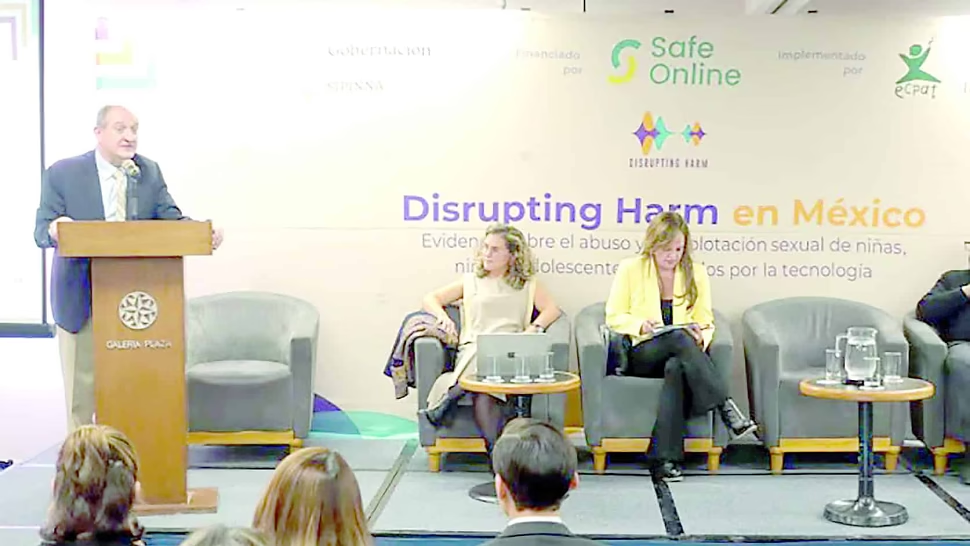
Unicef, ECPAT International and Interpol published the study “Disrupting Harm México”, which indicates that one in eight adolescent Internet users in the country – around 1.6 million – experienced sexual exploitation facilitated by digital technologies for a year.

67% of cases occurred online only, mainly on social networks and platforms. However, violence is not limited to the virtual sphere: in almost two out of every three situations, the victims knew their attackers, who were usually friends, partners or family members.

The report documents serious under-reporting. 32% of victims did not tell anyone what happened out of shame or fear, and less than 1% filed a formal complaint. This reflects normalization and silence around these attacks.

Consequences and call to action

In mental health, the consequences are profound. Those who suffered this type of violence are 15 times more likely to self-harm and 12 times more likely to have thoughts about their own death, compared to those who did not have that experience.

Fernando Carrera, Unicef ​​representative in Mexico, asked to reinforce prevention and responsibility of digital platforms. Lorena Villavicencio Ayala, from SIPINNA, stated that the State must guarantee the safety of girls, boys and adolescents in digital environments.

Continue reading