Segob organizes traveling tables to attend to disappearances in Mexico

Segob activates a plan to listen to groups excluded from the reform, but will it be enough?

Segob gets its act together (or at least tries)

Now that the General Law of Disappearances was reformed and approved (yes, again), the Ministry of the Interior decided that the best thing was to organize some traveling tables throughout the 31 states and CDMX. The goal? Listen to the search groups that, as always, were left out of the legislative glamor. Rosa Icela Rodríguez, the head of the agency, has already met with the country’s 32 Government Secretaries to talk about human rights and, obviously, the eternal issue of the missing. Spoiler: everyone nodded as if they were in a Zoom meeting with the microphone off.

“We evaluate positively” (or how to sound optimistic without compromising)

The attendees, in a burst of originality, described Rodríguez’s proposal as “positive”. Because? Because according to them, this will allow “to delve into the contexts of each region”. That is, basically recognizing that Mexico is not one country, but 32 mini-countries with different problems. The dates for the tables have not yet been defined (of course, because first you have to coordinate agendas between secretariats, and that is like organizing a group outing with friends who never decide anything).

RelatedReform on disappearances excludes search groups

Meanwhile, each region will start its own human rights agenda, because why wait for others? Saúl González Núñez, from Baja California Sur, already has plans: visit Nayarit and Querétaro. The main theme? The protocol that the groups have been asking for for years. Because nothing says “urgent” like a bureaucratic tour.

Chihuahua and its bonus track: migration

Santiago de la Peña, Secretary of the Government of Chihuahua, dropped the bomb: in addition to searching for missing people, they will also address migration. “In the case of Chihuahua it is extremely relevant,” he said, as if he had just discovered that his state borders the United States. The good news is that they agreed to “speed up communication” to set dates. In other words, they promised to send messages faster. WhatsApp group included?

In summary: Segob moves (slowly, but it moves), the groups are still waiting for real solutions, and the state secretaries… well, at least they now have a new topic for their speeches. Will it work? Who knows. But in the meantime, the hashtag #JusticeForTheDisappeared continues to trend.

Are you concerned about this issue? Share this note and continue exploring more content on human rights on our networks. Because visibility is the first step towards change. 🔍✊

Weapons and explosives seized in Culiacán; there is a detainee

Arrested in Culiacán with weapons, explosives and stolen vehicle.

Operational in the Los Angeles sector

CULIACAN, Sin. — Elements of the National Guard detained a civilian during a patrol in the Los Angeles sector, northwest of the capital of Sinaloa. The discovery occurred near a private housing unit.

Upon noticing the presence of the authorities, the individual made an evasive maneuver. He was chased and caught up for a search.

Weapons, chargers and explosives

In the truck he was driving—a 2022 model Mazda CX-5, white, reported stolen—two automatic rifles, a pistol, nine supplied magazines and a container with improvised explosive devices, still unquantified, were found.

The detainee was placed at the disposal of the Attorney General’s Office, which will open an investigation file. The vehicle was also seized with a report of theft.

According to previous information, an anonymous call to the emergency lines alerted about armed people in a residence in the area, near the road that leads to the Imala receivership.

Continue reading

Sheinbaum announces 42 CT scanners and telemedicine to strengthen health

The president detailed investments in medical equipment, telemedicine and improvement of clinics.

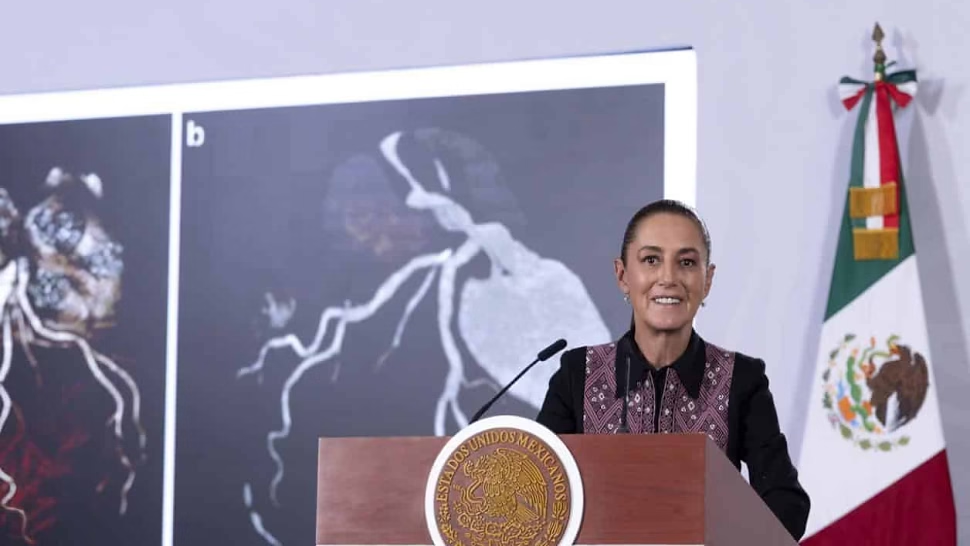
President Claudia Sheinbaum reported on advances in the public health system, with investments in equipment, telemedicine and improvement of clinics. He affirmed that the State must guarantee access to health from prevention to care for complex diseases.

“We are compensating for the profound damage that neoliberalism caused in the health system,” he said at the morning conference.

Equipment and telemedicine

The IMSS installed 42 state-of-the-art CT scanners in 40 hospitals in 19 states. Of these, 41 are from 256 cuts. They allow early detection of tumors and bleeding, perform up to 50 studies per day and reduce waiting times. They were acquired for 29 million pesos each, below the 40 million in the past.

The ISSSTE expanded telemedicine from 239 to 859 units. It offers consultations in 15 specialties, such as cardiology and dermatology, from 118 second and third level units to 741 first level.

The Clinic is Ours

The La Clínica es Nuestra program delivered 4,608 million pesos in 2025 to 8,483 medical units, with the participation of 67,864 people. 42 thousand improvement actions were carried out in infrastructure and equipment. The 2026 call will begin in July, including for the first time 153 units from Yucatán with 80 million pesos.

Sheinbaum added that progress is being made in the House to House Health program, with more than 20 million consultations with older adults and people with disabilities. Starting in August-September, you will be able to collect medications at Farmacias del Bienestar, health centers and a network of pharmacies. Next year the Universal Health Service will begin with a single credential.

Continue reading

Massive security reinforcement and alcohol ban at the Azteca

56,000 police officers and alcohol restriction for the game at the Azteca.

Measures for the Mexico-Czech Republic match

The government of Mexico City announced an unprecedented security operation for this Wednesday’s game at the Azteca stadium. 56,000 personnel will be deployed, five times more than the 11,219 employed last week.

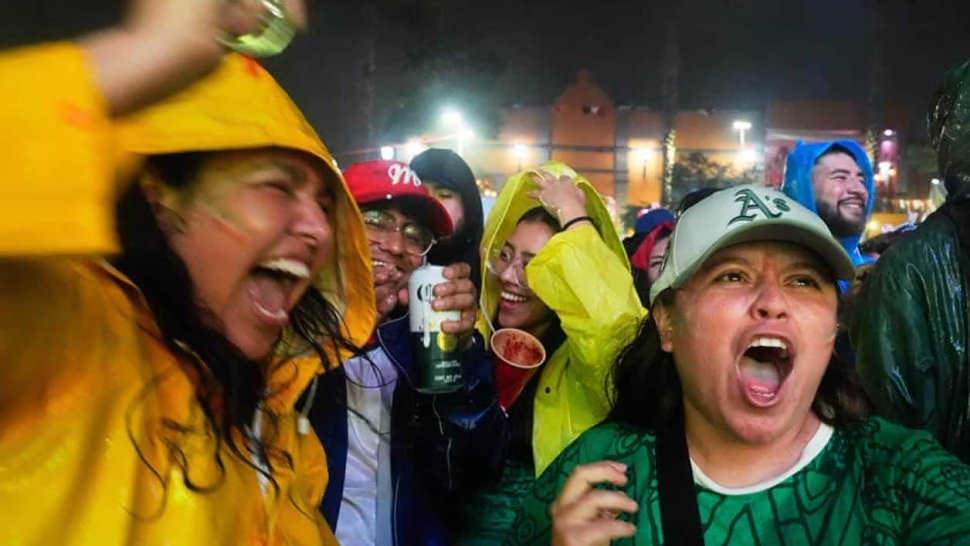
The decision responds to the celebrations of the previous Thursday, when some 700,000 people gathered in the capital after Mexico’s victory over South Korea. Although there were no injuries, nearly 40 tons of garbage were collected in the Ángel de la Independencia and the Zócalo.

The Secretary of Security, Pablo Vázquez, detailed that 7,500 police officers will guard the Azteca stadium. Another 3,275 will be in the Zócalo and 4,200 on Reforma Avenue. The objective is to protect players, referees, authorities and fans.

In addition, the Secretary of Government, César Cravioto, reported that starting at 3 p.m. on June 24, a ban on the sale of alcohol will take effect for sixteen hours. Applies to the Historic Center and five neighborhoods of Cuauhtémoc.

Sales will only be allowed in restaurants, hotels and private clubs, accompanied by food. Convenience stores and supermarkets are excluded. The fines for non-compliance amount to up to 293,275 pesos (about $17,251).

The Mexican Alliance of Transporters Organization (AMOTAC) called for mobilizations on highways in the 32 states and blockades in the capital to protest against the violence. The operation also considers these protests.

Continue reading