The Navy removes 390 tons of sargassum in Mahahual

An unprecedented operation frees the beaches of Quintana Roo from a silent invasion that threatens paradise.

The Epic Fight Against the Green Monster

On the coast of Mahahual, a scene worthy of a Homeric battle unfolds before the eyes of the world. The Secretary of the Navy, with the courage of titans, has declared war on an implacable enemy: the sargassum. They are not simple algae, but a voracious tide that advances without mercy, devouring beaches and threatening the tourist heart of Quintana Roo. 390 tons! A shocking figure, torn from the sands in a week of superhuman effort.

Heroes in the Line of Fire

Under the harsh sun, 37 sailors and 40 civilians—among them businessmen, restaurateurs and guardians of paradise—became the last line of defense. Armed with specialized machinery and surrounded by 2,265 meters of containment barriers, they fought a battle that seems straight out of a mythological story. Every gram of sargassum removed is a sigh of relief for the ecosystem and the economy, both on the brink of collapse.

RelatedThe battle against sargassum in Quintana Roo faces new challenges

The Eleventh Naval Zone, in a strategy worthy of generals, coordinates this operation with millimeter precision. It’s not just cleaning; It is a crusade for well-being. The words of the Navy resonate like a sacred oath: “We will reinforce actions in accordance with ocean conditions.” What dark forces drive this phenomenon? Climate change? Pollution? The mystery adds drama to this fight.

Meanwhile, the sargassum continues to arrive, like an endless army. But today, in Mahahual, humanity has won a battle. Can we win the war?

Share this feat! Spread the word about how the Navy and its team protect our paradises. Explore more about the Sargassum Care Strategy 2025 and join the global conversation.


Massive security reinforcement and alcohol ban at the Azteca

56,000 police officers and alcohol restriction for the game at the Azteca.

Measures for the Mexico-Czech Republic match

The government of Mexico City announced an unprecedented security operation for this Wednesday’s game at the Azteca stadium. 56,000 personnel will be deployed, five times more than the 11,219 employed last week.

The decision responds to the celebrations of the previous Thursday, when some 700,000 people gathered in the capital after Mexico’s victory over South Korea. Although there were no injuries, nearly 40 tons of garbage were collected in the Ángel de la Independencia and the Zócalo.

The Secretary of Security, Pablo Vázquez, detailed that 7,500 police officers will guard the Azteca stadium. Another 3,275 will be in the Zócalo and 4,200 on Reforma Avenue. The objective is to protect players, referees, authorities and fans.

In addition, the Secretary of Government, César Cravioto, reported that starting at 3 p.m. on June 24, a ban on the sale of alcohol will take effect for sixteen hours. Applies to the Historic Center and five neighborhoods of Cuauhtémoc.

Sales will only be allowed in restaurants, hotels and private clubs, accompanied by food. Convenience stores and supermarkets are excluded. The fines for non-compliance amount to up to 293,275 pesos (about $17,251).

The Mexican Alliance of Transporters Organization (AMOTAC) called for mobilizations on highways in the 32 states and blockades in the capital to protest against the violence. The operation also considers these protests.

Continue reading

UNAM, new WHO collaborating center in oral health

The WHO recognizes UNAM as a reference in oral health and aging.

International recognition for UNAM

The World Health Organization (WHO) designated the Department of Oral Public Health of the UNAM Faculty of Dentistry as a Collaborating Center in Oral Health and Aging. The distinction is valid for four years.

With this appointment, the highest educational institution consolidates itself as a regional reference in the comprehensive care of older adults.

Implications of the appointment

The recognition will allow university specialists to participate in the development of public policies focused on improving the quality of life of the elderly.

In addition, they will promote strategies to promote among older adults and caregivers the importance of maintaining adequate oral health as an essential part of general well-being.

The designation places UNAM on a level of technical cooperation with the WHO, which opens opportunities to influence global guidelines on aging and oral health.

Continue reading

Digital sexual exploitation affects 1.6 million adolescents in Mexico

1.6 million adolescents in Mexico suffer online sexual exploitation every year.

The report reveals alarming figures

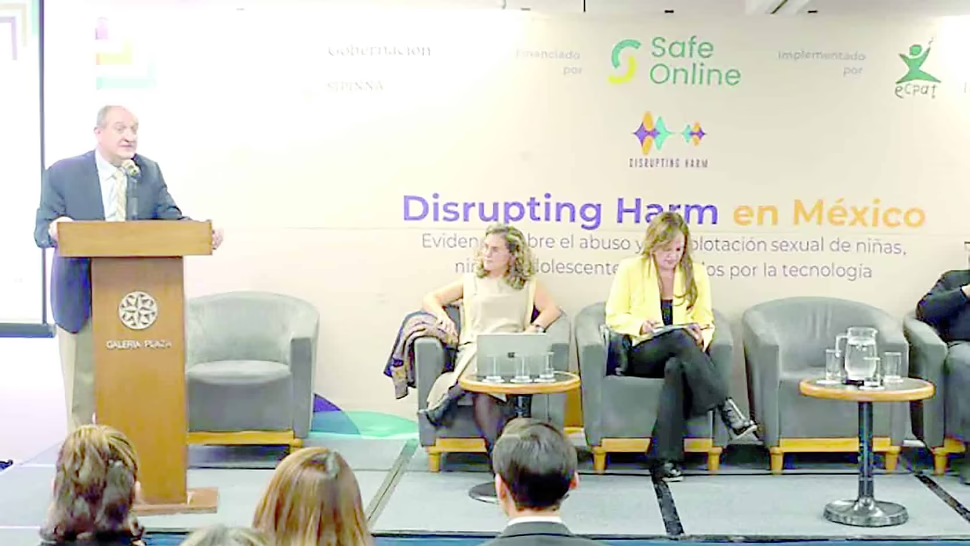
Unicef, ECPAT International and Interpol published the study “Disrupting Harm México”, which indicates that one in eight adolescent Internet users in the country – around 1.6 million – experienced sexual exploitation facilitated by digital technologies for a year.

67% of cases occurred online only, mainly on social networks and platforms. However, violence is not limited to the virtual sphere: in almost two out of every three situations, the victims knew their attackers, who were usually friends, partners or family members.

The report documents serious under-reporting. 32% of victims did not tell anyone what happened out of shame or fear, and less than 1% filed a formal complaint. This reflects normalization and silence around these attacks.

Consequences and call to action

In mental health, the consequences are profound. Those who suffered this type of violence are 15 times more likely to self-harm and 12 times more likely to have thoughts about their own death, compared to those who did not have that experience.

Fernando Carrera, Unicef ​​representative in Mexico, asked to reinforce prevention and responsibility of digital platforms. Lorena Villavicencio Ayala, from SIPINNA, stated that the State must guarantee the safety of girls, boys and adolescents in digital environments.

Continue reading