The Call of the Wind Sector to Accelerate the Energy Transition
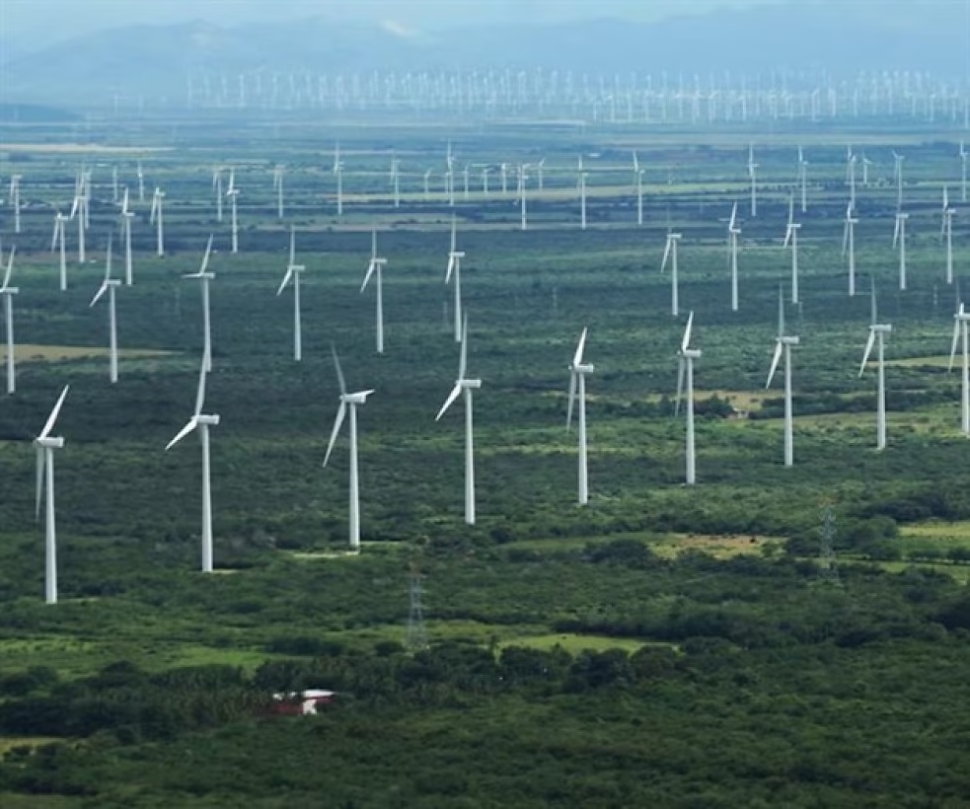
The private companies specialized in the generation of wind energy, represented by the Mexican Wind Energy Association (Amdee), have issued a forceful call to capitalize on the development of this clean technology. According to its 2025 annual report, Mexico faces a significant lag compared to global trends, a gap that can be closed by taking advantage of available investments. The organization, chaired by Gerardo Pérez Guerra, emphasizes that the country is at a critical crossroads to define its energy future.
Amdee emphasizes that the new regulatory mechanisms for the participation of the private sector, including mixed investment schemes and long-term commitments, represent a window of opportunity for effective collaboration with the public sector. However, this collaboration will only be fruitful if the procedures for awarding contracts, obtaining permits and all the procedures associated with the installation of a generation park are resolved in a agile and transparent manner. Creating these conditions is essential for companies’ capital and technical expertise to fully contribute to the shared goals of expanding renewable generation.
National Context and Leadership Opportunity
The report adds that Mexico has a unique opportunity to consolidate itself as a regional benchmark in clean energy. Although wind energy has already been established as a fundamental pillar within the national energy matrix, its future growth is conditioned by advances in transmission infrastructure, access to competitive financing and the design of public policies that provide long-term legal and economic certainty. Amdee predicts that progress in these areas will be decisive for the pace of the transition.
From a global perspective, the year 2025 has seen unprecedented progress in the decarbonization of the global energy system. The record figures in installed renewable capacity demonstrate a collective understanding of the urgency of accelerating the transition to a cleaner, safer and more sustainable energy system. However, these advances also confirm that, at a global level, we are still far from achieving the objective agreed upon at the Conference of the Parties (COP): tripling the capacity of renewable energy by 2030. This international context puts pressure on all nations, including Mexico, to increase their efforts.
Legal Framework and Conditions for Growth
In this scenario of global energy transformation, Mexico cannot afford to be left behind. The country has world-class wind potential, a growing industrial value chain and companies with the experience, technical capacity and commitment necessary to provide real and scalable solutions. A crucial milestone on this path was the publication in March 2025 of the secondary laws on energy matters, in particular the Electrical Sector Law. This regulation marked a structural change in the organization and operation of the sector, aligning with the constitutional reforms of October 2024 and with the National Strategy for the Electricity Sector (ENSE).
The new Electrical Sector Law opens up concrete opportunities to increase wind generation capacity, essential to accompany national efforts aimed at achieving an effective energy transition. However, the real impact of this law on investment flows will depend, to a large extent, on the practical implementation of the new participation schemes, on binding planning and on the clarity with which its provisions are translated into operational instruments that facilitate and encourage the participation of all actors in the sector. The Amdee rules that the letter of the law must be materialized in concrete actions that clear up uncertainty and attract the necessary capital.
Share this analysis on the future of wind energy in Mexico on your social networks and explore more content on sustainability and energy innovation on our site.