Screwworm threatens pets and humans in tropical areas

A lethal parasite is advancing in tropical areas: discover how to protect your animals and prevent its spread.

The danger of screwworm in animals and humans

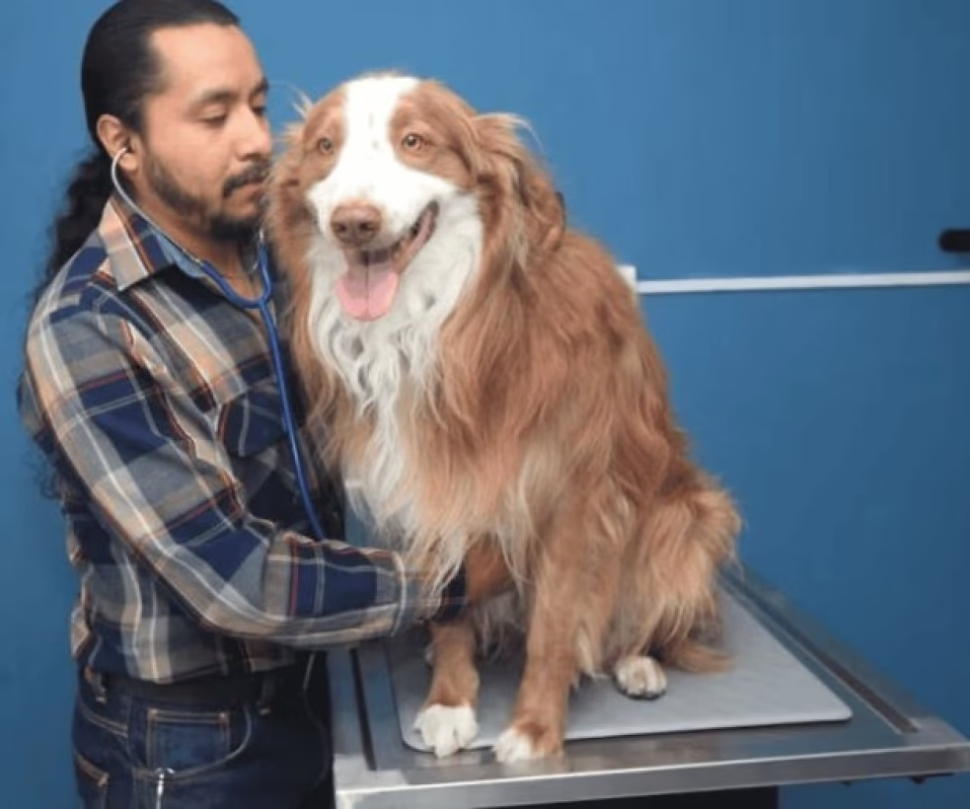
The screwworm (Cochliomyia hominivorax) represents a serious threat to animal and human health, especially in tropical regions such as the Isthmus of Tehuantepec in Oaxaca, Mexico. According to veterinarian Juan Bautista Pérez, this parasite spreads through exposed wounds, where it deposits its larvae, which feed on living tissue, aggravating the injuries and generating severe complications.

Life cycle and mechanism of infection

The adult fly deposits up to 500 eggs in open wounds of animals or humans. In just 24 hours, these hatch, releasing larvae that immediately begin to consume living tissue. For seven days, the larvae remain in the wound, causing intense pain, a bad putrefactive odor, and systemic symptoms such as loss of appetite and depression. Subsequently, they fall to the ground to complete their metamorphosis into adult flies in approximately 10 days, restarting the cycle.

RelatedMexico faces screwworm outbreak in cattle

The name “screwworm” derives from its behavior: the larvae penetrate vertically into the meat, making early detection difficult. Unlike other myiasis, this species does not consume dead tissue, which accelerates damage and increases the risk of secondary infections.

Impact on pets, livestock and humans

Originally associated with livestock, the parasite now affects pets and humans. In animals, the infestation causes necrotic wounds and sepsis if untreated. In humans, symptoms are similar, with cases reported in rural areas where medical care is limited. Dr. Pérez emphasizes that any exposed wound in endemic areas should be protected with bandages and repellents.

Treatment and control measures

Treatment requires immediate veterinary or medical intervention. Specific larvicides are applied and manual extraction of the parasites is carried out. In addition, it is mandatory to report cases to authorities such as Senasica in Mexico, to implement containment strategies. Prevention includes:

  • Monitor for wounds in pets during trips to risk areas.
  • Use repellents and cover injuries with sterile gauze.
  • Avoid areas with high fly density, especially in hot and humid climates.

This parasite not only compromises animal welfare, but also represents a public health problem, given its zoonotic potential. Collaboration between veterinarians, doctors and health authorities is key to its eradication.

Are you worried about your pet’s health? Share this information on your social networks to alert other owners and explore more articles on the prevention of parasitic diseases on our site.


Did you lose your luggage? The airline must pay you this

Know the compensation amounts for lost or damaged luggage on national and international flights.

Compensation for lost luggage

If you lose your carry-on luggage on a domestic flight, the airline must pay you 6,759 pesos, equivalent to 80 UMA. For checked luggage, the compensation increases to 12,673 pesos (150 UMA). This is established by the Federal Consumer Protection Agency (Profeco).

Each checked bag must have a check with two parts: one for the passenger and another attached to the luggage. This avoids confusion and facilitates complaints.

On domestic flights, you can check in between 15 and 25 kilos free of charge, depending on the aircraft. In addition, you carry up to two hand pieces that together do not exceed 10 kilos. The maximum dimensions are 55 cm long, 40 wide and 25 high.

If your luggage exceeds these limits, the airline may charge extra, as long as there is space. It also offers reduced rates to those traveling without suitcases.

For international flights, the rules depend on the corresponding treaty.

Where to claim

Profeco has modules at the Mexico City International Airport. They operate from Monday to Sunday from 7:30 a.m. to 8:30 p.m.; on holidays, from 8:00 a.m. to 8:00 p.m. You can also call the Consumer Telephone: 55 6887 22 or 01 800 468 8722.

Knowing your rights helps you demand fair compensation in the event of loss or damage.

Continue reading

Four young Tlaxcalans missing in Veracruz are rescued

Joint operation manages to locate the victims of a false job offer alive.

The rescue operation

Four young people from Tlaxcala, reported missing after responding to a job offer, were located alive in the municipality of Acultzingo, Veracruz. The search activated a joint operation involving state police, the Mexican Army and the National Guard.

The group’s last known location was a point in Acultzingo. They were traveling in a white pickup truck, accompanied by a gray vehicle. They lost communication with their families when they were on their way to work, which triggered the complaint and its spread on social networks.

An anonymous call allowed authorities to locate the exact location. Elements of the State Police, National Guard, Municipal Police and Civil Protection of Acultzingo moved to the scene and found the young people, who were placed under protection.

Return to Tlaxcala

The four rescued received care in the Acultzingo Municipal DIF System. The authorities confirmed that they were in good health. Subsequently, the necessary steps were taken to facilitate his return to the state of Tlaxcala.

No arrests or clashes were reported during the operation. Investigations continue to clarify the facts and find those responsible for the false job offer that led to the disappearance.

Continue reading

Mazatlán removes eight cubic meters of garbage during a cleaning day

Eight cubic meters of waste collected in the 41st edition of the program.

Cleaning day in Mazatlán

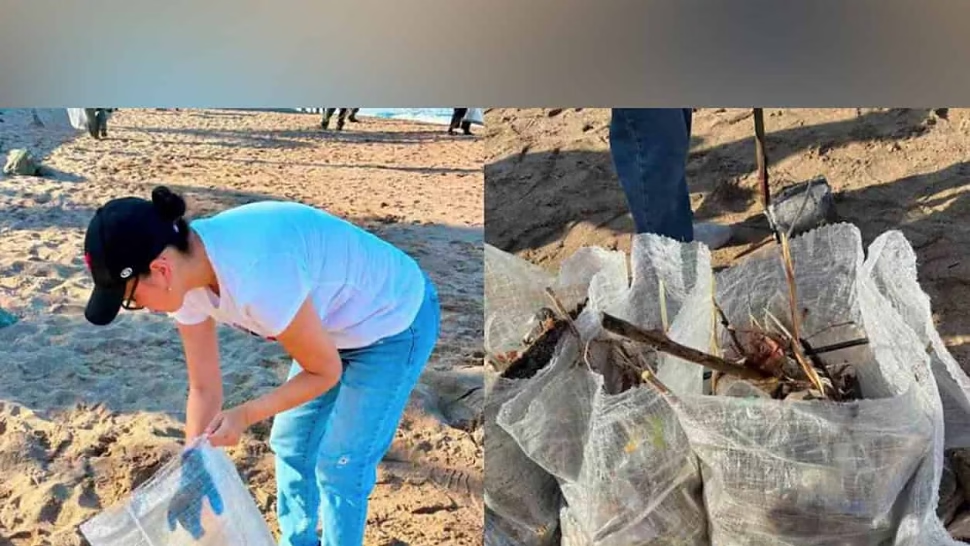
CULIACÁN, Sin.— Eight cubic meters of garbage, debris and branches were removed in a new day of cleaning beaches, parks and streets in the port of Mazatlán. The equivalent of 160 bags of waste left a renewed face in an area with a high tourist flow.

The 41st edition of the “Mazatlán I love you clean” program brought together municipal officials, hotel employees and volunteer environmentalists. The Beach Administrator was in charge of the coastal strip of Paseo de Olas Altas, where she collected forty bags to improve environmental conditions.

In the Villa Galaxia subdivision, staff from Public Services and the Drinking Water Board accumulated 120 sacks with disused furniture, leaves, debris and garbage. In addition, parks were cleaned, water leaks were repaired, and service modules were installed to quickly resolve neighborhood complaints.

The initiative not only seeks to improve the image of the port, but also to encourage citizen participation in environmental actions that benefit the community and tourists who visit Mazatlán.

Continue reading