Samuel García cancels the water transfer to Tamaulipas

The state avoids a critical water transfer thanks to recent rainfall and reservoir levels.

The water miracle that no one expected (but that everyone celebrates)

In a turn of events that has left more than one with their mouths open (and probably with an extra bottle of water in hand), the governor of Nuevo León, Samuel García Sepúlveda, has come out to announce what many consider a small modern miracle: they cancel the transfer of the El Cuchillo dam to the neighboring Marte R. Gómez dam in Tamaulipas. Yes, you read that right. In a world where bad news usually flows, it seems that water, for once, has decided to stay home.

The news, which has already been confirmed by the always reliable National Water Commission (Conagua)

RelatedConagua denies immediate transfer but leaves the door open for October

The unusual reason: the dams are… full?
It turns out that the reason for suspending this transfer of vital liquid was not an act of state sovereignty, a citizen blockade or a divine decree. No, gentlemen. The reason is so simple that it almost seems absurd: the reservoirs have good filling levels. Incredible, right? After months and even years of seeing dam levels drop more than the shares of an electric car company, it now turns out that they are in enviable condition.

The state leader, with an optimism that borders on the contagious, added that, thanks to this decision and the rains that have been recorded in recent months – because apparently, the sky did hear the prayers of the royals –, Nuevo León will remain with its trio of star reservoirs, La Boca and Cerro Prieto, completely full. One can almost imagine the prey smiling, bursting with happiness and, of course, H2O.

To make things clearer than the water from a spring (or at least, than the water from a well-managed dam), García Sepúlveda released the definitive phrase: “We are going to have the dams full, now without the transfer that is reviewed every October 31, already confirmed with the director of Conagua”. Let’s dissect this rhetorical gem. First, it announces the state of water fullness. Then, remind everyone that the dreaded annual exam on October 31st has passed. And finally, it appeals to the highest authority of water to give it a seal of irrefutability. A masterstroke in the art of political communication.

It is almost as if, suddenly, the management of water resources had taken a 180 degree turn. Do you remember the times of restrictions, the campaigns to turn off the tap while soaping your hands and the collective panic over a dry future? They seem like a distant bad dream. Now, the outlook is so rosy that one hopes that the citizens of Tamaulipas are not watching with envy from the other shore. After all, solidarity between states is nice, but having your own dams full is much more so.

The intrigue remains as to whether this abundance is the result of a brilliant hydraulic policy, a whim of the climate or a Faustian pact with the god of rain. Whatever the reason, the facts are the facts: for now, the water stays home. A situation that, without a doubt, will mark a before and after in the administration of the vital liquid in the region and that will surely be a campaign topic… sorry, of conversation, for a long time.

Isn’t it wonderful when good news comes from where you least expect it? Share this milestone in water management on your social networks and discover more analysis about natural resources on our platform.

Homicides in Mexico drop 48% in Sheinbaum’s government

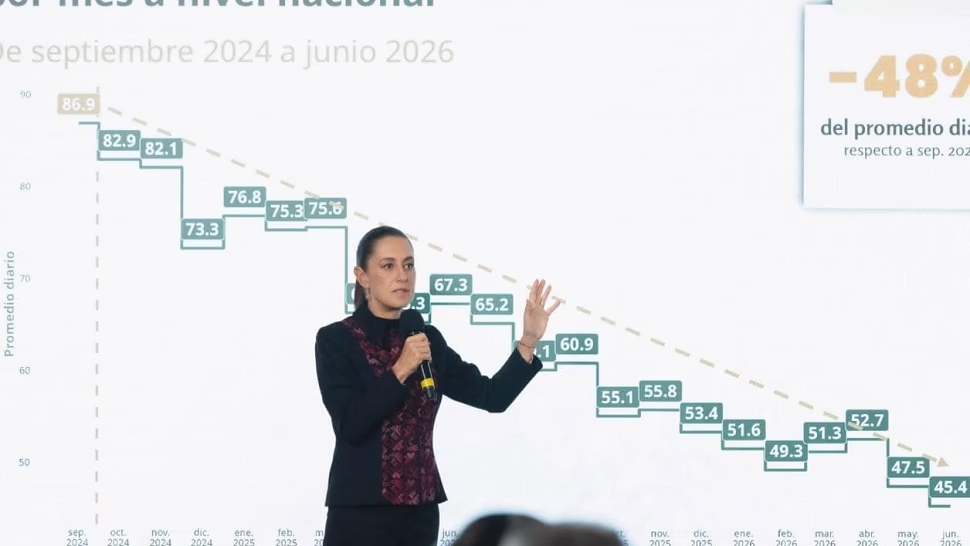
Daily homicides decreased from 86.9 to 45.4; 41 lives saved every day.

Results of the security strategy

President Claudia Sheinbaum reported that intentional homicides in Mexico were reduced by 48% between September 2024 and June 2026. The daily average went from 86.9 to 45.4 cases, which is equivalent to 41 fewer deaths each day.

“It is a strategy that is giving results, and the objective is to continue reducing homicides, continue reducing robberies, continue reducing extortion,” he declared at the morning conference.

Omar García Harfuch, Secretary of Security, explained that from October 2024 to June 2026, more than 59,500 people were arrested for high-impact crimes. 31,000 firearms and almost 500 tons of drugs were seized, including more than 5 million fentanyl pills. In addition, 2,600 clandestine methamphetamine laboratories were dismantled.

Within the framework of the anti-extortion strategy, 1,674 people were arrested for this crime between July 2025 and June 2026.

Marcela Figueroa, executive secretary of the National Public Security System, pointed out that the daily average of homicides in June 2026 is the lowest since 2015. Eight entities concentrate 54% of the cases: Guanajuato, Baja California, Chihuahua, Sinaloa, State of Mexico, Guerrero, Morelos and Veracruz.

However, 29 states reduced their daily average. The largest falls were recorded in San Luis Potosí (-81.7%), Zacatecas (-61.8%), Quintana Roo (-60.1%), Nayarit (-59.1%), Guanajuato (-50.9%) and Nuevo León (-50.6%).

High-impact crimes in general fell 32%: from 636.6 daily cases in October 2024 to 430.1 in June 2026. In the annual comparison, the reduction is 53% compared to 2018.

Rosa Icela Rodríguez, Secretary of the Interior, reported that in the axis of Attention to Causes, more than 7.3 million services and procedures were delivered, and 1,788 Youth Committees for Transformation were formed.

Sheinbaum reiterated: “There is zero impunity and we work every day for the good of the people of Mexico.”

Continue reading

Morena accuses the opposition of bargaining for unity for deceased migrants

Ariadna Montiel asks that national interests take precedence over partisan differences.

Morena demands unity in the face of deaths of compatriots

The national president of Morena, Ariadna Montiel Reyes, accused the opposition parties of “bargaining” unity from Mexico in the face of the cases of 17 compatriots who died in the custody of the United States Immigration and Customs Enforcement Service (ICE).

During a press conference, the Morenoist leader pointed out that the call to close ranks to demand answers from the US government must be above partisan and ideological differences. He considered that it is about the defense of the rights of Mexicans abroad.

Montiel Reyes affirmed that the opposition’s position reflects a lack of commitment to the country. He described it as “petty” that some leaders do not fully support the call for unity made by President Claudia Sheinbaum to address cases of alleged abuses against Mexican migrants.

The Morena leader maintained that the protection of fellow citizens must be a priority issue for all political forces. He called for placing national interests above partisan disputes.

Continue reading

Women’s Secretariat maintains support for wife of former director of Pemex

Government offers comprehensive care to wife of former Pemex director on trial for violence.

Permanent support from the Women’s Secretariat

The Women’s Secretariat reported that it will continue to provide comprehensive care, advice and psychosocial support services to María Felicia Jiménez, wife of the former director of Petróleos Mexicanos, Víctor Rodríguez Padilla. The support will be maintained if she requests it, within the judicial process she faces for alleged family violence.

In a statement, the agency clarified that any support will be granted with full respect for the will, autonomy and dignity of Dr. Jiménez. She also reiterated her commitment to assisting women who experience situations of violence through specialized protection mechanisms.

Decision not to attend hearing

The statement occurred after María Felicia Jiménez reported that she would not attend the hearing scheduled to ratify the pardon granted to her husband. He argued that he faces a strong media siege and seeks to protect his privacy and that of his children, especially that of his minor son.

The authorities keep open the possibility for the victim to access services when they consider it necessary. The case has generated public attention due to the power links of those involved, although the Secretariat assures that its actions are based on technical and human rights criteria.

Continue reading