Salinas appeals to the Inter-American Court for tax debt

The company alleges a prior agreement and denounces systematic persecution that takes it to international courts, while affirming its willingness to pay.

The tycoon, the SAT and selective memory

It seems that tax season has become the new corporate soap opera drama, and Grupo Salinas has just raised the ratings by announcing, with a solemnity that almost makes us cry, its willingness to pay what it owes. How generous! The company owned by the always controversial Ricardo Salinas Pliego not only reiterated its intention to settle its pending debts with the Tax Administration System (SAT), but also came up with the star argument: there was an agreement with the administration of former president Andrés Manuel López Obrador. Because, of course, in this country important fiscal pacts are sealed with a handshake and not with something as mundane as a signed contract.

The firm declared, in a statement that smells of corporate mothballs, the following: “having shaken hands is more valid than a signed piece of paper.” One can’t help but wonder if this philosophy of trust also applies when a client owes them money, or if it is an exclusivity to dealing with the treasury. Should the SAT start accepting promises about a bottle of tequila instead of legal documents? The idea, without a doubt, would revolutionize fundraising.

RelatedThe Court forces Salinas Pliego to pay his tax debt

When the dialogue ends, the international courts arrive

Faced with what they call, with a touch of Shakespearean drama, a “systematic persecution”, the next move by Grupo Salinas was to announce that it will go to the Inter-American Court of Human Rights. Because what better place to resolve a tax dispute than a human rights court? The decision came in response to the statements made by Arturo Medina Padilla, Undersecretary of Human Rights, and Grisel Galeano García, the Fiscal Attorney of the Federation, during the now traditional morning conference. The company, with the patience of a saint, once again explained that it is willing to pay, but only what the SAT resolutions and the court rulings dictate, which – oh, coincidence – establish that double charging is not applicable.

To demonstrate their good faith (that which is worth more than a piece of paper), our companies sent letters to the SAT requesting the adjustment of tax credits and the construction of a space for dialogue. One imagines this space for dialogue as a round table where, instead of swords, invoices and accounting calculations are crossed.

The attorney, prejudice and the right to… not pay twice?

The company expressed its “concern” – read: its deep anger – because, from the highest tribune in the country, the Tax Attorney dared to disqualify its sacred right to access justice. And what is worse, instruct the SAT to deny them the constitutional right to petition! The scandal is huge. Here we thought that the right to petition was for ordinary citizens who seek answers from the government, not for large corporations that discuss million-dollar amounts. How much we learn every day.

As a finishing touch, Grupo Salinas added, with a touch of melancholy, that they just want to “turn the page” to continue building value and inclusive prosperity for Mexico. A noble cause, without a doubt, supported by its more than 180 thousand employees and their families, and its more than 35 million clients. It’s almost moving. One almost forgets that the central debate is about the payment of tax obligations and not about a social responsibility campaign. In this great spectacle, accounts payable become a matter of principles, the tax authority becomes a persecutory villain, and a possible international legal conflict in the next chapter of this saga that we could title “The SAT strikes back.”

Are you intrigued by the outcome of this fight between the treasury and the business giant?Share this article on your social networks and explore more analysis about the ins and outs of the Mexican economy and politics.

Profeco warns about fraud in offers for the 2026 World Cup

The agency detected fake sites with unrealistic prices for tickets and tourist packages.

The Federal Consumer Prosecutor’s Office (Profeco) warned about misleading promotions related to the 2026 FIFA World Cup. In a statement, it noted that offers with very low prices for tickets, exclusive experiences, tourist packages and accommodation are circulating on social networks. These come from accounts without verifiable means of contact or clear change or cancellation policies.

Protection measures

Profeco explained that it has identified sites that appear to be trustworthy, but do not comply with electronic commerce requirements to guarantee secure transactions. Therefore, it recommended purchasing products and services only from official or authorized suppliers, and avoiding secondary markets.

In addition, the agency constantly monitors digital platforms and responds to complaints to punish those who spread misleading advertising. It urged consumers to report any suspicious practices, which allows unsubstantiated ads to be modified or removed. Citizen collaboration is key to protecting their rights in large-scale events such as the World Cup.

Continue reading

CIEP: 2026 World Cup mobility should not be isolated

The CIEP warns that mobility projects for the 2026 World Cup must be integrated into a strategic mass transportation plan.

Investment in public transport: beyond the World Cup

The Center for Economic and Budgetary Research (CIEP) presented the study “Mobility at the subnational level: Investment in public transportation within the framework of the 2026 World Cup.” Its conclusion is clear: mobility projects for the 2026 World Cup should not be isolated events. They must be part of a strategic plan that contemplates the construction of more mass transportation lines and connectivity between the host cities.

The CIEP emphasizes that investment in public transport must guarantee the right to mobility beyond the World Cup celebration. The benefits cannot be limited to visitors. They have to be the beginning of a more modern, efficient and inclusive transportation system for the entire population.

The study also diagnoses the current state of public transportation in Mexico. The urban development model is dispersed and is disconnected from territorial planning policies. As a result, the existing service is old, lacks adequate maintenance, and insecurity within units and stations reduces user confidence.

Headquarters cities and use of transportation

In 2026, the World Cup will be held in three cities: Mexico City, Guadalajara and Monterrey. In these cities, different mobility projects have been implemented to facilitate the movement of visitors. But the CIEP insists: these works must be the foundation of a long-term public transportation system.

The key fact: in the country’s main metropolitan areas, 40% of the population uses public transportation to go to work. In Mexico City, the figure rises to 49.2%; in Guadalajara, 38.6%; and in Monterrey, 33.4%. Not counting travel on foot or by bicycle, public transportation is the most used motorized means in Mexico.

Continue reading

Michoacán obtains Geographical Indication for its avocado

Recognition that benefits 48 thousand producers and opens new international markets.

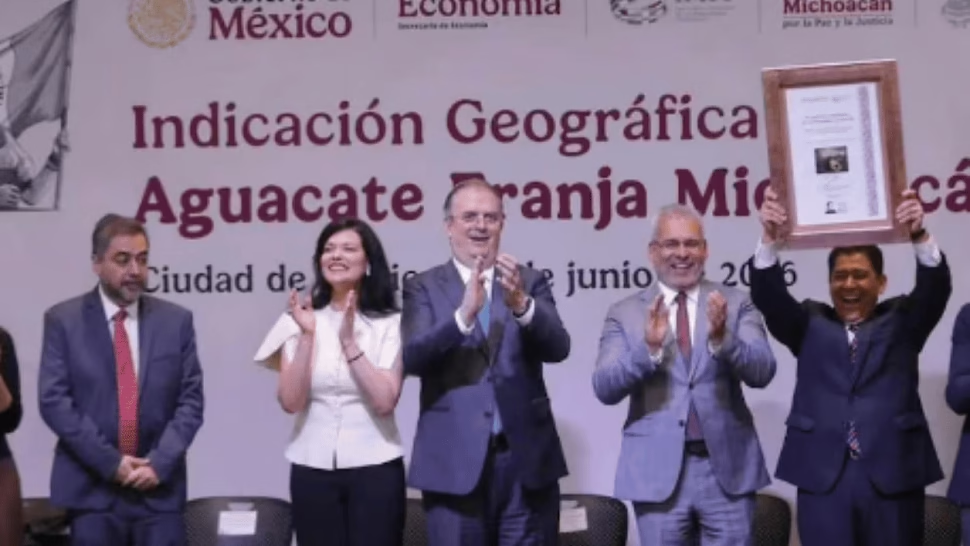
The Mexican Institute of Industrial Property (IMPI) granted the declaration of Geographical Indication (GI) to the avocado produced in the Michoacan strip. Governor Alfredo Ramírez Bedolla described the event as a step that strengthens consumer confidence and competition in the market.

A quality seal for avocado

In a press conference with the federal Secretary of Economy, Marcelo Ebrard, the state president explained that this designation recognizes the work of 48 thousand producers, 94 packing plants and an agribusiness that generates more than 150 thousand direct and indirect jobs. The GI allows the Michoacan product to be differentiated in national and international markets.

Ebrard confirmed that, on instructions from President Claudia Sheinbaum, projects are being developed to enhance the growth of Michoacán. He assured that support for the state and the productive sector will continue.

The general director of IMPI, Vidal Llerenas Morales, highlighted the joint effort of the state government and producers to obtain this certification, which adds value to avocado abroad.

The Secretary of Economic Development of Michoacán, Claudio Méndez, also participated in the event; and the presidents of APEAM, Raúl Martínez Pulido; from UDECAM, Miguel Melgoza Radillo; and of the Board of Directors of Avocado Producers and Packers A.C., Rafael Paz Vega.

Continue reading