Rubio supervises key center for Gaza ceasefire

A critical mission with 200 international troops seeks to consolidate the truce and plan the stabilization of the territory.

An Epicenter of Hope in a Land of Conflict

On a day full of historical significance that palpitated in the air, Secretary of State Marco Rubio entered the very heart of an operation that could define the future of a burning region. His visit to the coordination center in Kiryat Gat was not a mere protocol tour; It was the inspection of a newly erected bulwark against the shadow of war, a beacon of fragile hope in the midst of chaos. This nervous center, directed by the United States, has become the headquarters from which the cessation of hostilities in the besieged Gaza Strip is monitored with an iron pulse, while the Trump administration deploys its pieces on the board to deploy a multinational security force to consolidate the most unstable truce of the decade.

Rubio’s presence was not an isolated event, but the most recent link in a chain of power that is urgently mobilized. The place had witnessed, just days before, the figure of Vice President JD Vance, who with his signature hand had inaugurated this titanic undertaking. He was followed by the influential shadows of envoys Steve Witkoff and Jared Kushner, whose very name whispers of proximity to supreme power. Each visit was a clear message to the world: the stabilization of this fractured territory is a priority that does not admit failure.

RelatedRubio visits Israel amid escalating war in Gaza

The Architecture of a Peace Forged with Effort

Within the walls of this epicenter of diplomacy, a joint force of approximately 200 American soldiers works side by side with the Israeli military and delegations from allied nations. Their mission, as monumental as it is quixotic, is to weave plans for the stabilization and reconstruction of Gaza, a territory whose wounds still bleed. The scene that an Associated Press reporter was able to capture was a microcosm of the international community: Flags of Cyprus, Greece, France, Germany, Australia and Canada waved together, a mosaic of determination in the face of adversity. It was a powerful image, a whisper that unity was possible even in the most unlikely of places.

With the suppressed emotion of someone who knows the world is watching, the Secretary of State declared: “I think we have a lot to be proud of in the first 10 days, 11 days, 12 days of implementation, where we have faced real challenges along the way.” Each of his words weighed like a stone, acknowledging the obstacles overcome without hiding the enormity of the path ahead. In a strategic move that resonated with the force of a declaration of principles, Rubio appointed Steven Fagin, the experienced ambassador to Yemen, to command the civilian branch of this colossal effort. In command of the military machinery, a figure of indisputable authority: Admiral Brad Cooper of the Central Command, whose leadership would be the backbone of the entire operation. At this crossroads, the fate of millions hangs in the balance, and every decision, every alliance, every day of calm, is a battle won in a war for peace.

Do you think this international effort will make a definitive difference? Share this crucial story on your social networks and explore more content on the twists and turns of global geopolitics.
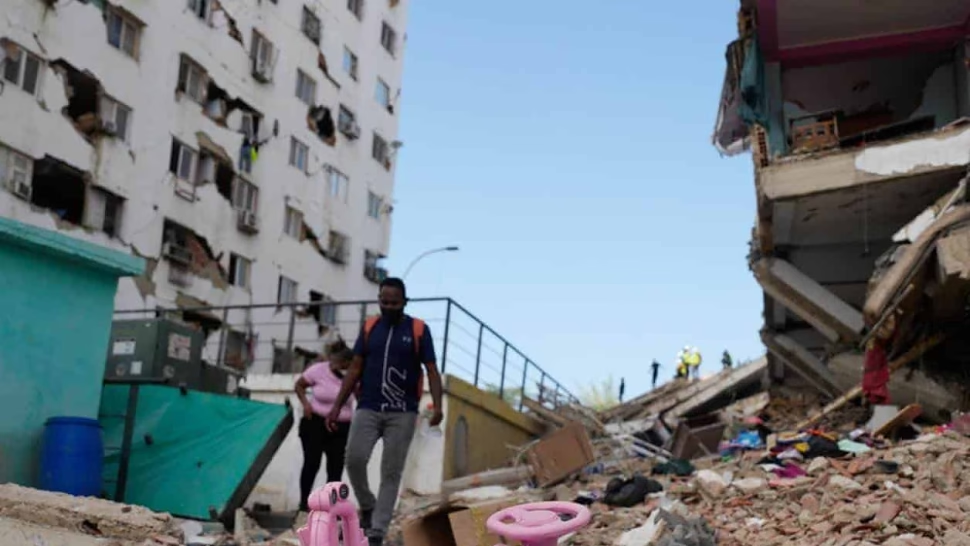
Double earthquake shakes Venezuela: more than 900 dead

Hundreds of dead and thousands of injured after two consecutive earthquakes on the northern coast of Venezuela.

Devastating double earthquake

An unusual double earthquake hit Venezuela on Wednesday, with magnitudes of 7.2 and 7.5 just 39 seconds apart. According to the United States Geological Survey (USGS), the earthquakes occurred along the San Sebastián fault, on the north coast of the country. The first earthquake was located near Morón, about 170 kilometers west of Caracas, while the second, the most intense, had an epicenter 16 kilometers southwest of that town.

Authorities reported at least 920 deaths and more than 3,360 injuries, although it is feared that the number will increase. The most affected region is La Guaira, north of Caracas, where dozens of buildings collapsed. The president in charge, Delcy Rodríguez, declared the area a disaster and deployed rescue teams. Thousands of families spent the night in parks, highways and open spaces. Caracas’ main airport closed due to damage, the subway suspended service and gas and electricity supplies were cut off in some areas.

International aid

The international community responded quickly. The International Red Cross launched an emergency appeal for 50 million Swiss francs and sent 17 tons of supplies from Panama. The United States contributed 150 million dollars, two urban search and rescue teams, specialized dogs and logistical support. The European Union sent 520 troops from eight countries, activated its Copernicus satellite service and offered geospatial images.

The United Kingdom allocated 2 million pounds, a rescue team with 68 members and drones. China promised emergency humanitarian aid. Brazil dispatched a plane with firefighters, water purifiers and medical equipment. India sent two C-17 aircraft with a field hospital and 30 tons of supplies. Italy and Türkiye also mobilized rescue personnel and equipment.

Humanitarian situation

Classes were suspended and schools became shelters. In La Guaira, families settled on baseball fields with sheets and plastic bags. Rodríguez announced a reconstruction fund of 200 million dollars for hospitals and housing. The seismic crisis adds to the complex political situation facing the government, amid internal and external tensions.

Continue reading

Earthquakes in Venezuela: citizens search for missing people in rubble

More than 920 dead and 51 thousand missing after two earthquakes in Venezuela.

The devastation caused by two consecutive earthquakes of magnitude 7.2 and 7.5 left at least 920 dead and more than 51,000 missing in Venezuela, according to official reports on Friday. The number of injured exceeds 3,300, while 243 people have been rescued alive.

Citizens take the search into their own hands

Inhabitants of areas such as La Guaira and Catia La Mar denounce the scarce presence of government rescue teams. With hammers and power tools, neighbors try to remove concrete slabs from collapsed buildings.

“My God, how do we get all the people out of there?” muttered Nazareth Jiménez, who is waiting for news of her brothers and nephews.

Omar Reyes walked among the rubble where two of his children are buried: “I was practically alone in this life.” He stated that about 20 relatives died.

Official response and international aid

The acting president Delcy Rodríguez assured that her government is deploying a total response in these “critical hours for the rescue.” He announced the militarization of La Guaira and the arrival of humanitarian aid. As of Friday, 861 international volunteers from Mexico, the United States, El Salvador, Switzerland and Colombia were working in the country. The UN reported that 25 search and rescue teams with 1,000 personnel are on the way.

However, residents consider the assistance insufficient. In Catia La Mar, looting of basic goods was recorded and the population improvised shelters in parking lots.

Stories among the rubble

Yuleidy Cadenas, 28, looks for her son, her mother and her brother in a collapsed tower in La Guaira. Friday was her son’s 12th birthday.

“I went up to the rubble and told them to yell at me, and no, no one. I just hope they get them out,” he said through tears.

The state press reported moments of hope: the rescue of a young man in Caracas and a girl covered in dust who emerged from a 10-story building. “We want to highlight this girl’s strength and desire to live,” said José Luis Núñez, head of the metropolitan rescue group.

Impact on the region

The International Organization for Migration estimates that up to 6.76 million people could be affected, about 2 million in Caracas alone. Loyce Pace of the Red Cross said: “People are still terrified to go back into their homes.”

The epicenter of the earthquakes was located near Morón, on the Caribbean coast, 170 kilometers west of Caracas. The superficiality of the movements amplified the destruction, explained geophysicist Marcos Ferreira of the Geological Survey of Brazil.

Continue reading

Venezuela raises the death toll from earthquakes to 589

589 dead and 2,980 injured after the earthquakes. La Guaira will be militarized.

The interim president of Venezuela, Delcy Rodríguez, updated this Friday the number of victims from the earthquakes that hit the country. The death toll amounts to 589 and there are 2,980 injured, more than doubling the previous toll of 235 deaths. The number is expected to increase, as thousands of people remain missing.

“Unfortunately, we now have 589 deaths,” Rodríguez declared before military and civilian officials. “We will go to save the trapped people, we work tirelessly on this task,” he added.

La Guaira under military control

The coastal state of La Guaira, north of Caracas and near the epicenter of both earthquakes, will be militarized. It is the most affected area. At least 100 buildings, including residential skyscrapers, collapsed in the city of the same name.

The authorities have intensified rescue efforts and are committed to recovering the devastated areas. The situation continues to evolve as evaluations progress. The magnitude of the earthquakes has caused a humanitarian crisis, and efforts are being made to provide assistance to those affected.

Continue reading