Road tragedy in Apodaca leaves eight dead and dozens injured

A road tragedy shocks Nuevo León after the loss of control of a transport unit in dangerous conditions.

A Sunday that ended in a Nightmare on the Asphalt

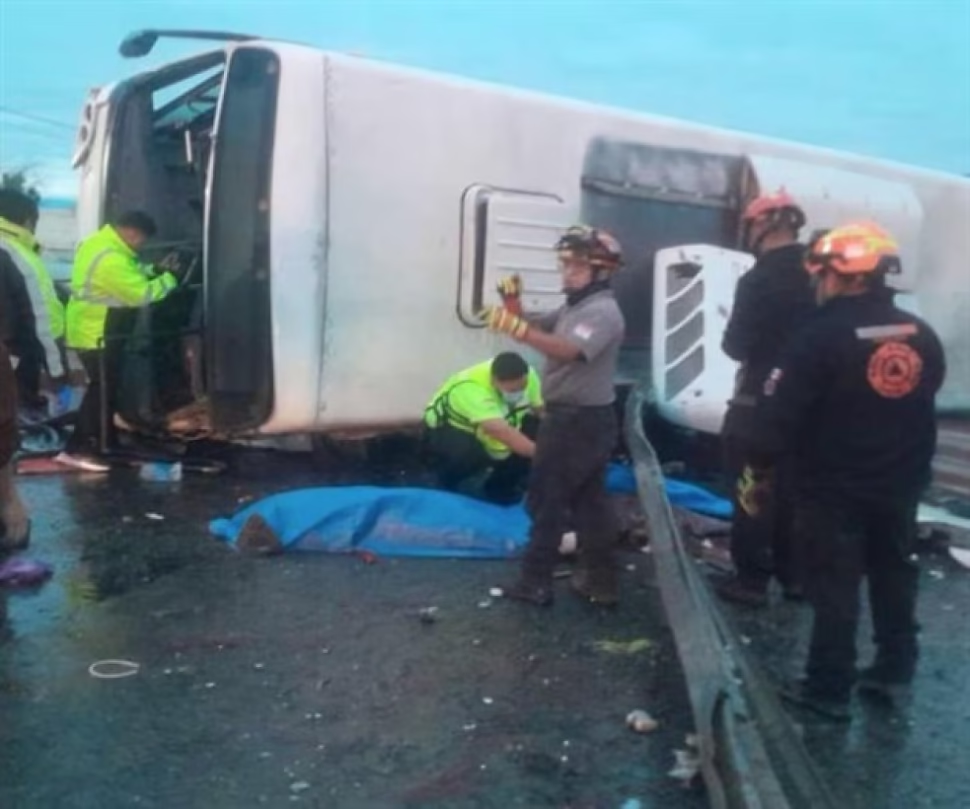
Sunday afternoon transformed into a scene of chaos and despair in the municipality of Apodaca, Nuevo León. What began as a routine trip culminated in one of the worst road tragedies in recent times, when a collective transportation unit became a mass of metal. The official balance, cold and devastating, showed eight lives taken and at least 58 people with injuries of varying degrees, marking dozens of families and an entire community with fire.

The Critical Moment on the Miguel Alemán Highway

The fateful episode involved a city bus on Route 611 bound for Pesquería. On the busy Miguel Alemán Highway, at kilometer 24, fate played its cruelest cards. According to the first investigations, the operator of the vehicle, identified as José Manuel Rosaldo Reyes, 46 years old, would have driven at a reckless excess speed. This factor, combined with the slippery pavement due to humidity and an alarming overcrowding of passengers, created the perfect storm. In a moment of terror, the driver lost total control of the heavy machine, which ended up overturning in a Dantesque spectacle that paralyzed the witnesses. Reyes himself, originally from Veracruz, died instantly, along with three other occupants whose breath was extinguished inside the twisted frame. Three more lay lifeless outside, and a final victim later succumbed in a hospital, struggling in vain against the severity of his injuries.

RelatedTragedy in Atlacomulco leaves dozens of victims due to collision

Mobilization and Response to the Catastrophe

The magnitude of the incident required a massive and coordinated response. The Mexican Social Security Institute (IMSS) deployed its emergency protocols to care for the multitude of injured people, of whom three were classified in critical condition. A human contingent came to the scene that seemed taken from a disaster movie: elements of the State Civil Protection, rescue teams and firefighters from the municipalities of Pesquería, Juárez and Higueras, and even specialized personnel from the Secretariat of National Defense and expert services. Together, they undertook the titanic tasks of immediate aid, extraction of bodies and the beginning of the meticulous forensic investigation to clarify every detail of this mournful day.

While the authorities continue with the painful process of identifying the fatal victims, the shadow of justice hangs over the investigation. The experts analyze each variable – the speed, the mechanical conditions of the bus, the state of the road – to precisely determine the legal causes and responsibilities that led to this irreparable human loss. This event once again puts on the table the urgent debate about safety in public transportation, the supervision of concessions and road culture in a state with high mobility.

This tragedy reminds us of the fragility of life in every journey. Help raise awareness by sharing this information on your social networks and exploring more road safety content on our site. Your voice can help prevent future losses.

INEHRM becomes a research and teaching center

The INEHRM is transformed into a research and teaching center under the new secretariat.

Transformation of the INEHRM

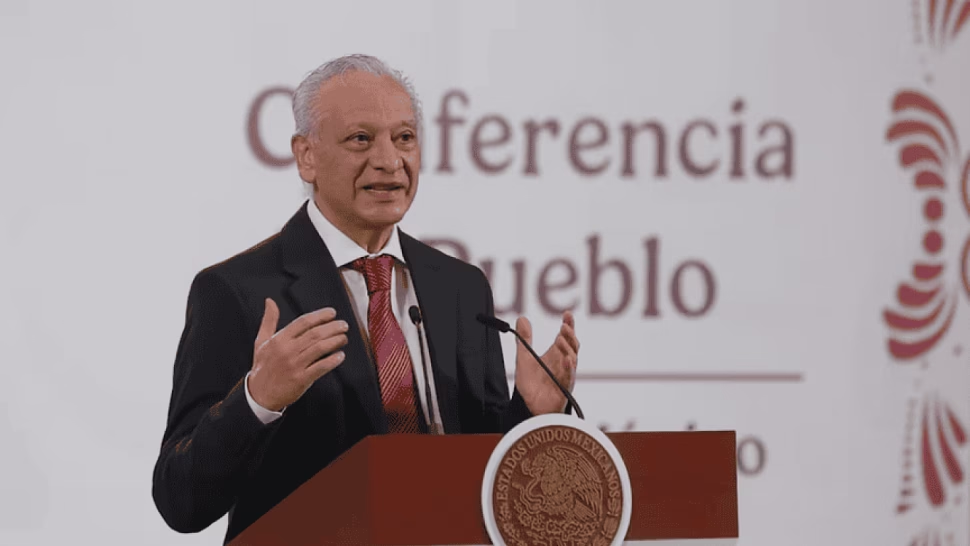
President Claudia Sheinbaum signed the decree that transfers the National Institute of Historical Studies of the Revolutions of Mexico (INEHRM) to the Secretariat of Science, Humanities, Technology and Innovation (SECIHTI). The institute becomes a decentralized public body with an academic focus.

Rosaura Ruiz Gutiérrez, head of SECIHTI, explained that the new scheme will train specialists in history to strengthen national capacities in social sciences and humanities.

Felipe Arturo Ávila Espinosa, director of the INEHRM, explained that the study plans will link historical knowledge with social, economic, political and cultural problems of the country, and will address the needs of the Federal Public Administration.

Hybrid educational offer

The offer will include bachelor’s degrees in History, Social Sciences and Humanities, and Public Administration and Good Government. In postgraduate studies, master’s degrees will be added in Mexican Humanism, Gender and Feminism Studies, and Social Movements and Rescue of Historical Memory. There will also be specialties in Political Communication and History Teaching.

Graduates will cover topics such as agrarianism, health, migration, artificial intelligence, violence and human rights.

Headquarters and call

The new headquarters will be at 80 Guatemala Street, Historic Center of Mexico City. The first admission call will be launched in July, and classes will begin in September.

Continue reading

Prosecutor’s Office grants protection measures to victim of family violence

The Morelos Prosecutor's Office issued protection measures after a complaint of family violence against the former director of Pemex.

The Morelos Attorney General’s Office activated protection measures in favor of Felicia Jiménez Lavie, who filed a complaint for family violence against her husband, Víctor Rodríguez Padilla, former director of Pemex. This was reported by prosecutor Fernando Blumenkron Escobar.

The measures, the official explained, will be available when the victim requires them. The complaint was filed in Mexico City and the Women’s Secretariat of the Government of Mexico directly follows up on the case.

Investigation in progress

Until now, Jiménez Lavie has not gone to the local Public Ministry to contribute more elements to the investigation folder. This was initiated ex officio last Friday, June 26, after a video was broadcast with images of attacks against the woman.

Blumenkron assured that the portfolio continues its integration. “The proceedings have not stopped and we are going to continue to guarantee justice for the victim,” he said. In addition, he indicated that there is coordination with the Women’s Secretariat and the capital’s Prosecutor’s Office, under the care route for victims of family violence.

Among the actions carried out, the Morelos Prosecutor’s Office seeks to locate the address where the physical assault occurred, to carry out expert reports in accordance with the images of the video broadcast by the victim herself.

Continue reading

Trump does not extend T-MEC: Mexico faces annual review

US rejects automatic extension of the T-MEC; validity is reduced to 10 years with annual review.

Rejection of automatic extension

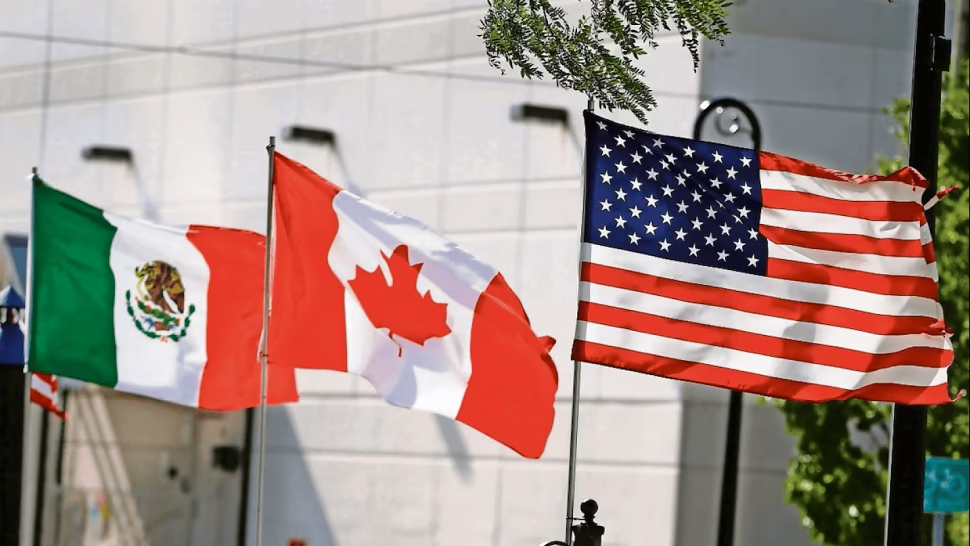
The United States decided not to automatically renew the Treaty between Mexico, the United States and Canada (T-MEC) for 16 years. This reduces its validity to a decade with an annual review. The measure generated concern among Mexican legislators.

Ricardo Monreal, coordinator of Morena in San Lázaro, explained that the treaty remains in force for another 10 years, but subject to evaluation each year. He noted that the United States presented 54 observations, including issues such as the vaquita porpoise and piracy. Mexico, for its part, raised 13 points, including clause 232 on tariffs.

“Only it will be reviewed year after year, but the Treaty is not finished, it continues for another 10 years because that is how it was signed six years ago,” declared Monreal.

The legislator warned that Donald Trump has been a constant critic of the USMCA and called for considering the benefits it has brought to the three nations.

Reactions of the opposition

Héctor Saúl Téllez, vice economic coordinator of the PAN, considered that the US position shows a lack of strategic anticipation on the part of the federal government.

“The US decision not to automatically extend the USMCA for 16 years in today’s review is not the end of the treaty, but it does reveal a lack of strategic anticipation by the federal government,” he stated.

Téllez recalled that Article 34.7 of the agreement had been known since 2018. Reaching July 1 without a clean extension represents a risk that, he said, should have been avoided.

The annual review will allow adjustments, but uncertainty about the future of regional trade persists. Mexico and Canada will seek to maintain the stability of the agreement for the next ten years.

Continue reading