Rigoberta Menchú receives emotional tribute at Filgua 2026

The International Book Fair in Guatemala opens with a recognition of the Nobel Peace Prize and German literature.

Tribute to the Nobel Peace Prize winner

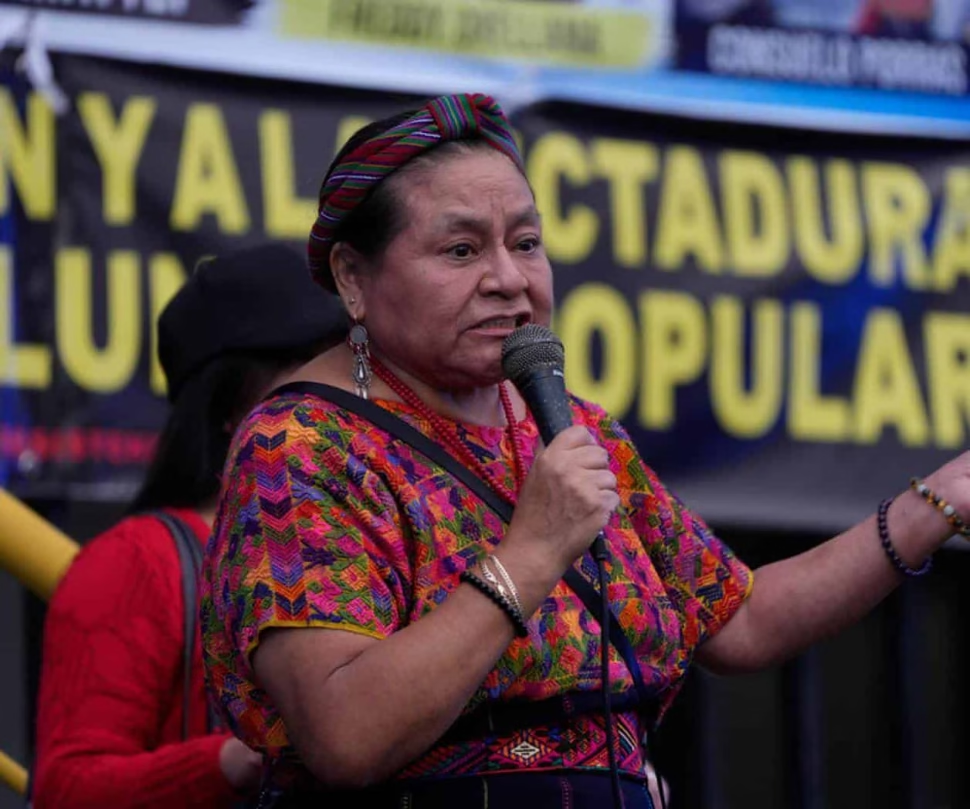
The International Book Fair in Guatemala, Filgua 2026, started on Tuesday with a special recognition to Rigoberta Menchú Tum, Nobel Peace Prize winner in 1992. Germany is the guest country of honor in this edition.

“I felt like a peacock, I felt worthy,” Menchú said through tears. “Receiving a tribute here is not only worth a Nobel Peace Prize, diplomas and keys of honor… this is a very important plus.”

The Quiché Mayan activist recalled her book “My name is Rigoberta Menchú and this is how my conscience was born” (1982), which narrates the army’s persecution of the indigenous population during the internal armed conflict (1960-1996). Menchú pointed out that this work transformed the perception of the Mayan civilization.

RelatedRigoberta Menchú, new foreign policy advisor in Mexico

With more than 20 honorary doctorates, Menchú has published several books, including “El baúl deños” (2016), co-written with Dante Liano.

President Bernardo Arévalo inaugurated the fair under the motto “Let’s go for a country of more readers.” He stressed that Menchú’s life “is a book that the world reads.” Arévalo also mentioned the Popol Vuh, “the essential book of our culture” and “the grandfather book from which other books come.”

The Minister of Education, Anabella Giracca, described Menchú as “a book made of earth, forest, river, star, hug, struggle and fortitude.”

Filgua 2026 will offer more than 800 activities and will remain open from July 7 to 19. It is the second tribute that Menchú receives from the fair; The first was in 2017, when the 50th anniversary of Miguel Ángel Asturias’ Nobel Prize was also celebrated. The remains of Asturias, who died in Madrid in 1974, will be repatriated from France to Guatemala at the end of this year.
US and Iran resume talks mediated by Oman

Dialogue intensifies after military pause in the Strait of Hormuz.

Pause in military actions

The United States and Iran maintain a de facto truce for the second consecutive day. The ceasefire was not officially announced by Washington, but the US ambassador to the UN, Mike Waltz, indicated that it seeks to give space for diplomatic efforts. Tehran also confirmed the suspension of its operations during the same period.

Negotiations in progress

Both parties are trying to resume the provisional agreement reached in June. The talks, mediated by Oman and other actors, focus on ensuring safe transit through the Strait of Hormuz, a key route for the global oil trade. Differences persist over the Iranian nuclear program.

Uncertainty extends to other routes such as the Bab al-Mandeb Strait, due to threats from the Houthis against Saudi maritime transport. The US Navy maintains surveillance in the area to protect commercial traffic.

Meanwhile, Israeli Prime Minister Benjamin Netanyahu will travel to Washington to meet with Trump. Netanyahu backed the diplomatic efforts, although he warned that he would respond firmly if Iran or its allies attack Israel.

Continue reading

Attack on Berlin Pride: one dead and 29 injured

A mass accident at the Berlin Pride parade leaves one dead and dozens injured.

The attack at the Pride parade

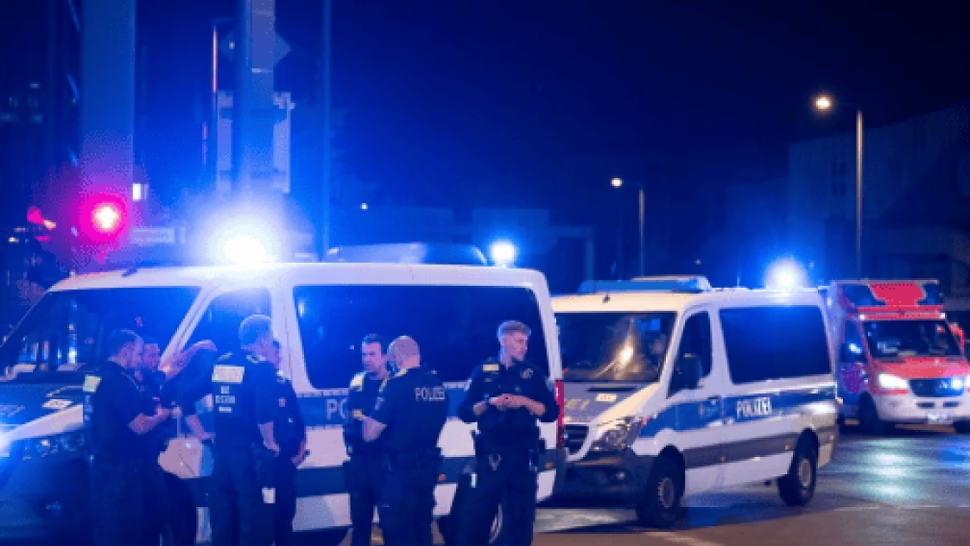
Germany faces new shock after the attack that occurred Saturday night during the Pride parade in Berlin. A white van broke into Tiergarten park around 10 p.m., running over dozens of people participating in Christopher Street Day (CSD), one of the busiest LGBTQ+ marches in Europe. The preliminary toll is one woman dead and 29 injured, none in critical condition. The vehicle ended up crashing into a tree.

The alleged perpetrator, Abdul Ballout, 21, a German citizen of Lebanese origin, was neutralized by special police forces in a shed in the Spandau district. According to the newspaper Bild, the agents opened fire after the man attacked them with a knife. Ballout died at the scene despite resuscitation attempts. The authorities identified him as a sympathizer of the Islamic State jihadist group and known for his links to extremist circles.

Witnesses indicated that, after getting out of the van, he attacked several passers-by with a machete. The search lasted more than a day with controls at borders, stations and airports. Police detained three people for questioning, although two were later released. The possible existence of accomplices is being investigated.

Investigation and political consequences

The site of the attack is a few meters from the end of the route and the main stage next to the Brandenburg Gate. On Sunday, citizens left flowers and messages such as:

“We must remain united”

Prayer services were held in St. Mary’s Church and a vigil in front of the Brandenburg Gate, where hundreds of people lit candles and displayed rainbow flags.

The German Chancellor, Friedrich Merz, went to the site accompanied by three ministers, laid a white rose and participated in a moment of prayer. This attack revives the debate on immigration and security two months before the regional elections in Saxony-Anhalt. The far-right party Alternative for Germany (AfD) leads the polls with more than 40% of voting intentions, promoting proposals for “remigration” and tightening border controls. International leaders expressed solidarity with the country.

Continue reading

UNESCO declares Landing Beaches as World Heritage

The 80-kilometer site that marked the end of the occupation in Europe gets maximum recognition.

Recognition by UNESCO

The beaches of Normandy, scene of the historic Allied landing on June 6, 1944, were inscribed as a UNESCO World Heritage Site. The decision was made during the 48th session of the World Heritage Committee in Busan, South Korea.

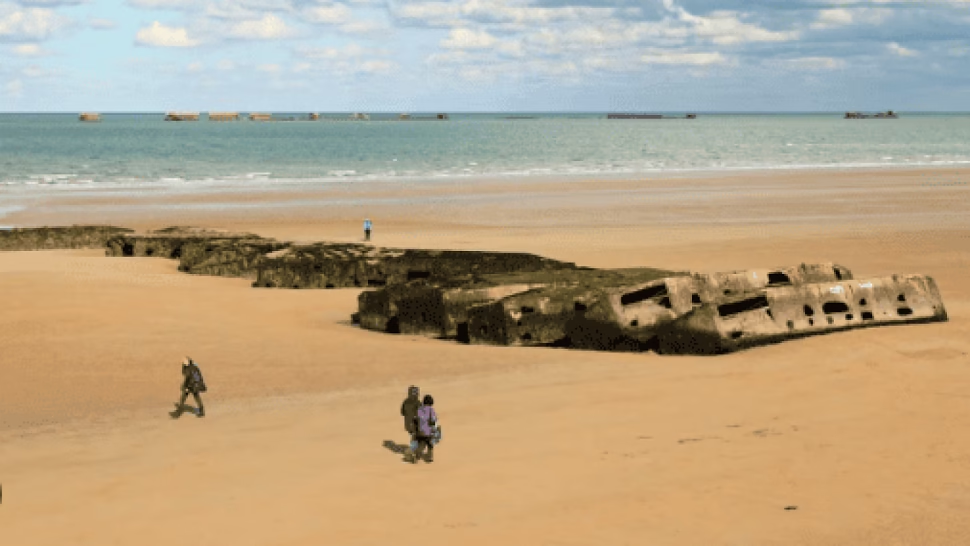
The coastal stretch of about 80 kilometers includes the five beaches known by their code names: Utah, Omaha, Gold, Juno and Sword. It also includes other key points such as Pointe du Hoc, the German artillery battery of Longues-sur-Mer and the artificial port of Arromanches-les-Bains.

The latter, designed by British engineers, was a system of submerged concrete caissons that allowed the creation of a temporary port. Thanks to him, nearly 2.5 million soldiers, more than 500,000 vehicles and four million tons of supplies landed.

A place of memory and reconciliation

The registration culminates a process started in 2008 by the Normandy Region, supported by more than 70,000 signatures. The file was paralyzed for five years due to a review of criteria and was reactivated in 2024.

UNESCO highlighted that the beaches represent not only a large-scale military operation, but also a site for transmitting the values of peace and reconciliation. He underlined his role in the rapprochement between France and Germany after the war, the basis of European integration.

French authorities hope the recognition will boost tourism and strengthen the preservation of this World War II memorial site.

Continue reading