
Prosecutor’s Office asks for coordination while insecurity continues

Prosecutor Ernestina Godoy calls for more coordination between agencies to combat crime, but what is behind the call?

Another call for coordination that should already be routine

The Attorney General’s Office (FGR) once again asked to “strengthen coordination” between security agencies. Its owner, Ernestina Godoy Ramos, said it in Manzanillo, Colima. The speech sounds familiar: synergy, joint work, concrete results.

“This synergy allows us to consolidate a stronger team in the face of security challenges,” he stated.

But here’s the thing: if coordination is so key, why is it still an announcement and not an operational reality? State security tables have existed for administrations. The agreements are signed. Photos are taken.

RelatedThe colossal challenges that await Godoy in the Prosecutor’s Office

Godoy talks about translating these agreements into “more robust investigations” and more arrest warrants. He says that fighting impunity prevents crime. You are legally right. It is basic Criminal Law.

The curious thing is the timing. This call occurs when the figures of certain crimes continue to generate social alarm. When the citizen perception of the authorities… well, let’s not delve into surveys.

The prosecutor also asked to communicate the progress to “generate trust.” Here my professional cynicism is activated: trust in institutions or in communications? Because they are different things.

Finally, the classic: “close and professional attention”, “people at the center”. I have heard it in so many press conferences that it already has the flavor of a remade script. I wonder how many citizens who have set foot in a prosecutor’s office lately would feel like they are “in the center” of something.

The diagnosis is correct. The recipe too. The execution… that is the part that always fails between the official discourse and the reality on the streets.
The United States does not extend the T-MEC, markets without problems

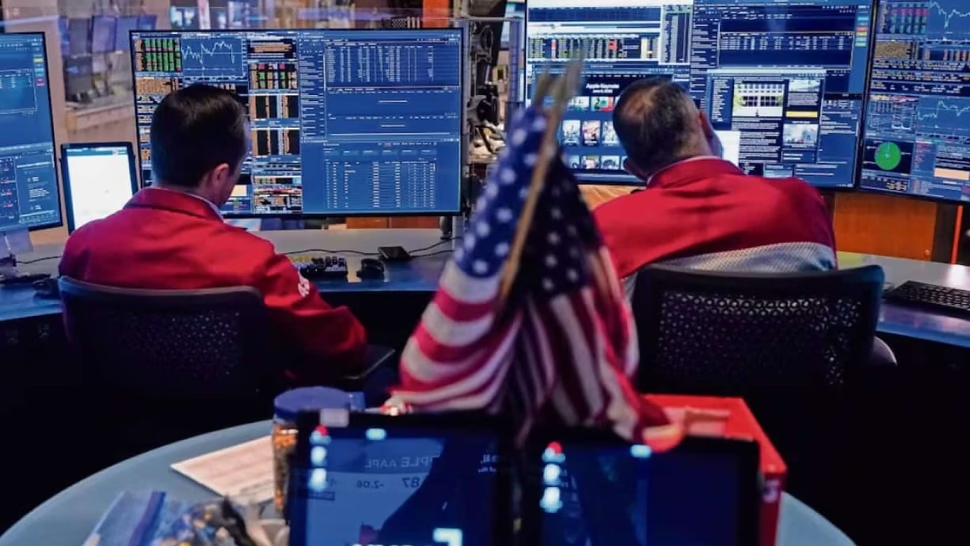
Markets calm due to the non-extension of the T-MEC until 2042, according to analysis.

T-MEC: No extension until 2042, stable markets

The United States decided not to extend the validity of the USMCA until 2042. The treaty will remain in force until 2036 with annual reviews. The decision did not generate turbulence in the financial markets. Analysts were already anticipating this scenario, according to the Mexico organization How are we doing?

In its report ‘The T-MEC is still in force’, the organization detailed that annual reviews were a possibility contemplated. Therefore, variables such as the exchange rate did not show negative reactions. On July 1, the peso stood at 17.54 units per dollar, with no relevant movements after the announcement.

Productive integration in North America is key. Mexico maintains its role as the main supplier of fresh fruits and vegetables to the United States. This strengthens regional food security, especially in the agri-food sector.

Looking ahead to the next negotiations, the central issues will be the reduction of tariffs, the defense of the rules of origin and access to agricultural markets. The United States will seek to reduce its trade deficit, while Canada will try to protect its key sectors.

Continue reading

They find remains of journalist Roxana Guzmán; They arrest eight, four were police officers

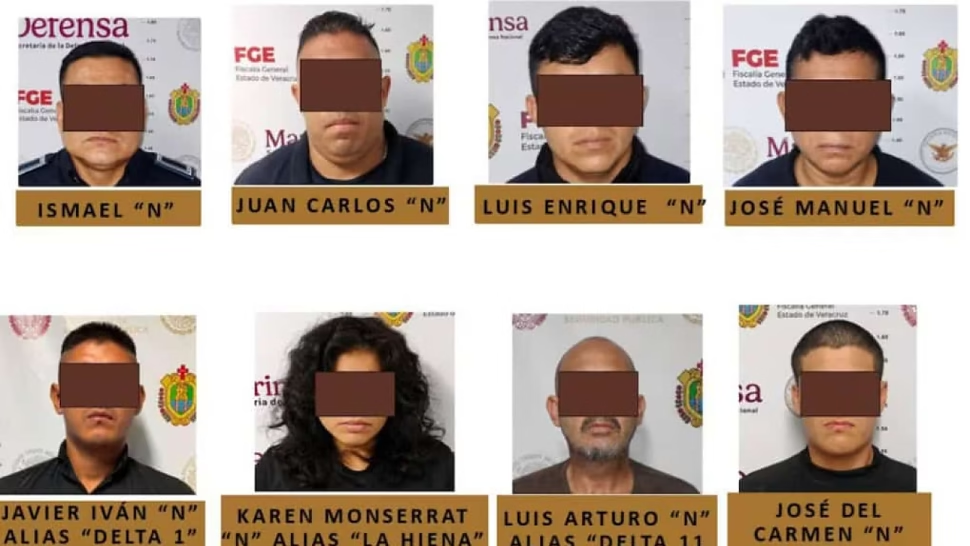
Eight arrested, four of them police officers, for the disappearance and death of the communicator in Nanchital.

The Veracruz Prosecutor’s Office confirmed the discovery of the remains of Roxana Guzmán, founding journalist of Pulso Informativo del Sureste. She had been deprived of her liberty at her home in Nanchital a month ago.

Kidnapping and arrests

Eight people were arrested, including four municipal police officers from Ixhuatlán del Sureste. According to the Prosecutor’s Office, the agents provided logistical support, resources and food to the criminal group. The names of those captured: Javier Iván “N” (alias Delta 1), José del Carmen “N” (Delta 7), Kenia “N” (La Hiena) and Luis Arturo “N” (El Pelón).

The events occurred on a ranch in the municipality of Moloacán. Roxana’s mother declared that the attackers were dressed as police officers and claimed that they were taking her daughter to a police station. Until now, the Prosecutor’s Office has not specified the motive.

Alarming context

With this loss, Veracruz adds 34 journalists deprived of their lives. The entity continues to be the most dangerous for practicing journalism in Mexico. The eight detainees are now at the disposal of the judicial authorities. The investigation continues to determine responsibilities.

Continue reading

CNDH requests changes to indigenous law to protect culture

CNDH calls to include prior consultation and stop commercial use without permission.

CNDH proposal

The National Human Rights Commission (CNDH) urged to strengthen the proposal for the General Law on the Rights of Indigenous and Afro-Mexican Peoples. The organization considers that it must guarantee real protection of cultural heritage. It also requires the direct participation of communities in the consultation process promoted by the federal government.

The pronouncement is given at the beginning of the Prior, Free and Informed Consultation Process. For the CNDH, this initiative is an opportunity to consolidate the legal framework that protects the material and intangible heritage of indigenous peoples. In addition, it seeks to avoid its misappropriation or exploitation.

The CNDH recalled that in its General Recommendation 35/2019 it already documented cases of unauthorized commercial use of indigenous designs, textiles and cultural expressions. This evidenced the need to strengthen legal mechanisms. For this reason, he highlighted the importance of recognizing collective authorship and the cultural rights of communities.

Necessary measures

The organization also called for strengthening the National System for the Protection of the Cultural Heritage of Indigenous and Afro-Mexican Peoples and Communities. He requested to provide it with more resources and ensure the operation of its national registry. He insisted that the law must provide for prior, free and informed consent for any commercial use of cultural elements.

Continue reading