
PlayStation will stop producing physical discs in 2028

Sony confirms the end of discs for PlayStation and the closure of stores on old consoles.

Sony Interactive Entertainment announced that it will stop manufacturing physical discs for its consoles starting in January 2028. The company will cease production of discs for new PlayStation titles. “Consumers and the entertainment industry are increasingly migrating from physical to digital formats,” said an official statement. They clarified that games already released or planned before that date will not be affected.

Digital transition and store closures

Days ago, Rockstar and Take-Two confirmed the exclusively digital launch of Grand Theft Auto 6, scheduled for November 19. At the same time, Sony announced the definitive closure of the PlayStation Store on PS3 and PS Vita. The suspension of sales will prevent the purchase of new games or additional content. It will be implemented by region: it will begin in August 2026 in select markets in Central America, then it will extend to the rest of Latin America and the Middle East at the end of the year. The global shutdown will end in July 2027.

RelatedPlayStation Wrap Up 2025 reveals your annual gaming statistics

Company spokespersons clarified that the blockage will not affect access to personal libraries. Users of older consoles will be able to continue downloading previously purchased software.

PlayStation is not an isolated case in the digital market. Amazon Prime Video warns that purchased content may become unavailable due to licensing restrictions. Apple also contemplates that a purchase may not be available for redownload if you lose rights. In video games, Steam and Nintendo talk about licensed, not sold, software. The pattern is clear: now you pay for access within an ecosystem.

Since its debut on February 28, 1990 in Japan, PlayStation has developed five home consoles, a multimedia center and an online service. It has sold more than 600 million units. The PS2 leads with more than 160 million, followed by PS4 with 117.2 million and the first PlayStation with 102.4 million.

OpenAI presents GPT-Live: more natural voice and fluid conversations

New voice model allows simultaneous conversations and real-time translation.

More natural voice

OpenAI launched GPT-Live-1 and its mini version, a new generation of voice models for ChatGPT. The interaction is now more like a human conversation: the system listens, responds and even pauses when the user thinks.

During the live performance, the voice mode responded immediately, maintained rhythm, and displayed natural intonation. He also performed simultaneous translation, listening and speaking at the same time.

According to OpenAI, more than 150 million people use their voice weekly on ChatGPT to answer questions, practice languages ​​or drive.

Full-duplex architecture

The main novelty is the full-duplex architecture: the model can listen and speak at the same time. It no longer waits for the user to finish before responding, but instead intervenes when appropriate or remains silent if it detects that the person is still thinking.

“GPT Live sounds so natural that it’s almost like talking to a real person. It’s a very special experience that you have to try to feel,” said Atty Eleti of the OpenAI technical team.

The system avoids interruptions due to environmental noise or short pauses. You can now use expressions such as “uh-huh” to indicate that you are still attentive. The user can ask to speak more slowly, pause or interrupt with new questions without breaking the flow.

Simultaneous translation and reasoning

When a query requires internet searching or complex analysis, GPT-Live delegates that task to GPT-5.5. The conversation continues without interruption while the frontier model processes the response.

“When GPT Live receives a question that requires deep analysis, it can delegate that reasoning to GPT-5.5, while GPT Live continues conversing with the user,” explained Kundan Kumar of the technical team.

Users choose between three levels of reasoning: Instant, Medium and High. Answers may include visual cards when it is more helpful to show than to tell.

Simultaneous translation works thanks to the full-duplex architecture: you listen to one language while generating the translation in another, similar to a professional interpreter.

Security and availability

OpenAI reinforced security with specific training for voice conversations and mechanisms that act in real time. If it detects risky content, redirect the conversation or end the interaction. The system only uses predefined voices, without imitating real people.

The update will be available this week for iOS, Android and ChatGPT.com. GPT-Live-1 will be the default model on Go, Plus and Pro plans; GPT-Live-1 mini is coming to the free plan.

Continue reading

These are the cell phones that will lose WhatsApp in July 2026

Meta will leave dozens of cell phone models without support. See the complete list.

End of support for older devices

WhatsApp periodically updates its list of compatible devices. The reason is technical: new features require newer operating systems and security measures that older computers cannot offer.

Currently, the app works on Android 5.0 or higher and iOS 15.1 and up. Models that do not meet these requirements will be out of service starting in July 2026.

Affected devices

Devices that will lose compatibility include:

  • Samsung: Galaxy S3, S4, S4 Mini, Ace 4, Core II
  • LG: Optimus G, L5 II, L7 II, L70, L90
  • Sony: Xperia Z, M, E1, L, SP
  • Motorola: Moto G, Moto E, Moto X (first generation)
  • Huawei: Ascend P6, Ascend G6, Ascend Y530
  • HTC: One M7, Desire 500, Desire 300, Desire 601

The company evaluates every year which devices have the fewest users and lack security updates. Therefore, it recommends that users of these models consider a change to more recent devices to continue using WhatsApp without problems.

Continue reading

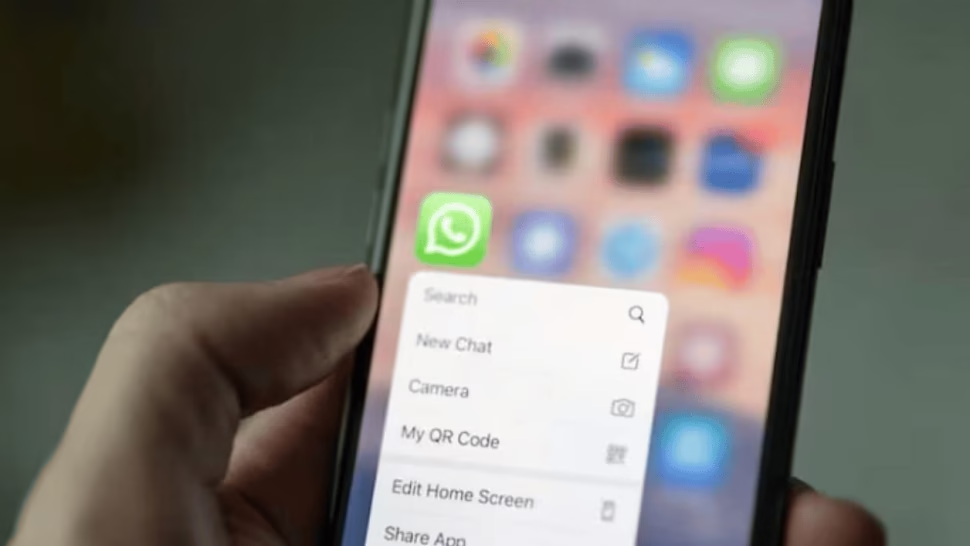
WhatsApp launches usernames to protect phone numbers

New function allows you to chat without sharing a phone number. Gradual deployment in the coming months.

How does the new WhatsApp option work?

WhatsApp announced the arrival of usernames, a feature designed to strengthen privacy. Starting this week, users can reserve a name, although the tool will be rolled out gradually over the coming months.

The mechanics are simple: instead of sharing the phone number, a username is given. This prevents the number from being exposed when starting a conversation. The company recommends using this option in situations such as events, interaction with neighbors or groups where not all the members are known.

For example, a parent can join their child’s sports team chat without revealing their number to the entire group. If someone wants to contact you on WhatsApp, just give them the username.

Booking step by step

To reserve a username, the user must have the most recent version of the application. Then follow this route:

  • Enter “Settings” from WhatsApp.
  • Click on “Account”.
  • The “Username” option will appear. Choose the one you want to recognize you.
  • When you click “Save”, the app will indicate if it is available. If it is, it is reserved. If not, he will ask to find another one.

The company noted that users will receive an in-app notification when usernames are available in their region. The feature will be gradually enabled in different countries.

Continue reading