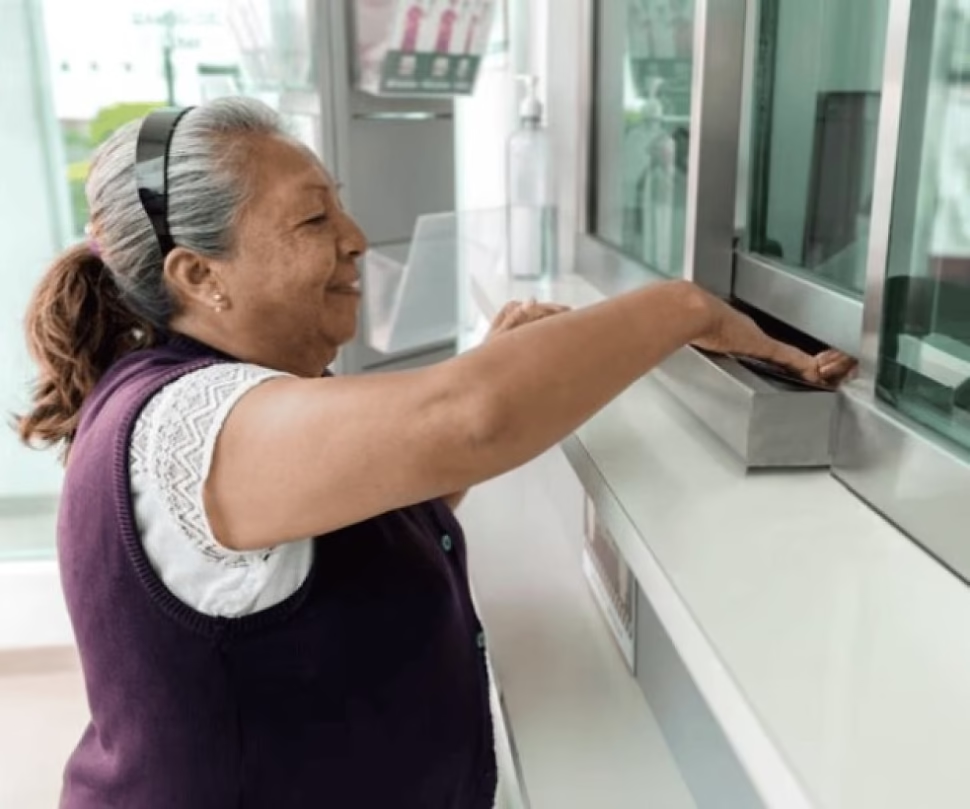
You lost your Welfare card Here is the bureaucratic circus to collect

Find out how to claim your money without a card in a process that seems designed to test your patience.

The great spectacle of charging without a card

Ah, the Government of Mexico, always so considerate of its citizens, has decided to distribute the bimonthly bread (also known as Welfare Payment) for July-August. But surprise! If you lost your card or some kind stranger decided to “adopt” it, prepare for a trip full of paperwork, paperwork and lines that would make even the most patient cry.

Step 1: Call and wait (like in a low-budget call center)

The first thing is to report the loss by calling 800 900 2000, a number that, according to rumors, responds between missed calls and 90s on-hold music. Once you manage to contact a human being (or a sleepy bot), you will receive a folio. What is it for? Well, it’s your golden pass to prove that you’re not making up a financial tragedy.

RelatedThe Women’s Wellbeing Pension card arrives, this you should know

Ironic note: This folio is more valuable than your lost card, so save it like it’s the last piece of gum in the apocalypse.

Step 2: The banking odyssey

With your folio in hand (or on the screen, because this is the 21st century), go to a Banco del Bienestar branch. Hours: 8:00 a.m. to 4:30 p.m., because clearly the banks don’t understand that people work. Take:

  • Official identification: INE, passport or, if you are creative, a municipal certificate signed by your uncle.
  • Beneficiary number: That little piece of paper you kept in the “important documents” drawer (next to the VHS manual).

If you can get there before they close (and without getting hit by a car), you can withdraw your cash. Congratulations! You have passed the first level of the bureaucratic labyrinth.

The payment schedule: Because your last name defines your destiny

To avoid crowds (or to add excitement to the matter), payments are made by letters of the last name. So if your last name starts with “Z”, prepare to wait like in a restaurant without a reservation. Check the official calendar, because arriving on the wrong day is like going to a party a day late.

Advice that no one asked for but everyone needs

  • Don’t share your data: Unless you want to give your money to an anonymous “advisor.”
  • Bring everything in original and copy: Because banks love paper (and making you photocopy it at the last minute).
  • Be patient: This is not Amazon Prime; your new card will arrive… someday.

The Secretariat of Welfare, in an unprecedented act of heroism, promises that no one will be left without their money. Although, of course, after jumping these obstacles, one wonders if the effort is worth it.

Ready for the challenge? Share this gem of a procedure with your friends and find out who has had the worst luck with bureaucracy. And if you want more tips for navigating the wonderful world of social programs, explore our related content!
The US sanctions two Mexicans for fuel smuggling linked to the CJNG

New US sanctions target a tax huachicol network linked to the CJNG.

US sanctions against huachicol network

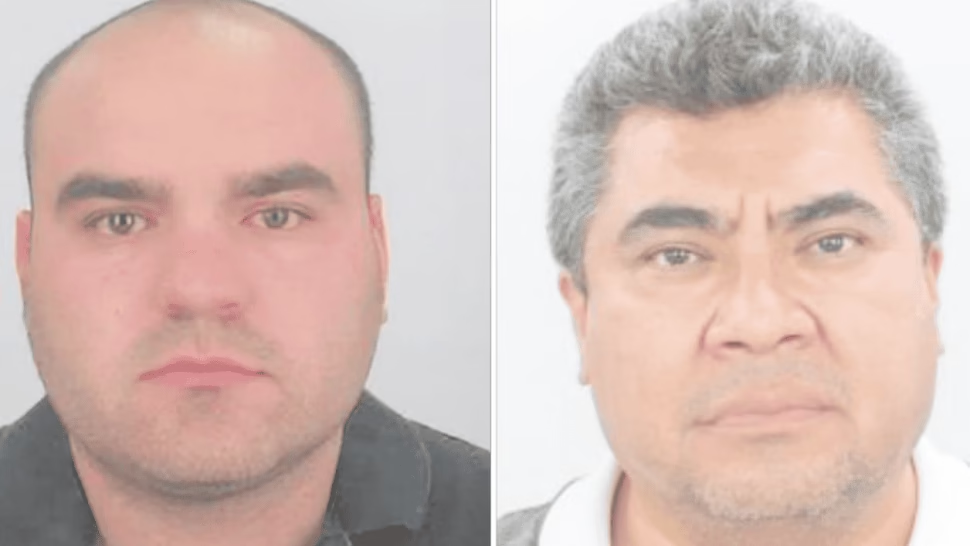
The United States Department of the Treasury sanctioned two Mexicans and their nine companies for their links to a fuel smuggling network of the Jalisco Nueva Generación Cartel (CJNG). They are Oscar Guillermo Juraidini Silva, 41 years old, and J. Refugio Ruiz Villagómez, 65.

The practice known as huachicol fiscal consists of introducing refined fuel into Mexico by evading taxes, declaring it as another commodity. The US alert indicates that in the last year, 160 suspicious activities worth 7 billion dollars were recorded.

Network details

Juraidini Silva is described as “a key operator” and “the mastermind” behind the cartel’s financial operations. He is accused of creating shell companies and falsifying customs documents to traffic fuel and evade IEPS, generating tens of millions of dollars annually for the organization. Ruiz Villagómez, for his part, “is known for smuggling fuel from the United States to Mexico,” paying fees to the cartels to clear customs.

“Mexican cartels, including Jalisco Nueva Generación and Sinaloa, use Mexican companies with permits to buy fuel from sellers in the United States, who take advantage of their relationships with refineries to divert it to networks of ghost companies,” the alert describes.

The sanctions immobilize all assets, accounts and interests under US jurisdiction of these people and companies such as Centro Cambiario La Peseta, OJ Living Trust and Jomadi Logistics & Cargo. The latter was already investigated in 2020 for violating sanctions against PDVSA.

Impact on the economy

The network operates mainly in customs in Reynosa, Matamoros and Nuevo Laredo. FinCEN, the US financial watchdog network, issued guidelines for banks to identify suspicious activity. US companies “launder illegal funds” by purchasing luxury cars, jewelry and real estate. In Mexico, cartels use that money for cash payments to “political campaigns and media outlets,” according to the document.

“Institutions have to be vigilant, since the cartels, their huachicoleros and financiers adapt to the efforts of the law and regulators,” the document states.

After the arrest of the Jensen family in April 2025, smuggling of Mexican crude oil into the United States decreased. But the reverse flow continues: FinCEN has received 160 reports of suspicious activities for $7 billion originating in Texas and Florida.

Continue reading

National Guard: 125 thousand elements and decrease in homicides

Sheinbaum led the National Guard's seventh anniversary with deployment numbers and results.

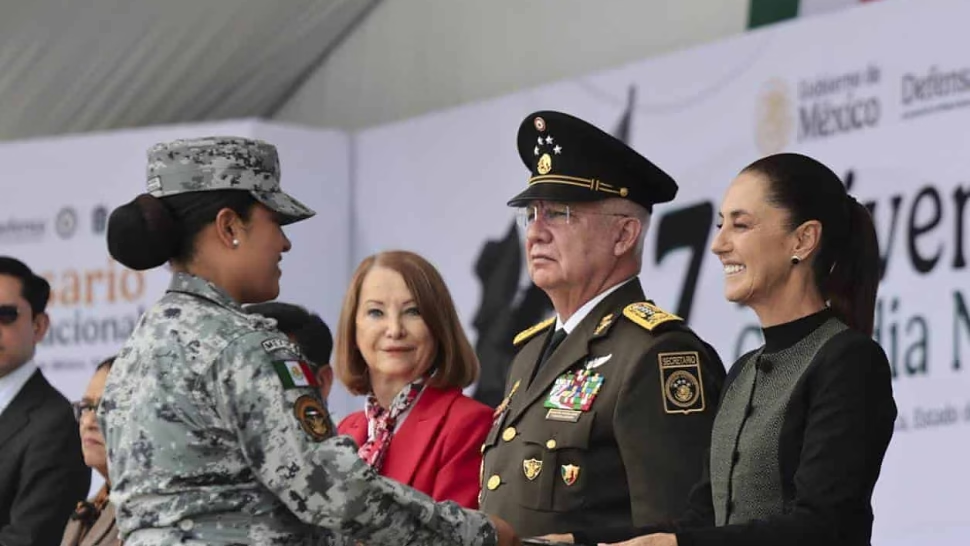
In Huehuetoca, State of Mexico, President Claudia Sheinbaum led the ceremony for the seventh anniversary of the National Guard, created in 2019.

Sheinbaum reported that the corporation has 125 thousand elements deployed in 53 coordinations and 590 barracks built by the Army. He highlighted that intentional homicide decreased 46% since October 2024, as part of the National Security Strategy.

Operating figures

Commander Guillermo Briseño Lobera explained that in the current six-year term, 45 thousand people have been arrested for crimes, 23 thousand firearms have been seized, more than 213 tons of drugs have been seized and two thousand clandestine laboratories have been dismantled.

He announced that Sedena is promoting a plan to reach 170,000 troops and 886 facilities by the end of the six-year term.

The president presented decorations to the personnel outstanding in security, training and confiscations, with special recognition to the elements of the Teotihuacan archaeological zone for their performance last April.

Continue reading

Mother of ABC Daycare victim demands justice from FGR

Victim's mother denies that the case is closed and demands that FGR resume investigations.

Juanita Luna, mother of one of the victims of the ABC Daycare, responded to the statements of President Claudia Sheinbaum. He clarified that the judicial file has never been closed and demanded that the Attorney General’s Office (FGR) continue the investigations.

The recent resolution of the Supreme Court of Justice of the Nation (SCJN) did not order reopening the case, Luna said. What it ruled is that crimes committed against minors are imprescriptible. Therefore, those responsible for manslaughter still need to be prosecuted.

Gabriel Alvarado Serrano, legal representative of the Manos Unidas por Nuestros Niño collective, explained that this judicial criterion strengthens the demand for justice. It marks a historical precedent for Mexican children, he noted.

Now it is up to the FGR to accelerate the current investigation files, the lawyer warned. If new evidence emerges, other public servants who were not originally included may be called to account regardless of the time that has passed.

During her morning conference, President Sheinbaum stated that the Prosecutor’s Office must reach the ultimate consequences in this case. He promised to deliver all the information required by the IMSS.

Sheinbaum also pointed out that the surrogate daycare model implemented during Felipe Calderón’s six-year term was marked by corruption, nepotism and serious security deficiencies. These failures led to the tragedy that claimed the lives of 49 minors in 2009.

Continue reading