Panama recovers full control of the trans-isthmus oil pipeline

Panama will buy 41% of Petroterminal without using public funds or increasing debt.

The Government of Panama began the process to acquire 41% of the shares of Petroterminal de Panama (PTP) that still belong to the American group NIC Holding Corp. The operation will give the State full control of the company, owner of the main trans-isthmus oil pipeline in the country.

Without Treasury resources

The purchase will be financed with Petroterminal’s own cash flows. Thus, funds from the National Treasury will not be used nor will public debt increase. Authorities did not reveal the amount or schedule.

RelatedThe United States carries out a military operation and captures Maduro in Venezuela

A key infrastructure

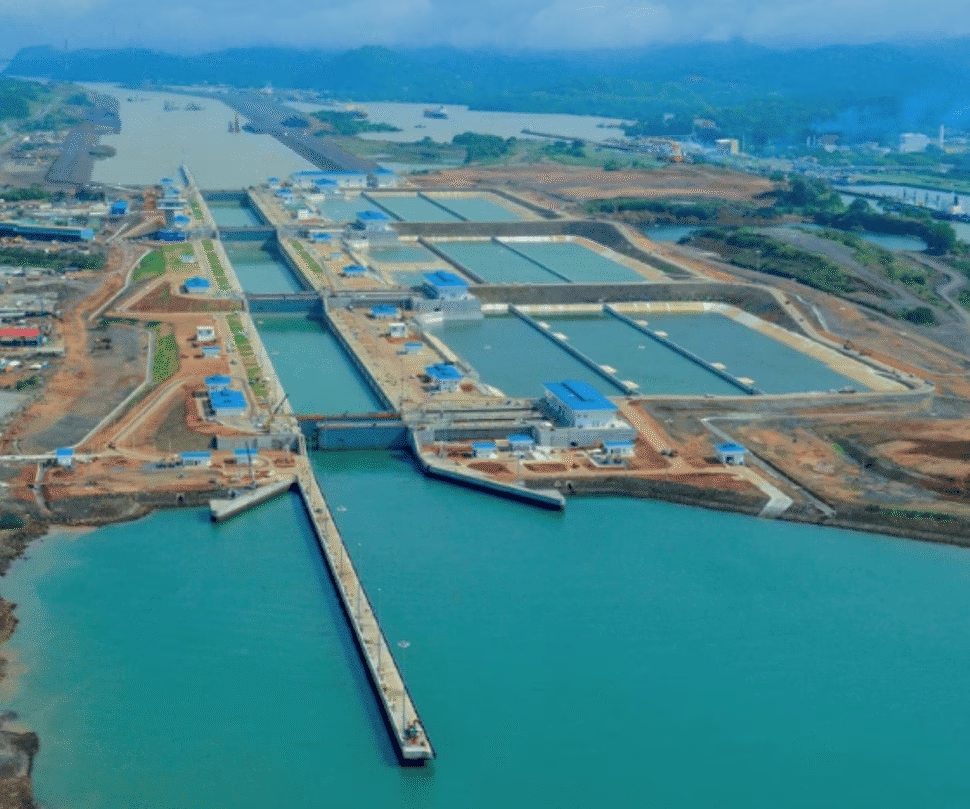
Petroterminal operates a 131-kilometer pipeline that connects Chiriquí Grande (Caribbean) with Charco Azul (Pacific). It allows hydrocarbons to be transported between both oceans without using the Panama Canal.

Strategic impact

The Government assured that the acquisition will strengthen Panama as a regional logistics and energy center. It will guarantee the continuity of operations, preserve jobs and enhance the country’s capacity to develop the sector.

5.5 earthquake in Peru leaves six dead and more than 30 injured

Tremor in Junín causes damage to homes and affects historical heritage.

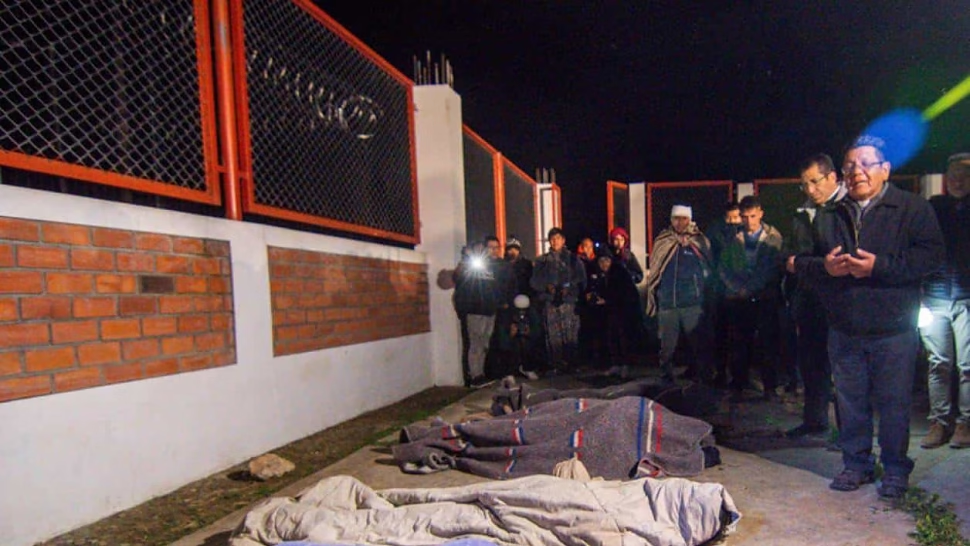
The number of deaths from the 5.5 magnitude earthquake that shook the Andean region of Junín rose to six, with more than 30 injured and 300 victims, according to Peruvian authorities.

The earthquake occurred on Saturday at 9:24 p.m. local time, with the epicenter two kilometers from the city of Sicaya, in the province of Huancayo. The United States Geological Survey (USGS) reported a depth of 10 kilometers.

Impact in the Junín region

After arriving in the Chongos Bajo area, one of the most affected, the president of the Council of Ministers, Luis Enrique Arroyo, offered a preliminary assessment: six dead and 32 injured, of which only six remain hospitalized. He added that 48 homes were destroyed and more than 250 were damaged. He warned that the evaluation is preliminary because there are surrounding districts with damage.

The head of Civil Defense, Luis Vásquez, pointed out that the type of adobe constructions in the area increased the impact. Rescue teams and health brigades continue with the search work and care for the injured, reported the National Institute of Civil Defense (INDECI).

The earthquake also damaged the historic structure of the church and old convent of Santiago de León in Chongos Bajo, built in 1565 and declared Monumental Heritage of the Nation. The tower that supported one of the crosses and the clock collapsed.

The interim president of Peru, José María Balcázar, assured that help has been deployed and that action is being taken quickly. He announced that he will travel to the area, while the head of the Council of Ministers, together with the Minister of Defense, tours the affected area.

The governor of Junín, Zósimo Cárdenas, identified five of the victims: an 18-year-old young man and four older adults between 69 and 73 years old. The age of the sixth deceased was not released.

Local images show distraught relatives in Chongos Bajo, where residents remain covered in blankets in front of their severely damaged homes. In the agricultural and livestock area, animals are also observed under the rubble.

“My home has been destroyed,” Hermenegilda Guamalato commented to radio Exitosa. She asked for help to find a place to stay with her three children in Huayucachi, another affected town.

The mayor of that town, Miller Vásquez, said that at least 50 homes “have been left habitable” and that blankets, tents and supplies are distributed.

Peru is in the Pacific Ring of Fire, so earthquakes are frequent. In 2007, a 7.9 earthquake in Pisco left almost 600 dead.

Continue reading

Tropical Storm Fausto forms in the Pacific without risk for Mexico

Fausto is moving safely west-northwest while another depression threatens the Gulf of Florida.

Fausto, first active system in the Pacific

Tropical Storm Fausto originated on Sunday in the Pacific Ocean, about 1,200 kilometers south-southwest of the southern tip of Baja California, the United States National Hurricane Center reported. With sustained winds of 65 km/h, it is moving towards the west-northwest at 20 km/h. Continued strengthening is expected and could become a hurricane Monday night. There are no coastal advisories or alerts in force.

For its part, Tropical Storm Elida, also in the eastern Pacific, continues to weaken. It is located 1,635 kilometers west of Baja California Sur, with winds of 95 km/h. Forecasters expect it to degrade to a remaining low in a couple of days.

Another depression threatens the Florida coast

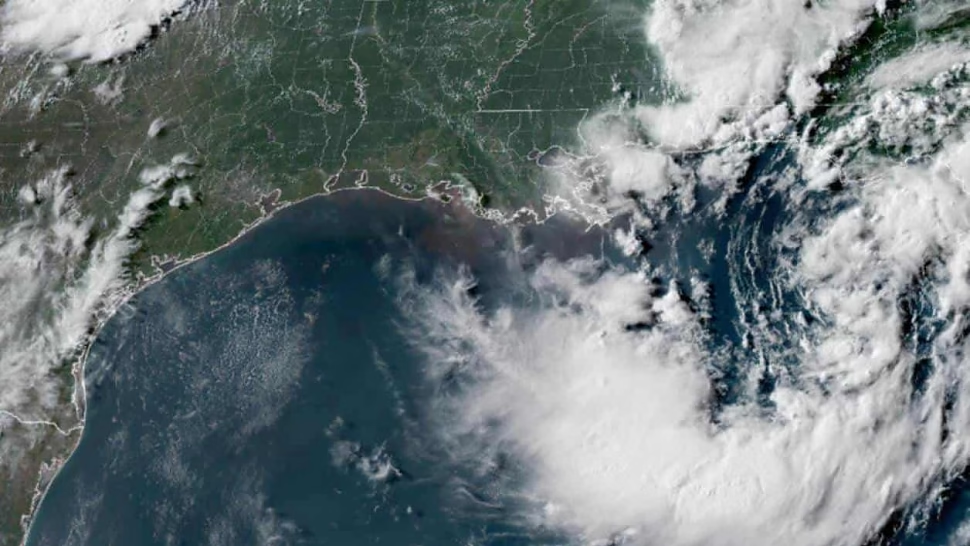
In the Gulf of Mexico, a tropical depression south-southeast of the Florida Panhandle could strengthen to a tropical storm early in the week. Authorities issued a storm watch for parts of the Panhandle to the Alabama border. The slow-moving system could approach the northern Gulf Coast in the coming days.

Regardless of whether it gains a name, it will bring heavy rain to coastal areas of northern Florida, Alabama, Louisiana and possibly eastern Texas. The depression was nearly stationary on Sunday, about 310 kilometers south-southeast of Panama City, Florida, with maximum winds of 45 km/h.

Civil protection authorities in Mexico maintain surveillance over Fausto and Elida, although so far they do not represent a danger to the national territory.

Continue reading

Tension between the United States and Iran escalates with new casualties

New US military death and bombings raise tension in the Middle East.

New hostilities in the Middle East

The United States reported the death of another soldier in Iraq during the controlled detonation of an Iranian drone. The number of American soldiers killed since the start of the war amounts to 17.

On Sunday, Washington launched more bombings against the Iranian Revolutionary Guard, in response to Friday’s attack in Jordan that left victims. The US Central Command reported that it hit coastal surveillance facilities, air defense and missile and drone warehouses, seeking to degrade Iran’s ability to control the Strait of Hormuz.

Iran reported that the bombings hit a nuclear power plant construction site in Darkhovin, although the IAEA said the site was in the initial stages and without nuclear material.

In parallel, Iran launched missiles towards Jordan, which were shot down by Jordanian air defenses. The Israeli army warned that these projectiles could reach its territory, activating alerts in Eilat.

“We are prepared to immediately resume combat,” said the Israeli Chief of Staff, Lieutenant General Eyal Zamir.

Attacks on civil infrastructure

Kuwait reported a second attack on a power and desalination plant, vital to the supply of drinking water. The Gulf Cooperation Council accused Iran of war crimes for damaging civilian facilities.

The Strait of Hormuz, a key route for global oil, has seen maritime traffic fall drastically: just eight transits on Saturday, compared to a daily average of 140 before the conflict. The United States imposed a naval blockade on Iranian ports and has redirected six ships.

Iranian Supreme Leader Mokhtaba Khamenei warned of “unforgettable lessons” if attacks continue. Iran reported at least 50 deaths and 517 injuries in the recent bombings. Negotiations for a permanent ceasefire, initially agreed for 60 days, are stalled.

Continue reading