Patient suffers seizures after being subdued by IMSS guards

A patient faces aggression when requesting treatment at the IMSS; The viral video sparks outrage.

An act of injustice that cannot go unpunished

Imagine having to fight for something as basic as your health, only to end up being a victim of violence. This was what a patient experienced at the General Hospital of Zone No. 1 of the IMSS in Villa de Álvarez, Colima, when he demanded the medication that his doctor had prescribed. What began as a legitimate claim ended in a heartbreaking scene: four security guards subdued the man, causing him to convulse in the midst of the struggle.

A system that fails those who need it most

The patient, a man of approximately 50 years old, arrived at the Pharmacy area after waiting two hours, only to be met with the refusal of an employee. “It is my right to have my prescription filled,” he insisted, recording the interaction. The staff’s response was to escalate the situation by calling security, rather than finding a solution.

RelatedIMSS hospital inaugurated in Chiapas for one million beneficiaries

Witnesses reported that the guards acted with excessive force: “They hit him on the head with a red thermos,” denounced Kenia Figueroa, who shared the video on networks. Despite the patient’s cries for help, the assault continued until he began to convulse. Only then did a doctor intervene.

The medication in question was pregabalin, an essential drug for treating seizures and neuropathic pain. The IMSS argued that it had already been delivered days before, but does this justify the violence? The institution promised to investigate, but the indignation on networks is palpable.

A call to action: health is a right, not a privilege

This case is not just about a patient, but about a system that should protect, not harm. If this situation teaches us anything, it is that we cannot normalize negligence or institutional violence. Share this story, demand transparency and join the conversation so that events like these are not repeated.

What do you think? Spread this content to make visible the importance of decent treatment in health services. Your voice counts!

Explore more stories like this and stay informed about patients’ rights. Together we can drive change.

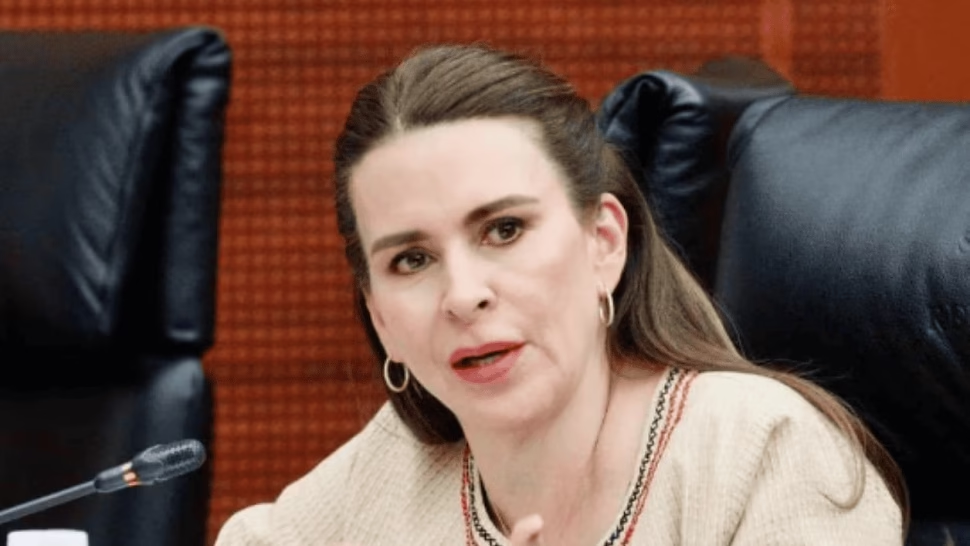
Kenia López Rabadán criticizes the INE for not stopping early campaigns

The PAN deputy demands that the electoral authority act without subordination in the face of anticipated acts.

The president of the Board of Directors of the Chamber of Deputies, Kenia López Rabadán (PAN), questioned the decision of the National Electoral Institute (INE) to remove the debate on the regulation of early campaigns from its agenda. He considered that the authority must act independently to stop these acts, especially those initiated by Morena in its internal process of selecting candidates for governors for 2027.

“The electoral authority must make an objective, clear and evident analysis, and without any type of subordination to anything. Hopefully the electoral authority can soon make a clear definition so that there are no anticipated campaign events,” he declared at a press conference.

López Rabadán warned that processes initiated outside the electoral calendar, even if they intend to be integrated later, are illegal and must be sanctioned. He insisted that pre-campaigns without legal basis generate bad practice for the country.

Position on Councilor Montaño’s project

The legislator also rejected the project of “General Guidelines to regulate and supervise the processes, acts, activities and propaganda carried out in political processes” promoted by counselor Jorge Montaño. He pointed out that any modification to the law should have been made 90 days before the start of the electoral process, and not now.

“If they want to modify the law, they had up to 90 days before the electoral process began to modify the electoral rules. If we get used to the law being violated and no one saying anything, it will be terrible for the country,” he stated.

The PAN member’s call comes amid Morena’s progress in defining its candidates for 2027, which has raised alerts about possible early acts of proselytism. The INE, for its part, has not issued an official position after removing the issue from the agenda.

Continue reading

Law against feminicide: PRI sees it as insufficient, Morena prioritizes it

The presidential initiative against feminicide divides opinions in the Senate: PRI questions impunity, PAN asks for analysis and Morena prioritizes it.

Proposal and reactions

President Claudia Sheinbaum’s initiative to create the General Law to Prevent, Investigate and Punish Femicide generated divided positions in the Senate. Morena will seek to rule it as a priority at the beginning of the next period in September, while the PRI and the PAN expressed reservations.

PRI: the problem is impunity

PRI senator Carolina Viggiano Austria maintained that feminicide cannot be resolved with new laws or increased penalties. “You can put 100 years or 70 years in prison, but if you never manage to investigate or sentence those responsible, what you put is simply propaganda,” he said.

He pointed out that the real reform is in the local prosecutor’s offices: insufficient, poorly paid and unprepared public ministries. He proposed strengthening research, technology and specialized personnel capacities with a gender perspective.

PAN: in-depth review

Mayuli Latifa Martínez, vice coordinator of the PAN, asked to read the initiative before setting a position. “This heinous crime against women should unify us,” she said. But he warned that it is not enough to create standards: prevention and protection actions are required.

He highlighted that before feminicide there is a chain of attacks—familial, psychological, economic—that many victims do not report due to lack of prompt justice and economic dependence. He demanded a detailed analysis of the obligations for the states.

Morena: approval required

Morenoist Verónica Camino Farjat celebrated that the proposal reached the Senate first. He explained that there are currently differences between states in the classification and sanctions of feminicide, which benefits perpetrators in cases that cross borders. “What we are looking for is that the same classification exists in all states,” he indicated.

Camino Farjat announced that the commissions could begin the analysis immediately, even before the regular period, to have the opinion ready in the first week of September. The Morena bench considers the initiative a priority to protect women’s rights.

Continue reading

They dismantle two clandestine laboratories in Michoacán and Nayarit

The Navy located and disabled two laboratories with the capacity to produce 17.5 tons per month.

The Secretary of the Navy (Semar) reported that in recent days, naval personnel located and disabled two clandestine laboratories in Michoacán and Nayarit. In the operations, 11 reactors of approximately 30 thousand liters were seized, as well as 2.5 tons of chemical precursors and specialized infrastructure for the production of illicit substances.

Details of the operation

According to a statement from the agency, both facilities had a production capacity of more than 17.5 tons per month. The estimated value in the illicit market reaches 412 million dollars. Semar stated that this seizure represents resources that stopped strengthening financial structures of criminal organizations.

The laboratories were identified through naval intelligence work, aerial and ground surveillance, operational reconnaissance and coordinated actions between security authorities.

Semar highlighted that under the current administration it has located and disabled a total of 75 clandestine laboratories. This is equivalent to an economic impact for organized crime of 20 thousand 186 million 608 thousand 766 Mexican pesos.

The agency assured that it will continue with these tasks as part of the National Security Strategy. Just on July 14, the Secretary of Security and Citizen Protection, Omar García Harfuch, reported that from October to June the Security Cabinet has dismantled 2,627 clandestine laboratories and methamphetamine concentration areas. In addition, it reported 498.98 tons of drugs seized, including 5 million 546 thousand fentanyl pills.

Continue reading