OPLEs warn of electoral chaos due to possible disappearance

Local bodies warn of chaos in the elections if its disappearance in the reform is approved. They defend their crucial work for democratic stability.

A Cry in the Night: The Battle for Mexican Democracy

In the halls of power, where the fate of the nation is decided, an epic battle is being fought at this very moment. The presidents of the Local Electoral Public Bodies, those silent guardians of the popular will, rise with the force of a hurricane to defend their own existence. Their world, a fundamental pillar of stability, hangs by a thread in the face of the overwhelming shadow of an electoral reform that threatens to erase them from the map forever. The Congress of the Union is the battlefield, and the future of the polls is the loot.

In a forum full of tension and significance, titled “Democratic Strengthening and the Development of Electoral Processes from Local Responsibility,” they issued a warning that echoed in the ears of legislators: its disappearance is not a simple administrative adjustment, it is the sentence of absolute electoral chaos that would plunge Mexico into uncertainty. Before the attentive gaze of deputies, the voice of the head of the Electoral Institute of Mexico City, Patricia Avendaño, rose like a banner of conviction. With a passion that electrified the atmosphere, he argued that the OPLEs have been the architects of stability and the unwavering guarantors of legality in every corner of the country.

RelatedINE and OPLES present proposals for electoral reform

“We are not defending a position, we are defending what we believe in, we defend principles,” he declared with an emotion that moved even the stones. “We believe in these guiding principles that were given with our constitution when this nation was formed, we believe in federalism, we believe in effective suffrage, we believe in objectivity and legality and that is what we defend from each of our trenches.” Each word was an oath, a call to arms in defense of the very foundations of the country.

The Retaining Wall: Functions that Define a Country

But what secrets do these institutions guard? Why is its existence so crucial? The response came from the hand of Paula Ramírez Höhne, President of the Electoral Institute of Jalisco, who with the precision of a surgeon dismantled any argument about duplication of functions with the National Electoral Institute (INE). He revealed that their work is complementary and coordinated, a perfect symbiosis to face the colossal magnitude of the elections. “They are necessary because the multitude of local positions makes a centralized organization materially impossible,” he stated, highlighting that they are proven institutions, beacons of innovation that have navigated waters where the Federation itself has faltered, especially in sensitive and advanced matters such as gender parity, the inclusion of indigenous peoples, the recognition of migrants and the avant-garde technological.

In a final twist that revealed the complexity of her work, Blanca Yassahara Cruz García, president of the OPLE of Puebla, detailed in detail the functions that support the local democratic architecture. From the registration of candidacies, that founding moment where political dreams begin, to the meticulous supervision of each stage of the electoral process. Their role as electoral official for acts of a legal nature, the sacred counting of each vote and the strict monitoring of regulatory compliance in their state, are the threads with which they weave the fabric of justice at the polls. Its possible disappearance is not just the elimination of an organism; It is the dismantling of a complete ecosystem of guarantees and balances.

The fate of Mexican democracy is currently being debated. The choice is clear: strengthen the system from its local roots or risk a future of uncertainty and disorder. This is a battle for the very essence of citizen representation. Share this crucial information on your social networks and help spread the word! Explore more analysis on the future of democratic institutions on our portal.

Merlin Duck already has a commemorative National Lottery ticket

Merlin the duck, symbol of the 2026 World Cup, immortalized on a National Lottery ticket.

The National Lottery presented the commemorative ticket of the Superior Draw No. 2891 with the image of the Merlin duck, the bird that became a symbol of Mexican culture during the 2026 World Cup celebrations. The head of the organization, Olivia Salomón, unveiled the design together with the owner of the duck, Karla Ivette Gómez López, and her children Cristian and Carlos Gómez.

The bill shows Merlin, a two-year-old Peking duck, with his characteristic Mexican National Team shirt and white plumage. The institution explained that the image seeks to represent collective memory and national identity.

“Merlin ended up representing something much bigger: the joy of a people and that nearby Mexico that conquered the heart of the world,” said Olivia Salomón.

Merlin went viral when he was filmed wearing his t-shirt while accompanying his family to sell water on the streets of the capital. Its popularity reached President Claudia Sheinbaum, who recognized the bird. In addition, the duck is already a registered trademark: on June 26, its owner received the certificate from the Mexican Institute of Industrial Property (IMPI) and the Ministry of Economy.

“Merlin never conquered people because he was a duck, he conquered them because there was always a Mexican family behind him,” added Salomón, who paid tribute to Karla Ivette for representing many working women.

Raffle details

The Superior Draw No. 2891 will be held on Friday, July 24, 2026. 2.4 million pieces went on sale, with a Grand Prize of 17 million pesos in two series and a distributable bag of 51 million pesos in prizes.

Karla Ivette thanked the affection and highlighted that this tribute represents all the working families in Mexico who seek daily sustenance.

Continue reading

Mexico recovers 3,716 archaeological and historical pieces in 21 months

In less than two years, Mexico has repatriated 3,716 pieces, surpassing previous efforts.

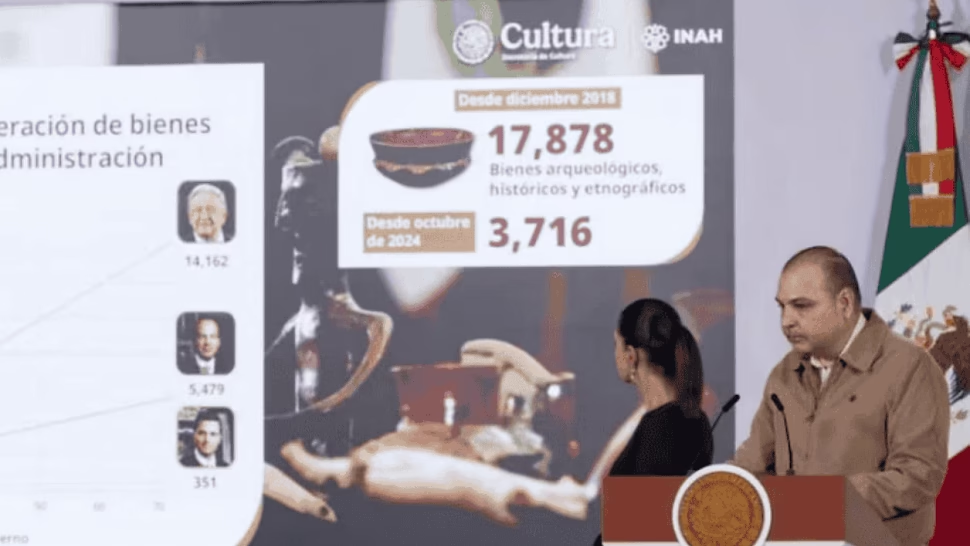
The National Institute of Anthropology and History (INAH) reported the recovery of 3,716 archaeological and historical assets in one year and nine months of the current administration. This was reported by its director, Joel Omar Vázquez Herrera, during the morning conference at the National Palace.

The official attributed the achievement to the coordinated work between the government of Mexico, the Ministry of Culture and the Ministry of Foreign Affairs. The strategy promoted by President Claudia Sheinbaum has strengthened dialogue with other countries to return pieces that are part of the national memory and identity.

“We are working hard to recover and repatriate the memory, the identity of the people of Mexico based on permanent dialogue with different governments of the world,” said Vázquez Herrera.

Figures that make a difference

The current numbers contrast with previous administrations. During the six-year term of Enrique Peña Nieto, 351 pieces were recovered; the current figure is 10 times higher. It also represents 68% of what was obtained during the Felipe Calderón government, when 5,479 assets were returned. During the six-year term of Andrés Manuel López Obrador there were 14,162, adding since the beginning of the Fourth Transformation a total of 17,878 repatriated objects.

The United States is the main country of origin, with 3,369 recovered pieces. They are followed by Italy (174), Canada (133), France (19) and Spain (7).

Emblematic pieces

Among the most relevant assets is a skull covered with turquoise mosaics, of Mixtec origin, repatriated from the Netherlands and already on display in Villa de Tututepec, Oaxaca. Also a Mayan carved panel from Yaxchilán, Chiapas, depicting the ruler Pájaro Jaguar, recovered in New York. Also, a Mexican basalt sculpture, also from New York.

In historical heritage, the “Manual of ceremonies of the Province of the Holy Gospel of Mexico” was recovered, a Franciscan document printed at the beginning of the 18th century, secured by the Federal Police of Argentina and returned to Mexico.

“We are going to continue with this effort and determination to recover the memory, identity and belonging of the ancient peoples that give meaning to contemporary generations,” stated the director of INAH.

Continue reading

Sheinbaum announces telephone alert for El Niño rains

Federal government activates telephone alert due to intense rains due to El Niño. Coordination with 32 states.

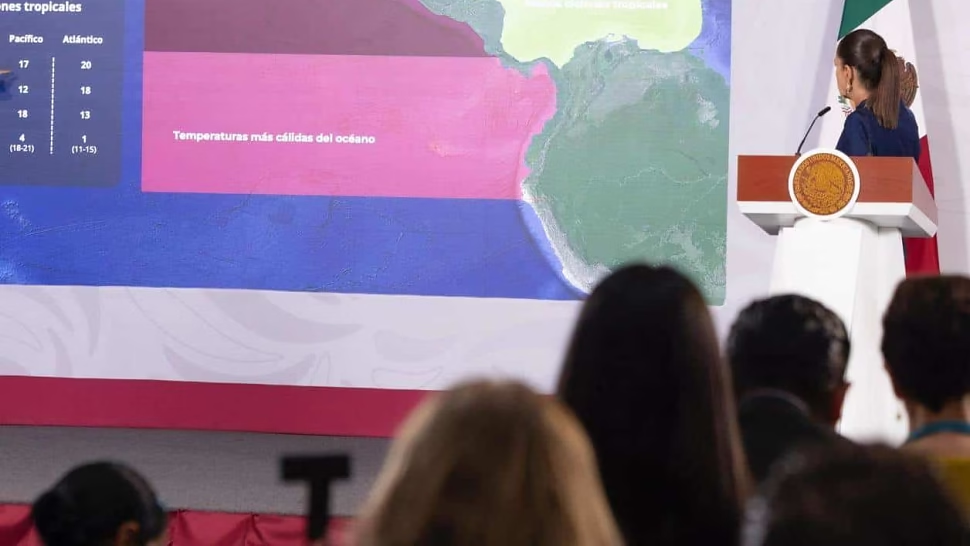
President Claudia Sheinbaum reported that in approximately two months a telephone alert system will be ready to notify the population about meteorological phenomena. The measure is part of the preventive actions against the intense rains that the El Niño phenomenon will bring.

“The objective is that in two months or so we will have the telephone alert ready so that all people, all Mexicans, can be informed,” he stated during the morning conference.

The system is developed in coordination with the Digital Transformation and Telecommunications Agency, the National Civil Protection Coordination and the National Meteorological Service.

Risks of the climate phenomenon

Fabián Vázquez Romaña, coordinator of the SMN, explained that El Niño—an interaction between atmospheric and oceanic temperatures that repeats every two to seven years—has a 63% probability of being very intense. The highest peak is expected to occur in December of this year and continue until 2025.

The consequences include heavier rain in the north of the country towards the end of the year, a greater probability of intense cyclones and possible drought in the center during the next year. “Whether the cyclones are going to reach the coast or not, we cannot know until a few days before,” he warned.

Actions in territory

Laura Velázquez, head of Civil Protection, explained that Command Posts are installed in the 17 coastal states. So far there are 11 formed; the rest will be completed next week. In addition, river and dam desilting, channel opening and barrier placement are carried out.

The agency maintains updated maps, monitors shelters and deploys teams throughout the country to serve the population. Coordination includes the 32 states, legal and expanded cabinets, and the National Water Commission.

Continue reading