OpenAI wants to buy Chrome and Google is not happy

What would happen if AI took over the world's most used browser? OpenAI's masterstroke could change the internet.

The circus of monopolies and browsers

Ah, Google, that technology giant we all love to hate, could be forced to part with its beloved Chrome. Yes, the same browser that you accidentally installed when downloading anything on the internet. Judges in the United States, in a burst of poetic justice, have declared that the company is a monopoly (surprise!). And as punishment, they could force her to sell her flagship browser. What’s next? That Microsoft has to give away Windows?

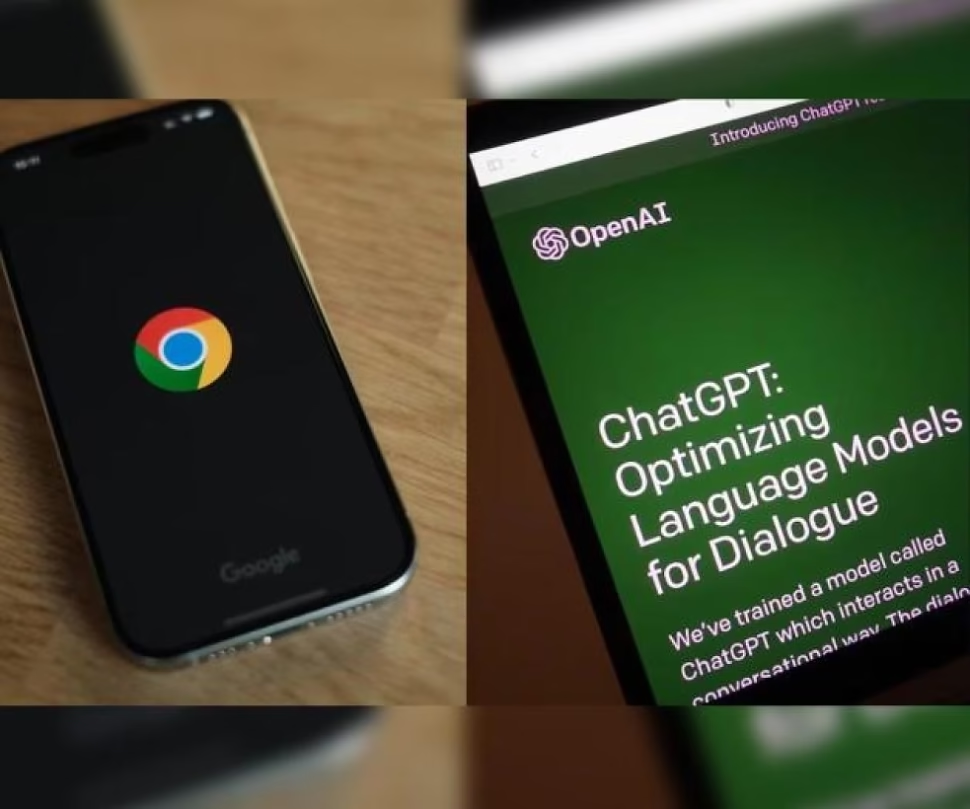
But here comes the comical twist: OpenAI, the same company behind ChatGPT, is already rubbing its hands like a cartoon villain. Nick Turley, ChatGPT’s product manager, enthusiastically stated that they would be interested in purchasing Chrome. Of course, because what better way to dominate the world than to take over the browser that half the planet uses to search for “how to make homemade bread”?

RelatedOpenAI challenges Google with the launch of its Atlas browser

The revenge of the AI

It turns out that OpenAI had already tried to collaborate with Google to integrate its search engine into ChatGPT. But Google, in an act of arrogance worthy of a teenager, said no. Now, with the possibility of buying Chrome, OpenAI could have its sweet revenge. “Oh, don’t you want to collaborate? Well now the browser is mine, baby!” Of course, Turley put it more elegantly: “We would offer a truly incredible experience.” Translation: “We’d have ChatGPT tell you what to look for before you think about it.”

OpenAI had already been working on their own browser, but they admitted that it is not as easy as making a chatbot that writes poems about carrots. So why reinvent the wheel if you can buy it? Chrome already has millions of users, infrastructure and, most importantly, that annoying search bar that always suggests uncomfortable things to you.

If this happens, the landscape of browsers and online searches would change more than Elon Musk’s mood on Twitter. Imagine: instead of Google spying on you, it would be an AI that would decide what results to show you. Better? Worse? Or just weirder?

Google doesn’t want to let go of its toy

Of course, Google isn’t willing to give up Chrome without a fight. Anne Mulholland, vice president of regulatory affairs, released a statement worthy of a Netflix drama: “It would harm American consumers, the economy, and technological leadership.” That is, basically, “if they take Chrome away from us, the country will collapse.” Dramatic, but effective.

Meanwhile, Google will have to wait to see if the judges decide that its punishment is to sell Chrome or simply receive a public scolding. For now, OpenAI is still there, waiting like a child in front of a candy store, ticket in hand.

What’s next? If OpenAI sticks with Chrome, be prepared for your browser to make bad jokes while you search for recipes. And if Google manages to keep it, well, at least we’ll still have those cookies that no one wants but we all accept.

Can you imagine an internet dominated by AI? Share this note and join the debate. Or better yet, explore more content about how technology is changing the world (and sometimes making it more absurd).


How artificial intelligence transforms global security

Motorola Solutions is committed to hybrid models and agentic AI in the transformation of the sector.

Security industry: cloud migration and artificial intelligence

Security is undergoing a profound transformation. The cloud, generative artificial intelligence and video surveillance systems as decision tools are redefining the sector. This was stated by Pedro Simoes, global vice president of video security and analytics at Motorola Solutions.

“The cloud is a very strong trend, but it is not a solution for all sectors,” he explained. Prison facilities, airports and nuclear plants require hybrid models that combine local infrastructure with cloud services. Motorola Solutions is committed to unified platforms.

One of the key advances is agentic artificial intelligence. The company introduced Operator, a platform that integrates video, access controls and sensors in a single interface. The objective: reduce the time between detection and response. “It’s not just identifying. It’s being collaborative in decisions,” said Simoes.

The role of sensors in smart cities

Cameras no longer just record: they are sensors. “Today a camera produces data that can be used to optimize logistics, mobility or business decisions,” he added. Security information extends to multiple applications.

However, the growth of AI poses privacy challenges. Motorola Solutions developed “AI nutrition labels,” documents that detail capabilities and limitations of its models. “We are the first company in the sector to create and use this type of labels,” said Simoes.

Mexico and the 2026 World Cup

Mexico is experiencing a key moment for the 2026 FIFA World Cup. The arrival of millions of visitors is driving investments in technological infrastructure and security in airports, hotels and stadiums. Simoes confirmed collaboration with governments, without revealing details. “Safety is a priority; our responsibility is to develop technology that protects people and infrastructure.”

He recommended organizations think long term: “The decision should not be based only on current problems, but on the challenges of three or five years.” The combination of cloud, generative AI and unified platforms will define the next stage of the sector.

Continue reading

Strawberry Moon: the June full moon will arrive on the 29th

The Strawberry Moon will light up the night sky on June 29. Know its origin and other names.

The night sky will offer a notable astronomical event at the end of June. That month’s Full Moon, known as the Strawberry Moon, will reach its maximum splendor on Monday, June 29, according to the specialized portal Star Walk.

When and how to see it?

The full moon will occur exactly at 5:57 in the afternoon, central Mexico time. It will be the first full Moon after the summer solstice, which according to the same source will happen on Sunday, May 21. The satellite will be fully illuminated from June 28 to 30.

The origin of the name

Despite what its nickname suggests, the Moon does not take on a pinkish or reddish hue. The name “Strawberry Moon” comes from the native North American peoples, who named it that way because it coincided with the harvest season for this fruit in various regions of the continent.

In other cultures, this same full moon receives names such as:

  • Moon of Moras
  • Honeymoon
  • Rose Moon
  • Moon of Ripening Berries
  • Garden Moon
  • Green Corn Moon
  • Windy Moon
  • Birth Moon
  • Moon When the Buffalo Bellows

All of these nicknames are linked to natural phenomena typical of the same time of year.

Continue reading

The oldest plague: remains from 5,500 years ago in Siberia

Traces of plague from 5,500 years ago found in teeth of Siberian hunter-gatherers.

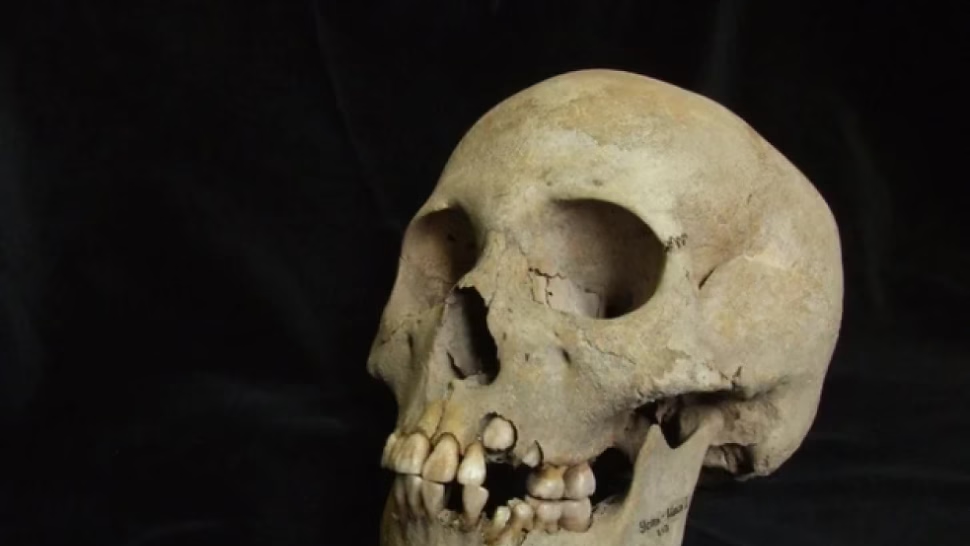
Scientists have identified the earliest evidence of plague known so far: traces of bacterial DNA in the teeth of hunter-gatherers buried near Lake Baikal in Siberia. Carbon dating indicates that the disease caused outbreaks about 5,500 years ago, about 200 years earlier than previously thought.

Finding in Siberia

A team led by geneticist Eske Willerslev of the University of Copenhagen analyzed remains from four cemeteries. They found traces of Yersinia pestis in the teeth of 18 individuals. The dating revealed two episodes of infection.

“To understand our own history, understanding the history of the plague is extremely important,” Willerslev said.

The prehistoric plague spread in stages. According to the authors, it was probably transmitted from marmots—native rodents—when people consumed their raw organs or handled infected skins. It also spread from person to person through coughing or sneezing.

Many of the deceased were children between 8 and 11 years old. Three girls were buried together; two were cousins. An aunt and her nephew were found in another mass grave. “There were people who buried the dead and who knew who they were. It’s a very human element,” said co-author Ruairidh Macleod, an expert in ancient DNA at the University of Oxford.

Implications of the study

The researchers note that children may be at greater risk due to still developing immune systems. The presence of multiple victims suggests that the prehistoric plague caused both isolated cases and outbreaks, said geneticist Aida Andrades Valtueña, from the Max Planck Institute for Evolutionary Anthropology, who was not involved in the study.

This ancient strain evolved long before the bubonic plague responsible for the medieval Black Death. However, there is evidence that earlier plagues were just as serious. The disease not only affected populous cities, but also small nomadic groups.

“Understanding the steps the bacteria took to become the deadly pathogen we know today can provide clues about how pathogens could emerge in the future,” wrote Andrades Valtueña.

The study was published Wednesday in the journal Nature.

Continue reading