
OpenAI wants to buy Chrome and Google is not happy

What would happen if AI took over the world's most used browser? OpenAI's masterstroke could change the internet.

The circus of monopolies and browsers

Ah, Google, that technology giant we all love to hate, could be forced to part with its beloved Chrome. Yes, the same browser that you accidentally installed when downloading anything on the internet. Judges in the United States, in a burst of poetic justice, have declared that the company is a monopoly (surprise!). And as punishment, they could force her to sell her flagship browser. What’s next? That Microsoft has to give away Windows?

But here comes the comical twist: OpenAI, the same company behind ChatGPT, is already rubbing its hands like a cartoon villain. Nick Turley, ChatGPT’s product manager, enthusiastically stated that they would be interested in purchasing Chrome. Of course, because what better way to dominate the world than to take over the browser that half the planet uses to search for “how to make homemade bread”?

RelatedOpenAI challenges Google with the launch of its Atlas browser

The revenge of the AI

It turns out that OpenAI had already tried to collaborate with Google to integrate its search engine into ChatGPT. But Google, in an act of arrogance worthy of a teenager, said no. Now, with the possibility of buying Chrome, OpenAI could have its sweet revenge. “Oh, don’t you want to collaborate? Well now the browser is mine, baby!” Of course, Turley put it more elegantly: “We would offer a truly incredible experience.” Translation: “We’d have ChatGPT tell you what to look for before you think about it.”

OpenAI had already been working on their own browser, but they admitted that it is not as easy as making a chatbot that writes poems about carrots. So why reinvent the wheel if you can buy it? Chrome already has millions of users, infrastructure and, most importantly, that annoying search bar that always suggests uncomfortable things to you.

If this happens, the landscape of browsers and online searches would change more than Elon Musk’s mood on Twitter. Imagine: instead of Google spying on you, it would be an AI that would decide what results to show you. Better? Worse? Or just weirder?

Google doesn’t want to let go of its toy

Of course, Google isn’t willing to give up Chrome without a fight. Anne Mulholland, vice president of regulatory affairs, released a statement worthy of a Netflix drama: “It would harm American consumers, the economy, and technological leadership.” That is, basically, “if they take Chrome away from us, the country will collapse.” Dramatic, but effective.

Meanwhile, Google will have to wait to see if the judges decide that its punishment is to sell Chrome or simply receive a public scolding. For now, OpenAI is still there, waiting like a child in front of a candy store, ticket in hand.

What’s next? If OpenAI sticks with Chrome, be prepared for your browser to make bad jokes while you search for recipes. And if Google manages to keep it, well, at least we’ll still have those cookies that no one wants but we all accept.

Can you imagine an internet dominated by AI? Share this note and join the debate. Or better yet, explore more content about how technology is changing the world (and sometimes making it more absurd).

Satellite Internet, the bet to close the digital divide in Mexico

Mexican geography limits fiber deployment, but low orbit satellites are emerging as an alternative.

Satellite internet as a solution to the digital divide in Mexico

Mountains, jungles and deserts make Mexico one of the countries with the most complex orography in Latin America. Bringing fiber optics to isolated communities implies an investment that is difficult to recover with few users. As a result, one in five households still lack internet access or receive poor service.

Faced with this scenario, low orbit (LEO) satellite internet is emerging as a strategic alternative. “Deploying physical infrastructure in Mexico is expensive due to geography. In many cases, satellite internet represents the most viable option to connect areas where fiber will not reach in the short term,” explains Ernesto Piedras, director of The CIU. Companies like Starlink, with more than 10,300 active satellites, already operate in the country. Since May 2021, it obtained a concession and closed 2024 with 160,631 subscriptions, making Mexico its second Latin American market, only behind Brazil. Starlink has signed contracts with CFE Telecomunicaciones for up to 1,556 million pesos to connect remote communities.

However, cost remains a barrier. While a fiber optic plan costs an average of 544 pesos per month, satellite internet starts at 899 pesos, plus equipment and installation. “Commercially it is still not as viable because it is still more expensive and requires purchasing an antenna whose price remains high,” says Fernando Esquivel, from The CIU. The service makes economic sense when it is shared between communities or companies, and with the support of public policies.

Experts agree that this technology will not replace fiber optics, but will complement it. “Terrestrial services are faster and have lower latency. Satellite communication reaches areas that fixed internet would not reach,” says Hugo Simg, from MediaTek. Deployment also requires regulation and coordination between governments and companies. The race to connect Mexico is no longer only being fought underground, but from space, where a new generation of satellites promises to reduce the digital divide that keeps millions out of the digital world.

Continue reading

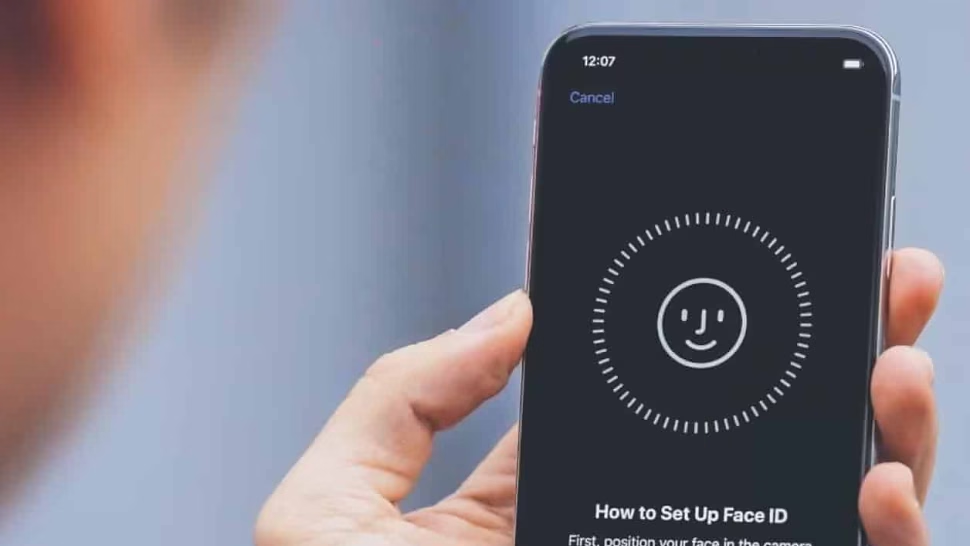
Banks prepare for biometric facial controls in October

Banks claim to be ready for facial biometrics in branches since October.

The main banking institutions in the country claim to be prepared for the new regulations on facial biometric controls when opening accounts, which will come into force next October.

What did the banks declare?

Marcos Ramírez, general director of Grupo Financiero Banorte, pointed out that the institution has made progress to reinforce the identification and security of its users. “We are in time and form with everything established by law and a little ahead, with the prudential limits of the law,” he indicated.

These measures will strengthen control over customer identification. Since 2018, by regulation, fingerprint biometrics are already required to open accounts.

Implementation details

On July 1, the National Banking and Securities Commission (CNBV) incorporated facial biometrics into the regulation for multiple banking in customer identification and authentication. Institutions that opt ​​for this mechanism must comply with technical, operational and security requirements.

Continue reading

AI detects breast cancer with 90% accuracy

An autonomous model analyzes thermographs and classifies tissues without human intervention.

An artificial intelligence model developed by Raúl Castro Ortega, a researcher at the Polytechnic University of Tulancingo, manages to identify breast cancer with an accuracy of 90%. The results were presented during the SPIE Photonics Europe 2026 International Congress, in Strasbourg, France.

How the system works

The system uses convolutional neural networks with attention mechanisms to analyze breast thermographs. Unlike traditional methods, the model autonomously learns the patterns of healthy and diseased tissue, without a specialist previously defining the characteristics of the images. This reduces processing time and improves consistency of results.

The study, titled “Breast thermography analysis using convolutional neural networks with attention mechanisms,” uses an algorithm based on the heat diffusion equation. This approach focuses analysis on thermogram regions of interest and classifies tissues with high levels of sensitivity and specificity.

Impact on early detection

The accuracy achieved represents a significant advance for the early detection of breast cancer, which can improve survival rates and facilitate timely treatment. The researcher highlighted that the system does not replace the specialist, but rather works as a support tool for faster and more consistent diagnoses.

Continue reading