Nuevo León plays economic chess while the US brandishes tariffs

The northern state does not shrink from possible tariffs and is committed to reinventing its production model with concrete measures.

Because nothing says “sustainability” like improvising in the face of a tariff bomb

Ah, Nuevo León, that industrial oasis where even the cacti have MBAs. The Secretary of Economy, Betsabé Rocha Nieto (a name that sounds like a character from a business soap opera), announced with great fanfare – well, more like PowerPoint and office coffee – that they will reinforce their Economic Development Strategy 2025. The reason? That the neighbor to the north threatens with 30% tariffs, because what better way to celebrate the T-MEC than by putting stones in the way.

Three approaches, six axes and zero originality in the names

In a display of creativity worthy of a human resources manual, the official broke down the “three approaches”: Investment (surprise!), MSMEs (the classic) and Talent (because of course, until now they had forgotten about that). But wait, there’s more! Six lines of action that promise to decentralize development, because there is nothing like removing industries from Monterrey to spread smog in a democratic way. Among the pearls:

RelatedNuevo León registers an economic growth of 5 percent
  • “Agreement to attract investment outside the metropolitan area”: That is, convince companies that the interior of the state exists. Revolutionary.
  • “Economic activation of women”: Because in 2025 we continue to announce this as a novelty. What progress.
  • “Non-fiscal incentives”: Translation: “We cannot lower taxes, but here you have a participation certificate.”

Rocha Nieto, in a burst of optimism worthy of a motivational coach, declared: “We are not standing idly by.”. Of course, because moving papers in an air-conditioned office is the same as rolling up your sleeves. Of course, he boasted that the “Made in Nuevo León” program already has 1,500 affiliated companies. How many are still operating? That information was curiously left out.

Selective globalization: 91 projects in 16 countries (but the north is still in charge)

The speech mixes an economic patriotism worthy of a 1940s movie with harsh reality: 91 foreign investment projects in 16 countries sound impressive… until you remember that 70% of the state’s GDP is still tied to NAFTA. “Market diversification” seems more like a toast to the sun than a strategy, especially when the main client (the US) plays tariff roulette.

The most ironic thing? All of this is aligned with the State Plan 2022-2027, that document that surely all citizens have printed under their pillow. Between regulatory innovation (read: less bureaucratic procedures for the same old ones) and social mobility (spoiler: it’s still easier in theory than in practice), the state government shows that it knows how to do two things excellently: present pretty slides and wait for investment to rain.

Will it work? Who knows. But in the meantime, Nuevo León continues to be that place where economic speeches shine brighter than results. Of course, with better WiFi.

Are you curious about how to survive the next economic crisis in style? Share this scathing analysis and discover more insightful content here. Because laughing at the economy is the first step to not crying.
Mazatlán removes eight cubic meters of garbage during a cleaning day

Eight cubic meters of waste collected in the 41st edition of the program.

Cleaning day in Mazatlán

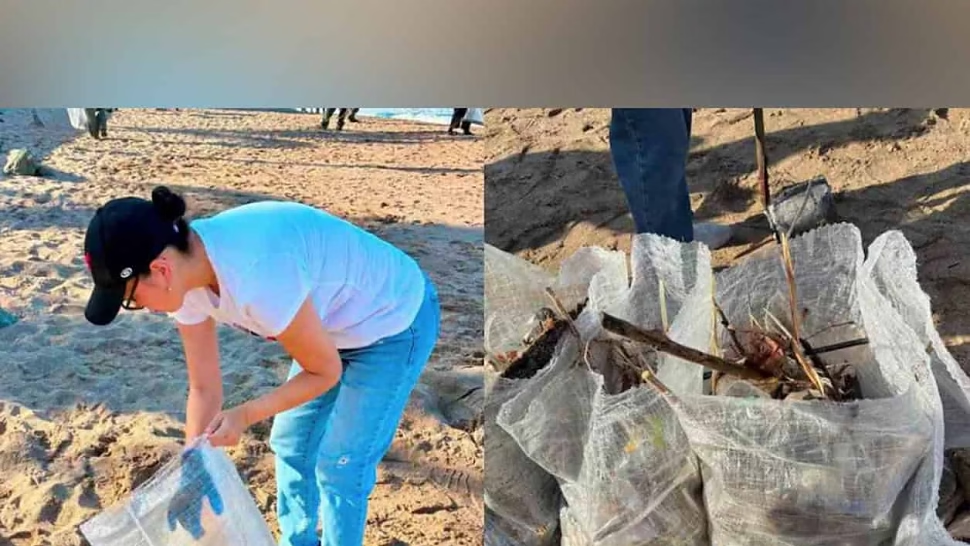
CULIACÁN, Sin.— Eight cubic meters of garbage, debris and branches were removed in a new day of cleaning beaches, parks and streets in the port of Mazatlán. The equivalent of 160 bags of waste left a renewed face in an area with a high tourist flow.

The 41st edition of the “Mazatlán I love you clean” program brought together municipal officials, hotel employees and volunteer environmentalists. The Beach Administrator was in charge of the coastal strip of Paseo de Olas Altas, where she collected forty bags to improve environmental conditions.

In the Villa Galaxia subdivision, staff from Public Services and the Drinking Water Board accumulated 120 sacks with disused furniture, leaves, debris and garbage. In addition, parks were cleaned, water leaks were repaired, and service modules were installed to quickly resolve neighborhood complaints.

The initiative not only seeks to improve the image of the port, but also to encourage citizen participation in environmental actions that benefit the community and tourists who visit Mazatlán.

Continue reading

PRI urges to reinforce prevention in the face of intense rains

PRI senators ask to reinforce warning and preparation for the heavy rain season.

Call from the PRI due to risks of heavy rains

PRI senators requested to strengthen prevention, monitoring and dissemination of early warning actions to face possible emergencies due to heavy rains. The request arises after the failures of federal Civil Protection during Hurricane Otis in Acapulco, where the population and tourists were not adequately alerted.

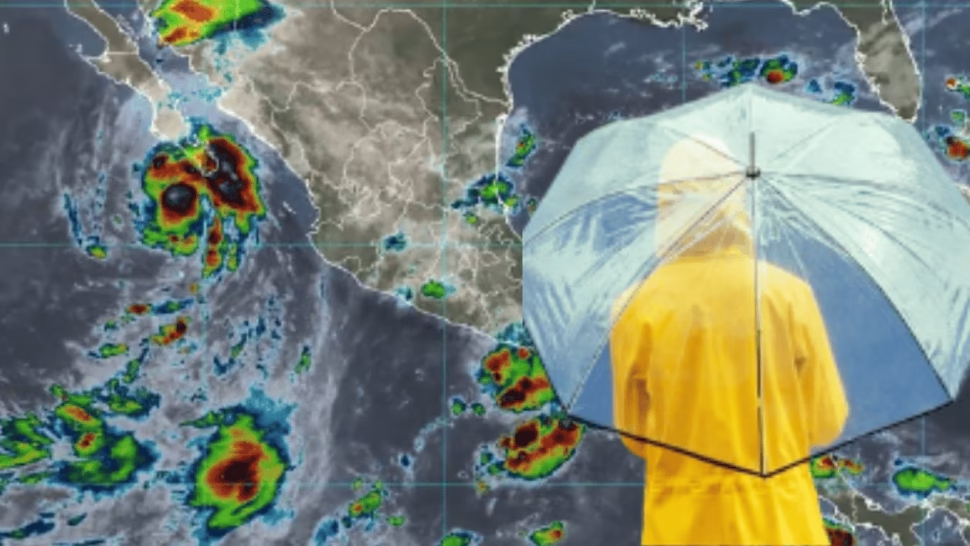
The point of agreement, published in the Gazette of July 22, is based on forecasts from the National Meteorological Service (SMN) of Conagua. For the next few days, the interaction of the Mexican monsoon, low pressure channels, humidity from the Pacific, Gulf of Mexico and Caribbean Sea is expected, in addition to the possible development of cyclonic systems.

These conditions, they warn, will favor intense rains with electric shocks, gusts of wind and high waves. The risk includes urban flooding, overflowing of rivers and streams, landslides in mountainous areas, severe flooding, falling trees and interruptions in communication routes.

Concrete actions requested

The PRI group requests that the National Civil Protection Coordination (CNPC), together with state and municipal authorities with heavy rain forecast, reinforce the identification of vulnerable areas, cleaning of channels, sewers and drainage systems. They also request to enable temporary shelters when necessary and disseminate self-protection measures.

In addition, they propose that the Ministry of Infrastructure, Communications and Transportation intensify the supervision and preventive maintenance of highways, bridges and federal roads susceptible to damage due to rain, floods, landslides or landslides.

Continue reading

Senate will review regulation of militarized schools after fatal cases

Senator promotes review of 1943 regulations after deaths of minors in private military-type schools.

Review of regulations after fatal cases

Given the death of a 13-year-old girl in a private militarized school, Senator Guadalupe Chavira announced that the Senate will review the Regulations for Private Military-Type Academies, in force since 1943. The legislator described the ordinance as anachronistic and incompatible with the current protection of children’s rights.

The regulations allow military instruction from primary to technical levels, including shooting classes in secondary school and the use of grades that grant authority to certain students over others. Chavira pointed out that these are not isolated cases; In 2025, another 13-year-old minor died at the Ollin Militarized Academy, in Morelos, after suffering serious abuse during a camp.

“The tragedy that occurred with Dafne, whose suffocation under water is being investigated, should call us to reflection and action. These schools do not have the power to organize summer camps or to authorize practices such as hazing, which ended in the death of a 13-year-old girl,” declared the senator.

The Ministry of Public Education (SEP) reported that the academy where the case occurred was operating with a 2022 incorporation agreement. After being closed for investigations, the school resumed online classes claiming the students’ right to continue their training. The agency faces at least eight additional complaints of mistreatment.

Chavira demanded a new legal framework that grants the SEP clear regulatory powers, since the 1943 regulation leaves responsibility to the Secretariat of National Defense. Specialists warn that in these private schools discipline is imposed through violence and hierarchical submission, unlike official schools where there are human rights areas and supervision of the CNDH.

Continue reading