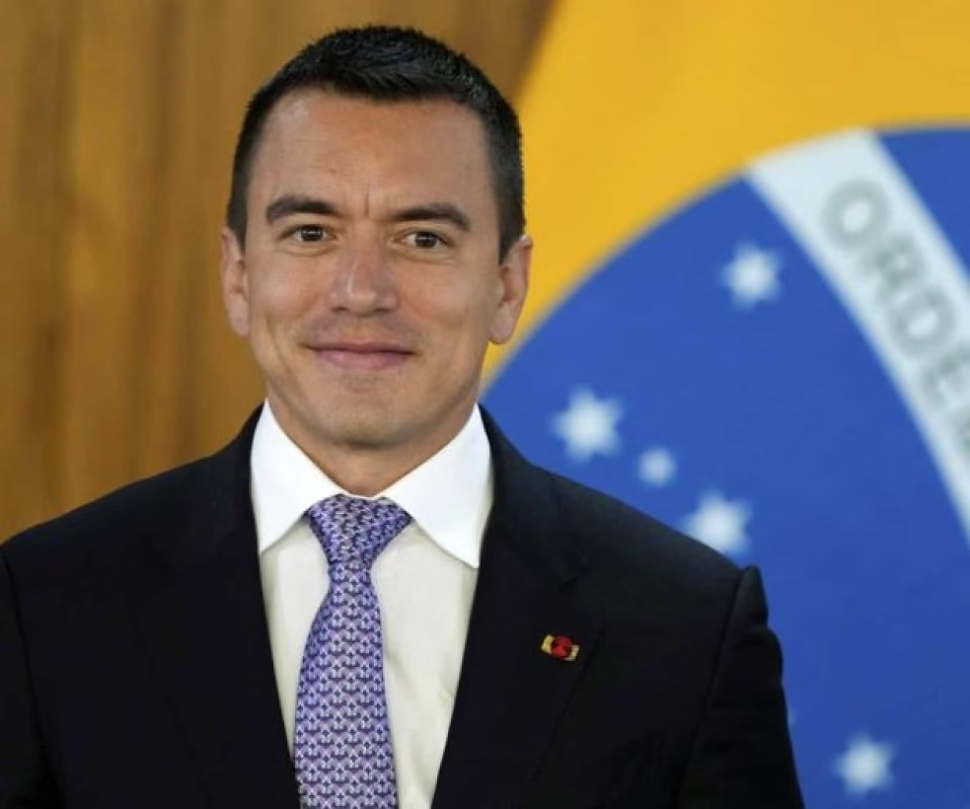
Noboa presents a new consultation after rejection by the Constitutional Court

The Executive insists with its agenda after the first judicial setback. The fight for power continues with new proposals.

The Presidential Remix: Noboa Relaunches His Consultation As If It Were a DLC

It seems that President Daniel Noboa took the Constitutional Court’s rejection of his first set of questions as a simple “first failed attempt” at a video game. Because this Tuesday, the Ecuadorian government did what any millennial would do when faced with a “game over”: it inserted another coin and pressed “start” again, presenting seven new questions for its long-awaited popular consultation. The move is clear: he wants this plebiscite to take place at the end of the year, because what better way to close 2025 than with a bit of constitutional drama?

Last week, the Court said “hold my beer” to four of the eight original questions, throwing a wrench of legal reality into the party. The most controversial, the one that sought to subject judges to political trials, was discarded because it was considered that, surprise, it compromised judicial independence and broke the system of checks and balances. Basically, they told him that you can’t change the rules of the game just because you’re not doing well.

RelatedDaniel Noboa denounces an attempted poisoning with jam

Revenge Will Be Tweeted: The New Proposals

But Noboa doesn’t give up that easily. In a movement that smacks of “fine, I’ll do it myself”, the president has insisted on his fight with the Constitutional Court. One of the new questions seeks, with all the subtlety of a meme, to limit the power of the high court. The proposal is that to declare the unconstitutionality of a law, six of the nine judges would now need to agree. It’s like wanting to change the rules of soccer so that the goal only counts if seven players score it. Pure strategy, of course, to prevent the initiatives that, according to him, are crucial to combating the violence that plagues the country.

And speaking of controversial initiatives, the Court also said “nope” to the question about chemical castration for child rapists. Given this, the government opted for plan B: proposing the creation of a public registry of people convicted of sexual crimes against minors. Something like a list of shame, but with legal validity. It is not the radical solution that some expected, but it is what is on the menu of politically correct options.

Another one that returned to the fray, like that artist that we all thought disappeared, is the proposal to authorize casinos in five-star hotels. The Court previously rejected it for lack of clarity, but apparently Noboa’s team gave it a once-over with the spell checker and re-released it. Because nothing says “we’re solving the country’s problems” like allowing people to lose their paychecks on luxury slot machines.

And here comes the most passive-aggressive wink of all: a question that seeks to prohibit the use of the name or image in political campaigns of any person sentenced for crimes against the public administration. Who could this gem be directed to? Well, just to name one, former president Rafael Correa and his entourage of former officials sentenced for corruption. It’s like blocking your ex on all social networks, but on a constitutional level. The level of pettiness is admirable.

To top it off, the president also included proposals for constitutional reforms to speed up the prosecution of crimes such as extortion and those linked to organized crime. Because if there’s one thing Ecuador needs, it’s less bureaucracy and more efficiency, especially when it comes to putting bad guys behind bars.

What Did Pass the First Cut (Literally)

Not everything was rejection in the first round. The Court gave the green light to some questions, such as the implementation of hourly work in the tourism sector (because nothing combats crime like labor flexibility) and the reduction of the number of assembly members, which are currently 151. It had also previously validated issues such as allowing the presence of foreign bases in the country – something prohibited since 2008 – and the elimination of subsidies to political parties. The latter has already been approved by the Assembly and must be ratified in the referendum. Basically, the renovation menu is as varied as a DJ’s playlist at a wedding.

The underlying message is clear: Noboa is determined to leave his mark, and if he has to overcome legal obstacles with the persistence of an influencer trying to make a TikTok go viral, he will do it. The popular consultation is emerging as the next great political reality show in Ecuador. And we, the audience, can only wait with popcorn in hand to see what happens in the next episode.

Are you intrigued by how this fight between the Carondelet Palace and the Constitutional Court will continue? Share this article on your social networks and tag those who love political drama. And if you want to stay up to date with more analysis on the memes that are generated from the decisions of our rulers, explore more related content in our politics section. Because in the digital age, even popular queries have their own gossip thread.

France intercepts new ship from the Russian network that evades sanctions

France intercepts another oil tanker linked to the Russian network that evades sanctions in the Mediterranean.

The French Navy intercepted the Cameroonian-flagged oil tanker Deliver off the coast of Sicily on Tuesday. The vessel would be part of the fleet of unregistered vessels that Moscow uses to circumvent international restrictions on its crude oil exports.

“The French Navy carried out an inspection with boarding on the oil tanker Deliver while it was transiting in violation of international maritime law,” President Emmanuel Macron reported on his social networks.

Inspections on the rise

Since September, France has carried out four inspections of ships suspected of belonging to this network. The United Kingdom did the same in June with the oil tanker Smyrtos in the English Channel. Paris and London are leading a stricter application of European sanctions that Russia has until now managed to evade with relative ease.

This Friday, representatives of the 27 EU member states will analyze the twenty-first package of sanctions. Among the proposed measures are maintaining the cap on the price of Russian crude oil, expanding the list of vessels banned from European ports and restricting imports of Russian fishing products.

There is less consensus on prohibiting entry to Russian veterans who have fought in Ukraine. Italy and France expressed reservations about the difficulty of identifying them without generating a general ban on Russian citizens.

At the same time, Ukraine intensified its operations in Russian territory. kyiv claimed to have attacked two refineries in Ufa, 1,500 kilometers from the front. “We are implementing our long-range sanctions plan,” declared Volodymyr Zelensky before authorizing a 40-day operation led by the Ukrainian security services.

The Ukrainian president also obtained the first 3 billion euros of a 90 billion European loan. “It is clear that it is Russia that prolongs the war and ignores all diplomatic proposals,” Zelensky said in conversation with Ursula von der Leyen.

Continue reading

Evacuation paused in the Strait of Hormuz after attack on ship

UN suspends maritime rescue plan after shooting at ship in the Persian Gulf.

The International Maritime Organization (IMO), a UN agency, paused the evacuation of ships stranded in the Strait of Hormuz. The decision was made after the British military reported that a ship was hit by a shell off the coast of Oman.

The Secretary General of the IMO, Arsenio Domínguez, explained that the plan will be suspended until security guarantees are confirmed. The attacked ship was not part of the evacuation effort.

Warnings from Iran and new routes

Hours before the attack, Iran threatened to prohibit passage through the strait without permission from Tehran. The new Persian Gulf Strait Authority, created by the Iranian government, warned in X that transit outside its designated routes “will not be covered by the guarantee of safe passage.”

The United Kingdom’s Maritime Trade Operations center indicated that the ship suffered damage, but with no casualties or environmental impact.

Opening an alternative passage would ease pressure on the global economy and reduce Iran’s influence in peace negotiations. The US Secretary of State, Marco Rubio, assured during a visit to the Persian Gulf that Washington is committed to the new route.

“If that stops, then we’re going to have a problem,” Rubio said.

The price of oil briefly fell below $73 a barrel, a sign that the market is seeing improvement.

Negotiations and regional tensions

The United States and Iran are discussing the terms of a provisional peace agreement, with a period of 60 days to define details such as the passage of ships and the future of Iranian enriched uranium.

Meanwhile, the escalation of fighting in Lebanon threatens the truce. The Lebanese Ministry of Health reported five deaths from Israeli attacks in the last two days. Hezbollah called the actions violations of the ceasefire, but has not responded.

The Israeli army confirmed the death of a reservist soldier and another wounded in southern Lebanon.

Maritime transit in figures

Despite the incident, more ships are crossing the strait, although far below pre-war levels. Shipping company Maersk managed to remove its container ship Maersk Baltimore and another ship on Thursday.

According to Lloyd’s List Intelligence, 125 vessels crossed last week, up from 33 the week before. S&P Global reported 78 transits on Wednesday, the highest number since the conflict began, but still far from the daily average of 130.

Iran considers the new route “unacceptable and completely dangerous.” The naval arm of the Revolutionary Guard warned that “action will be taken against violators.” On Wednesday, they threatened an oil tanker by radio: “they are within range of my missiles,” according to the security firm Ambrey.

Rubio met with Gulf Cooperation Council ministers to ensure their interests will be protected. Bahraini Foreign Minister Abdullatif bin Rashid al-Zayani said the deal brings hope, but it is “critical that Iran fulfills its obligations.”

Continue reading

Earthquakes in Venezuela: 188 dead and 40 thousand missing

Two earthquakes in Venezuela leave 188 dead and 40,000 missing, according to estimates.

Official balance and independent estimates

Two earthquakes of magnitude 7.1 and 7.5 shook Venezuela on Thursday, leaving a provisional toll of 188 dead and 1,520 injured, according to Jorge Rodríguez, president of the National Assembly. Around 2,000 families lost their homes. The first tremor occurred at a depth of 20 km; the second, stronger, only 10 km away.

An independent civil initiative estimates that the missing people could reach 40,000. The government has not validated that figure. The coastal area of ​​the state of La Guaira and the west of Caracas were the most affected.

“Everything was falling on us. It looked like a horror movie. It lasted about two minutes,” a resident told the local press.

International response and solidarity

Interim President Delcy Rodríguez declared a state of emergency, closed schools and courts, and mobilized all health personnel. Communications and the airport are collapsed; many bridges were damaged.

International help arrived quickly: rescue teams from the United States, the European Union, Türkiye and Mexico. The IMF allocated 200 million euros for reconstruction. Italy will send firefighters and civil protection.

The lack of supervision in construction—few projects meet anti-seismic standards, without urban planning—would have aggravated the damage, according to local complaints. Venezuela is located on the fault between the Caribbean and South American plates, an area of ​​high seismic risk.

Continue reading