New strategy to search for missing people in Mexico

Plan prioritizes forensic database and coordination between institutions.

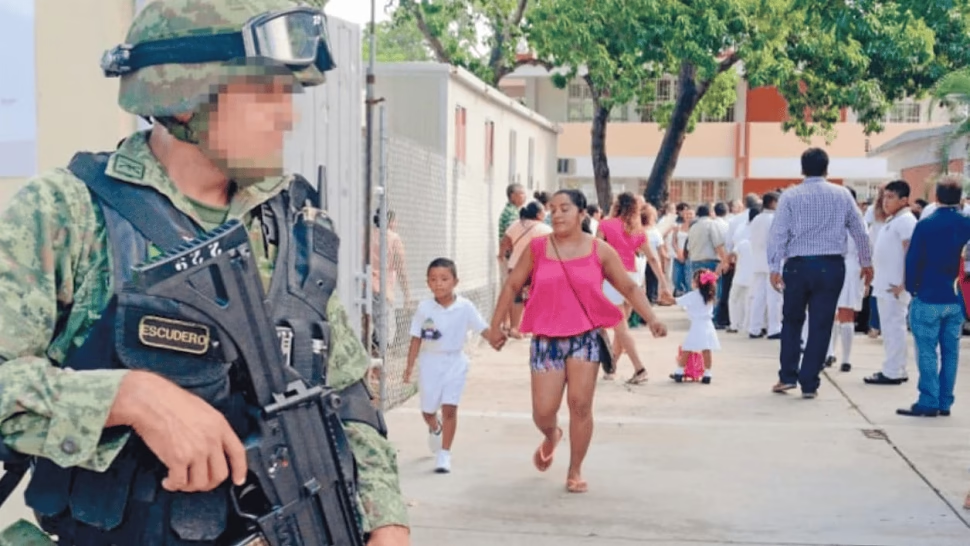
The federal government presented a reinforced strategy for the search for missing people. The plan includes strengthening forensic databases, coordinating institutions and accelerating the location, both in life and in identification of remains.

The Undersecretary of Human Rights, Arturo Medina Padilla, explained that the consolidation of the National Forensic Data Bank is prioritized. This database includes records of unidentified deceased persons, mass graves, fingerprints and genetic profiles.

RelatedSenate debates reform to create a single platform for searching for missing people

It also seeks to strengthen collaboration between the National Search Commission (CNB), the Attorney General’s Office (FGR) and the state prosecutor’s offices. The objective is to create a unified system that allows information to be crossed and improve the location of people.

Figures and mechanisms

According to the government, there are more than 132 thousand cases of missing and unlocated people. At least 46 thousand reports lack sufficient information to initiate effective searches. Therefore, we will work directly with families and groups to update data.

The Secretary of the Interior, Rosa Icela Rodríguez, pointed out that immediate search mechanisms and dialogue tables with family members have been activated. In addition, the Single Identity Platform was implemented, a tool that has already made it possible to locate thousands of people. The State thus seeks to address the crisis of disappearances with concrete and coordinated actions.

Mazatlán removes eight cubic meters of garbage during a cleaning day

Eight cubic meters of waste collected in the 41st edition of the program.

Cleaning day in Mazatlán

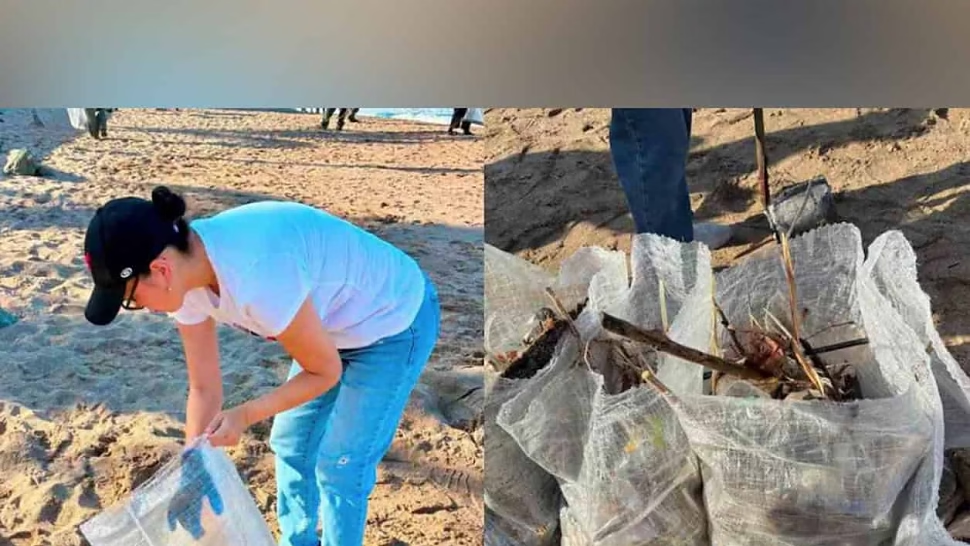
CULIACÁN, Sin.— Eight cubic meters of garbage, debris and branches were removed in a new day of cleaning beaches, parks and streets in the port of Mazatlán. The equivalent of 160 bags of waste left a renewed face in an area with a high tourist flow.

The 41st edition of the “Mazatlán I love you clean” program brought together municipal officials, hotel employees and volunteer environmentalists. The Beach Administrator was in charge of the coastal strip of Paseo de Olas Altas, where she collected forty bags to improve environmental conditions.

In the Villa Galaxia subdivision, staff from Public Services and the Drinking Water Board accumulated 120 sacks with disused furniture, leaves, debris and garbage. In addition, parks were cleaned, water leaks were repaired, and service modules were installed to quickly resolve neighborhood complaints.

The initiative not only seeks to improve the image of the port, but also to encourage citizen participation in environmental actions that benefit the community and tourists who visit Mazatlán.

Continue reading

PRI urges to reinforce prevention in the face of intense rains

PRI senators ask to reinforce warning and preparation for the heavy rain season.

Call from the PRI due to risks of heavy rains

PRI senators requested to strengthen prevention, monitoring and dissemination of early warning actions to face possible emergencies due to heavy rains. The request arises after the failures of federal Civil Protection during Hurricane Otis in Acapulco, where the population and tourists were not adequately alerted.

The point of agreement, published in the Gazette of July 22, is based on forecasts from the National Meteorological Service (SMN) of Conagua. For the next few days, the interaction of the Mexican monsoon, low pressure channels, humidity from the Pacific, Gulf of Mexico and Caribbean Sea is expected, in addition to the possible development of cyclonic systems.

These conditions, they warn, will favor intense rains with electric shocks, gusts of wind and high waves. The risk includes urban flooding, overflowing of rivers and streams, landslides in mountainous areas, severe flooding, falling trees and interruptions in communication routes.

Concrete actions requested

The PRI group requests that the National Civil Protection Coordination (CNPC), together with state and municipal authorities with heavy rain forecast, reinforce the identification of vulnerable areas, cleaning of channels, sewers and drainage systems. They also request to enable temporary shelters when necessary and disseminate self-protection measures.

In addition, they propose that the Ministry of Infrastructure, Communications and Transportation intensify the supervision and preventive maintenance of highways, bridges and federal roads susceptible to damage due to rain, floods, landslides or landslides.

Continue reading

Senate will review regulation of militarized schools after fatal cases

Senator promotes review of 1943 regulations after deaths of minors in private military-type schools.

Review of regulations after fatal cases

Given the death of a 13-year-old girl in a private militarized school, Senator Guadalupe Chavira announced that the Senate will review the Regulations for Private Military-Type Academies, in force since 1943. The legislator described the ordinance as anachronistic and incompatible with the current protection of children’s rights.

The regulations allow military instruction from primary to technical levels, including shooting classes in secondary school and the use of grades that grant authority to certain students over others. Chavira pointed out that these are not isolated cases; In 2025, another 13-year-old minor died at the Ollin Militarized Academy, in Morelos, after suffering serious abuse during a camp.

“The tragedy that occurred with Dafne, whose suffocation under water is being investigated, should call us to reflection and action. These schools do not have the power to organize summer camps or to authorize practices such as hazing, which ended in the death of a 13-year-old girl,” declared the senator.

The Ministry of Public Education (SEP) reported that the academy where the case occurred was operating with a 2022 incorporation agreement. After being closed for investigations, the school resumed online classes claiming the students’ right to continue their training. The agency faces at least eight additional complaints of mistreatment.

Chavira demanded a new legal framework that grants the SEP clear regulatory powers, since the 1943 regulation leaves responsibility to the Secretariat of National Defense. Specialists warn that in these private schools discipline is imposed through violence and hierarchical submission, unlike official schools where there are human rights areas and supervision of the CNDH.

Continue reading