Mexico strengthens its search system for missing people

New tools and reinforced coordination are implemented to expedite investigations and provide answers to families.

A new phase in the search for missing people in Mexico

The Secretary of the Interior (Segob), through its head Rosa Icela Rodríguez, has announced the beginning of a transformative stage for the National Search System. This structural change, formalized during the first session of the body, is characterized by the integration of improved tools and a strengthened legal and operational framework. The declaration underlines a renewed institutional commitment to address one of the most urgent humanitarian problems in the country, marking a turning point in government strategies.

The context of this renewal is framed in the persistent crisis of disappearances that affects Mexico, which demands more effective and coordinated responses between the different levels of government and civil society. Strengthening the localization and identification processes represents a central objective, responding to years of demand from family groups. The analysis of the previous situation indicates that the lack of homologation in protocols and the dispersion of information were significant obstacles that this new phase aims to overcome.

RelatedReport reveals serious flaws in search for missing people

Institutional strengthening and new leadership

A pivotal element in this reconfiguration is the incorporation of Martha Lidia Pérez Gumecindo as the new National Search Commissioner. This appointment is not a mere administrative change, but a key piece within a comprehensive strategy that seeks to provide the System with specialized leadership. The designation is complemented by the formation of the Citizen Council and the recently implemented legal reforms, creating a more robust institutional ecosystem with greater audit and planning capabilities.

The direct cause of these modifications is the prevailing need to optimize inter-institutional coordination. The expected effect is the creation of synergies that make it possible to streamline investigations, centralize forensic data and generate actionable intelligence. The head of Segob emphasized that, although there are now more effective instruments, the path presents considerable challenges. This recognition of the challenges ahead is indicative of a realistic approach that understands the complexity of locating and identifying thousands of people in a vast and diverse territory.

Official statements project that these actions will converge in a tangible strengthening of localization processes. The declared commitment is to “work in a more coordinated manner to strengthen the processes of locating and identifying missing persons with the firm commitment to doing justice to the families.” This phrase encapsulates the ultimate objective of the system: to transcend the administrative search to become an effective mechanism of reparation and justice for those affected. The conclusion that emerges from the analysis is that Mexico is trying to transition from a reactive and fragmented model to a proactive and unified one, although its success will depend on constant implementation and the allocation of sufficient resources.

Do you consider these initiatives to be a decisive step? Share this analysis on your social networks to expand the conversation and explore more public policy content on our site.

Semar seizes half a ton of cocaine in Manzanillo

They seize 270 kilos of cocaine in a container in Manzanillo; two migrants detained.

Operational in the port of Manzanillo

The Secretary of the Navy (Semar) secured 268 packages with 270 kilos of cocaine inside a container in the port area of Manzanillo, Colima. During the inspection, they located two men with an irregular immigration status on board the ship where the drugs were found. Both were placed at the disposal of the authorities.

The cargo was discovered by personnel from the Naval Port Protection Unit (UNAPROP) during unloading maneuvers from a container ship. Semar reported that the drugs were left in charge of the Public Ministry to integrate the investigation folder. Elements of the FGR carried out the weighing, counting and identification of the evidence.

Regarding the detainees, the agency indicated that they were in good health. They were transferred to determine their legal status due to their irregular stay in the country, although their nationality was not specified.

The operation was carried out in coordination with the National Customs Agency of Mexico (ANAM), the Secretariat of Security and Citizen Protection (SSPC) and the Attorney General’s Office (FGR), through the Criminal Investigation Agency (AIC).

Semar indicated that these actions are part of the permanent inspection, surveillance and port protection operations to prevent illicit trafficking of substances. It should be remembered that a day before, the same agency seized five packages with 139 bricks containing approximately 137 kilos of cocaine in the port of Lázaro Cárdenas, Michoacán, where five people of Ecuadorian nationality were detained.

Continue reading

Trans people take shelter in Segob to demand dialogue with Rosa Icela

Trans activists demand a direct meeting with the Secretary of the Interior after days of protest.

A group of trans and non-binary people held a day of protest this Friday inside the Ministry of the Interior (Segob) to press for a meeting with its head, Rosa Icela Rodríguez. Since Thursday, they remain in a room at the agency, in the Juárez neighborhood, Cuauhtémoc mayor’s office, Mexico City.

They demand concrete advances: a reform of articles 1 and 73 of the Constitution, a Comprehensive Trans Law and public policies in various agencies. Activist Victoria Sámano explained to EL UNIVERSAL that recommendation 42-2024 of the CNDH “has been half fulfilled.”

“They have only been simulation tables, tables to wear us down and they have not even been followed up,” he denounced.

As part of the protest, they held a “dissident sonidero” with the SoniTrans collective, where several couples danced to make their rights visible. They also called for a collection of food, batteries, blankets and presence.

The protest coincides with another CNTE demonstration. Sámano pointed out that they have already spoken with the teachers and criticized the government’s “omission” with different social groups: teachers, searching mothers and trans people.

“It is not about a single group, but about the deficiency and omission of this government,” he stated.

Faced with Segob’s initial refusal to schedule a direct meeting with the secretary, the protesters warned that they will not withdraw until they obtain one. “We’re staying here until they give us a meeting!” they concluded.

Continue reading

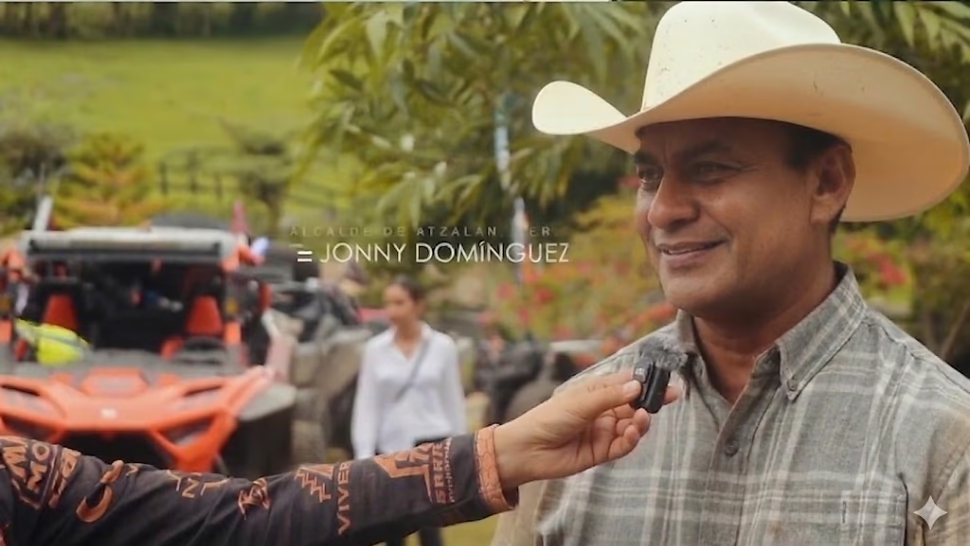
Atzalan vibrates with the adrenaline of the Citrus Route 2026

Atzalan, Veracruz. Between dirt roads, natural landscapes and great family coexistence, the 2026 edition of the traditional Citrus Route, one of the adventure events...

Atzalan, Veracruz. Between dirt roads, natural landscapes and great family coexistence, the 2026 edition of the traditional Citrus Route was successfully carried out, one of the most anticipated adventure events for all-terrain vehicle fans in the region.

From early in the morning, dozens of participants from various municipalities of Veracruz and neighboring states gathered to travel the routes designed by the organizers, crossing rural trails, forested areas and characteristic roads of this municipality located in the central mountainous area of the state. 

The activity brought together drivers of ATVs, ATVs and UTVs, who enjoyed a tour full of excitement, camaraderie and spectacular natural views. During the day, an atmosphere of family coexistence prevailed, strengthening the ties between lovers of motor sports and adventure tourism.

Participants highlighted the hospitality of the inhabitants of Atzalan and the beauty of the natural settings that the region offers, factors that have made the Citrus Route a benchmark for this type of events in Veracruz.

In addition to promoting recreation and sports, the activity represents an important economic benefit for service providers, local businesses and entrepreneurs, who benefit from the arrival of visitors during the development of the event.

Authorities and organizers agreed that the Citrus Route continues to consolidate itself as a platform to promote regional tourism, showing the state and the country the natural, cultural and gastronomic wealth of Atzalan.

With a large participation and white balance, the 2026 edition concluded, leaving a memorable experience for attendees and reaffirming its place as one of the most important off-road meetings in the Veracruz entity.

Editorial | This is Veracruz

Continue reading