New explosion in Moscow leaves three dead, including two agents

A new outbreak of violence shakes the Russian capital, marking a worrying pattern of attacks in the middle of the street.

Moscow trembles again: violence takes hold in the streets

It seems that in the Russian capital they have decided to change fireworks for real explosive devices. This Wednesday, Moscow’s routine was interrupted, once again, by a detonation that took the lives of three people. The macabre detail? Two of them were law enforcement agents who, in a fit of professional zeal, approached to interrogate a “suspicious subject.” The reward for their diligence was, according to Investigative Committee spokesperson Svetlana Petrenko, an explosion that sent them and an unfortunate passerby to a premature meeting with their fate. Forensic experts should be beginning to consider applying for a permanent office in the area.

The irony, or rather the sinister coincidence, is that the event occurred in the same area where, just on Monday, a lieutenant general named Fanil Sarvarov decided that traveling by car was overrated. An explosive device placed under his vehicle was responsible for giving him a posthumous promotion. Sarvarov was not just any soldier; He was the head of the Operational Training Directorate of the General Staff. You would think that a man with that resume would know how to avoid an attack, but apparently the manual did not cover that chapter.

RelatedA new explosive attack in Moscow leaves three dead

A worrying pattern and the usual accusations

So, let’s do the math: in just over 48 hours, two explosions in the same area and several deaths, including a high-ranking military commander and now two police officers. Simple bad luck or a message written with gunpowder? The Russian authorities, in a plot twist that no one saw coming, have already hinted that Ukraine could be behind this latest episode. Because, of course, in today’s complex geopolitical situation, what better way to destabilize a rival than by eliminating generals and traffic agents on their own streets? It is the third assassination of a senior commander in just over a year, a statistic that no military leader would want on his resume.

The atmosphere in Moscow must be more charged than the device that killed the general. As Russian investigators search for clues in the rubble, ordinary citizens wonder if going out to buy bread has become a high-risk activity. The official narrative points to a sabotage campaign orchestrated from abroad, a theory that conveniently justifies any future security measures, no matter how draconian. Meanwhile, life, or what’s left of it, continues in a city where the sound of an explosion is beginning to be as routine a concern as traffic.

What’s next? Security reinforcements at every corner? Curfews? Or maybe, just maybe, an uncomfortable reflection on the capacity of the agencies themselves to guarantee security at the heart of power. For now, the only ones who give explanations are the spokespersons, and the only ones who receive them are the citizens, who see how their citizen security vanishes in smoke and rhetoric.

Did this escalation of violence impact you? Share this analysis on your social networks to keep your network informed and explore more content about the current complex geopolitical situation on our site.

Ramiro Valdés, key figure of the Cuban Revolution, dies at 94

Ramiro Valdés, historic Cuban leader and companion of Fidel Castro, dies.

Ramiro Valdés, the last commander of the Cuban Revolution, dies

Ramiro Valdés Menéndez, commander of the Cuban Revolution and figure close to Fidel and Raúl Castro, died this Sunday at the age of 94. This was confirmed by the Communist Party of Cuba (PCC) and the island’s government in an official statement. No details were offered about the causes of death nor was it reported how the funeral will be.

“Ramiro Valdés Menéndez is deserving of the respect and admiration of the people of Cuba for his dedication and proven loyalty to the revolutionary cause,” said the note published in Cubadebate.

Valdés was part of the group that assaulted the Moncada Barracks in 1953, the act that began the armed struggle against Fulgencio Batista. He then fought under the command of Che Guevara and received the honorary title of Commander of the Revolution. He was also declared “Hero of the Republic of Cuba.”

He held senior positions in the government, including the Ministry of the Interior, but in 1986 he stepped down from power after an argument with Fidel Castro. He remained away from public life for 17 years. In 2003 he returned to the Council of State. In 2006, Raúl Castro appointed him Minister of Information Technology and Communications, despite being over 70 years old. In 2011 he became number three in the PCC, only behind Raúl and José Ramón Machado Ventura. In 2019 he became Deputy Prime Minister, a position created by the new Constitution.

Known for his critical stance towards the Internet, in 2007 he stated: “The wild horse can and must be dominated, and infocommunications, put to work for peace and development.” He rarely appeared in public and never spoke to the press.

President Miguel Díaz-Canel reacted on social networks: “The physical departure of the commander of the Revolution, Ramiro Valdés Menéndez, hurts deeply, like that of a father. That is how I always loved and respected him. This is how I will remember his support and advice, his discreet collaboration and exemplary dedication to the service of the Homeland.”

Continue reading

Sweltering Europe: France on red alert due to extreme heat

France activates alerts and restrictions in the event of temperatures exceeding 40°C in the midst of an exceptional heat wave in Europe.

France is facing an exceptional heat wave that has forced the cancellation of trains, concerts and sporting events, in addition to restricting alcohol consumption in areas under red alert. Almost a third of the country is at that level, with thermometers reaching 40°C. An even hotter Monday is forecast.

Authorities installed misting stations at the Eiffel Tower and other points in Paris to cool the population. However, drownings are increasing: French media reported four deaths of minors on Saturday, while swimming to beat the heat. In Germany, a man lost his life in the Rhine River and three people are still missing. Health authorities warn that these incidents worsen during periods of high temperatures.

Measures and concerns

The government banned drinking alcohol outdoors in areas under red alert and asked the organizers of Music Day – a festival that brings together crowds throughout the country – to limit alcohol consumption to “preserve emergency services and allow medical personnel to concentrate on caring for the most vulnerable.”

“In this heat, it’s the only way to have fun going out,” swimmer Nicolás Cruz told The Associated Press, while splashing in the Saint Martin Channel.

Zouzou Hobbs, initially skeptical about swimming in the murky urban canal, decided to take a chance: “But it’s hot. I’m going to take my chances. We need to cool off before tonight, when we’re going to be dancing.”

The authorities are especially attentive to homeless people and older adults. Some 15,000 older people died in the 2003 heat wave in France, prompting national reflection. This year, the government mobilized emergency services and armed forces to prepare for wildfires, imposed surveillance on water supplies for nuclear reactors and ordered the closure of 845 schools on Monday.

The heat spreads across Europe

Spain began the summer with much of the country on alert, with temperatures around 40 °C, even in the interior of the Basque Country. Outdoor sports and cultural activities have been suspended. In Italy, eight cities extended heat advisories (“red flags”), with temperatures in the 30s and 40s. In Milan, farm owners installed fans and sprinklers for cows, while Fashion Week attendees fanned themselves under umbrellas.

Germany expects up to 39C on Wednesday, and the UK has issued an “extreme heat” warning for southern England and Wales, with highs of 38C possible. The British Met Office recalled that the record for June is 35.6 °C since 1976. Thunderstorms threaten Germany and Poland.

French Prime Minister Sébastien Lecornu called a crisis meeting and ordered planning for better adaptation to heat waves “through air conditioning, if necessary.” The World Health Organization said more than 200,000 people in Europe died from heat-related causes in the last four years, most of them preventable.

Continue reading

Begoña Gómez, on trial for influence peddling in Spain

The wife of the Spanish president will face trial for alleged corruption crimes.

Court order against Sánchez’s wife

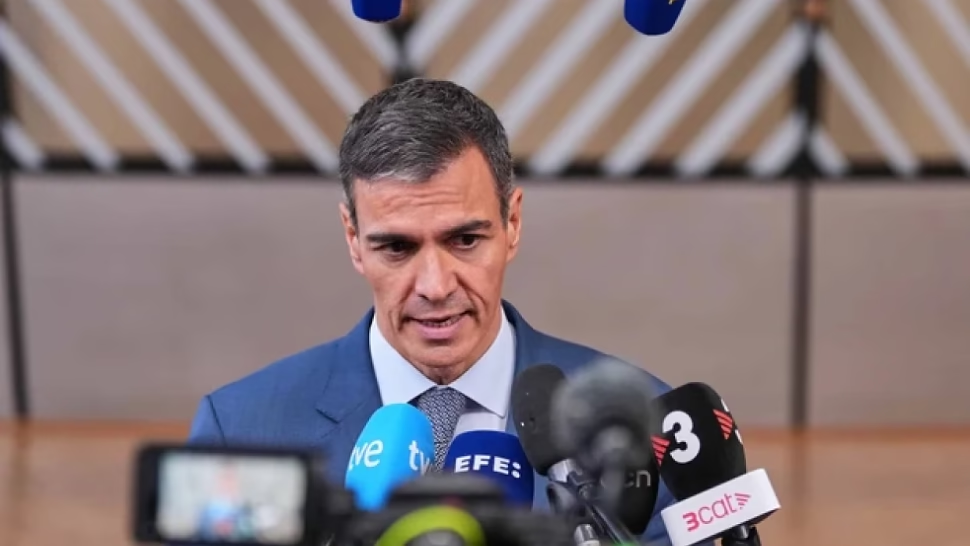
An investigating judge in Madrid ordered that Begoña Gómez, wife of the president of the Spanish government, Pedro Sánchez, sit in the dock for alleged crimes of influence peddling and corruption. The resolution includes the delivery of his passport and the obligation to appear in court every two weeks.

Judge Juan Carlos Peinado argued that there is a risk of flight. A trial date has not yet been set. The court decision has intensified the political debate in Spain.

Reactions and context

The opposition has demanded a response from the socialist government. Several political leaders consider that the case affects the integrity of the executive. For now, Sánchez maintains his support for his wife and has reiterated his confidence in justice.

The process continues and it is expected that the coming weeks will define the judicial calendar.

Continue reading