National Vaccination Week extends throughout May in Mexico

Government extends vaccination day until May with more than 900 thousand doses applied.

Vaccination without deadline?

The Federal Government confirmed what many expected: the 24th National Vaccination Week is not going to end in seven days. It extends throughout May. The official excuse? Guarantee the right to health and strengthen preventive medicine. Of course, because if we have learned anything it is that public health campaigns always need more time than they promise.

As of April 27, authorities report 916,258 doses applied since the formal start on April 25. Almost a million pickets in less than a week. Sounds good, but the question is: how many people fall under the radar? The President said that nursing staff will continue to work in hospitals and medical units. In other words, there is no excuse not to go.

“This extension seeks to make it easier for the population to go for the biological products of the basic scheme”

It includes the respiratory syncytial virus vaccine for pregnant women, which according to official figures reduces the risk of serious illness in newborns by 80%. That is something worth remembering.

RelatedMexico moves towards mass immunization during National Vaccination Week

What they don’t tell you in the statement

The Ministry of Health detailed that they monitor the application of vaccines against tuberculosis, hepatitis A, hexavalent, rotavirus and pneumococcus for children under one year of age. There are also doses against HPV for adolescents, tetanus boosters for adults and vaccines against Covid-19 and influenza for vulnerable groups and older adults.

But here comes the juicy part: they linked this day with the six-year goal of strengthening infrastructure and medical personnel. According to them, so far in 2026, 18,962 specialists have been integrated into the public system and they maintain the project of building 12,000 hospital beds. It sounds ambitious, but we already know how these announcements end when there are budget cuts.

The truth is simple: as long as doses continue to arrive and there are personnel willing to apply them, this is good news. But let’s not get our hopes up—each extension is a reminder that the system is as saturated as our social media with political memes.

Imports of Mexican cattle to the US resume

Following a health agreement, the US will reopen the port of Douglas, Arizona, for Mexican cattle.

President Claudia Sheinbaum reported that the United States will resume importing Mexican cattle starting the last week of August. The decision came after an official communication from the US Secretary of Agriculture, Brooke Rollins.

Reopening schedule

The reopening will begin at the border port of Agua Prieta, Sonora, linked to the Douglas crossing, Arizona. August 24 will be the first date of operation. Later, two additional points will be enabled in Chihuahua, subject to compliance with the Joint Action Plan against screwworm.

Sheinbaum instructed federal agencies to accelerate coordination with US authorities. He highlighted the work of the Secretary of Agriculture, Julio Berdegué, and the director of Senasica, Columba López, to strengthen health measures.

  • The animals will enter with complete inspections to verify that they do not show signs of the plague.
  • Later, the opening of the ports of Santa Teresa and Columbus, in New Mexico, will be evaluated.

The president described the news as positive for Mexican ranchers, who for months contained the spread of the screwworm. He appreciated Rollins’ willingness to maintain an institutional relationship.

Rollins, for his part, stated that the protection of the US livestock industry remains a priority and that the temporary closure of crossings was necessary to reduce risks. The reopening is possible thanks to binational collaboration.

Continue reading

More than eight million apocryphal cigarettes seized in Manzanillo

Joint operation in Manzanillo detected shipment of counterfeit cigarettes.

Operational in the port of Manzanillo

Federal authorities seized more than eight million allegedly apocryphal cigarettes in the port of Manzanillo, Colima. The operation was coordinated by agencies of the security cabinet and the National Customs Agency of Mexico (ANAM).

Personnel from the ANAM and the Administrative Unit of the Manzanillo Customs detected inconsistencies in an operation to import cigarettes from abroad. This led to a specialized review.

As a result of the inspections, the authorities located 8 million 436 presumably counterfeit cigarettes. The merchandise was insured with the support of the Secretary of the Navy (Semar).

The ANAM reported that this type of operations are part of the permanent mechanisms of operational intelligence, risk management and strategic analysis. The objective is to strengthen security in foreign trade operations and detect documentary irregularities or goods of illicit origin.

The comprehensive analysis of the operation made it possible to reinforce documentary traceability, operational review and validation of commercial profiles. The authorities maintain surveillance at entry points into the country to combat illegal trade.

Continue reading

Perception of insecurity drops to 59.8%: Sheinbaum

Perception of insecurity in Mexico drops to 59.8%, the lowest figure since 2018.

ENSU results

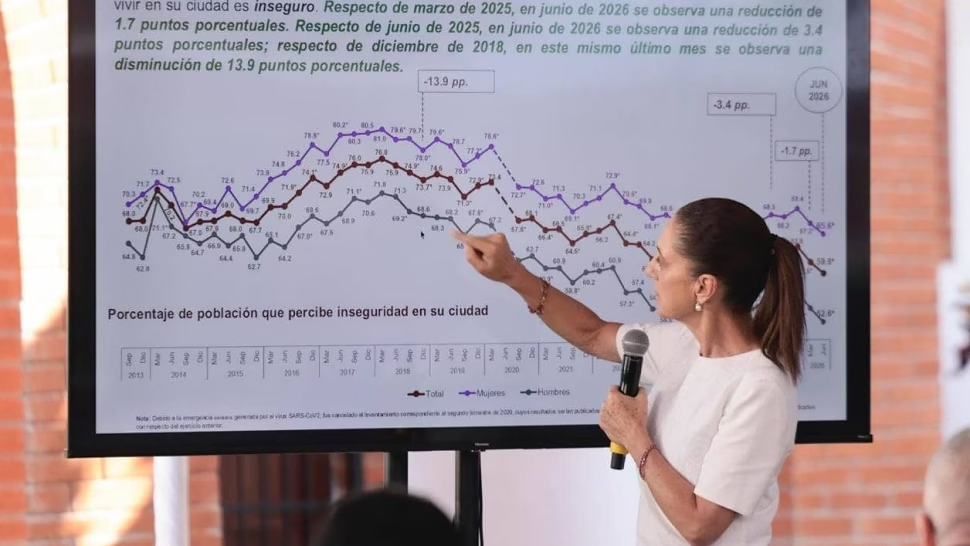
President Claudia Sheinbaum reported that the perception of insecurity in urban areas fell to 59.8% in June 2026, according to the National Urban Public Security Survey (ENSU) of the INEGI. In December 2025 it was 63.8%, which represents six consecutive months of decline.

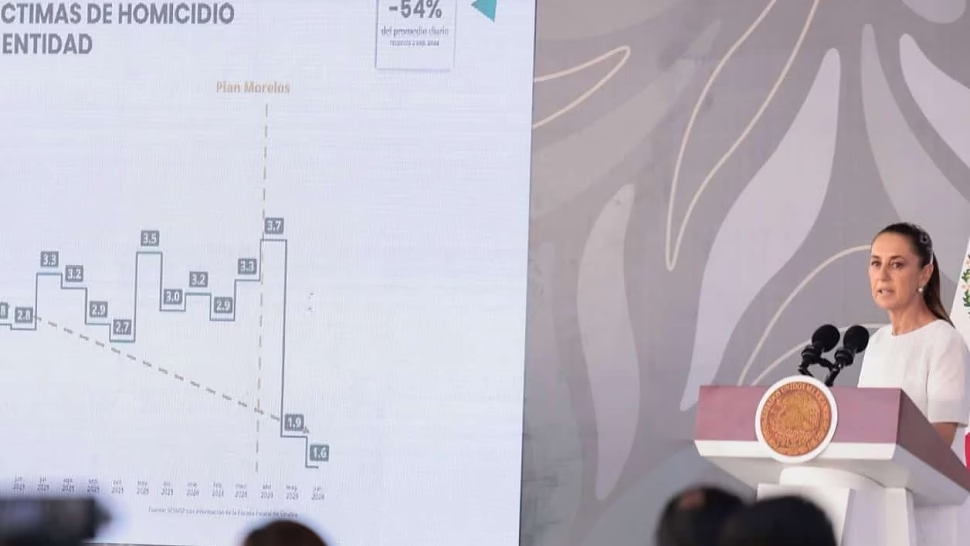
“The important thing here is that we are giving results in the security indicators and people are beginning to notice this decrease,” he said during the morning conference in Cuernavaca, Morelos.

Historical comparison

Sheinbaum recalled that in December 2018, under the government of Andrés Manuel López Obrador, the perception of insecurity was 73.7%. The previous lowest point was reached in September 2024 at 58.6%. The president attributed the improvement to the National Security Strategy.

The ENSU measures citizens’ feeling of insecurity in their environment. Recent data reflects a positive trend, although the challenge remains to maintain the reduction in crime. The authorities continue to implement actions to consolidate these results.

Continue reading