Movistar Mexico changes hands amid digital bet

A new business alliance seeks to take the reins of the mobile operator, promising technological changes without altering the brand.

A new chapter for the Mexican ‘musketeer’

OXIO Inc. and Newfoundland Capital Management have just announced that they signed an agreement to purchase Movistar México from Telefónica S.A. The operation, of course, still needs approval from regulators. They say that with this they seek to open a new line of growth in the troubled local market.

The curious thing here is not only the change of ownership, but what they promise not to change. If the transaction is completed, the Movistar brand and its management team would remain as is. The new investors swear that users will not notice interruptions during the transfer. It sounds good, but one always wonders: is it a gesture of respect for the client or a strategy to not scare away the current base while they are cooking something behind?

“Users will not experience interruptions in service during the transition,” the new investors assured.

The true transformation is in the cloud

The project is not limited to a simple change in shareholders. The master plan is to migrate Movistar’s entire network and operations to OXIO’s “Telecom-as-a-Service” platform. Translation: they want to bring everything to a cloud-native architecture.

RelatedMovistar KOI conquers the LEC Spring Split and advances to the MSI

The promise is a more agile and digital model, with data analysis and artificial intelligence tools to optimize processes. It sounds like textbook corporate jargon, but deep down it is the old recipe: modernize to reduce costs and look for new sources of income.

Why Mexico? For investors, the answer is obvious: market size, digital growth and its position as a key node in North America. The growing demand for mobile services for fintech, e-commerce and entertainment makes the country an irresistible target.

The question that remains, as always, is whether this acquisition will really be a boost to competition and quality of service, or simply another financial move on the telecommunications board. Time, and user bills, will tell.


Senate will review regulation of militarized schools after fatal cases

Senator promotes review of 1943 regulations after deaths of minors in private military-type schools.

Review of regulations after fatal cases

Given the death of a 13-year-old girl in a private militarized school, Senator Guadalupe Chavira announced that the Senate will review the Regulations for Private Military-Type Academies, in force since 1943. The legislator described the ordinance as anachronistic and incompatible with the current protection of children’s rights.

The regulations allow military instruction from primary to technical levels, including shooting classes in secondary school and the use of grades that grant authority to certain students over others. Chavira pointed out that these are not isolated cases; In 2025, another 13-year-old minor died at the Ollin Militarized Academy, in Morelos, after suffering serious abuse during a camp.

“The tragedy that occurred with Dafne, whose suffocation under water is being investigated, should call us to reflection and action. These schools do not have the power to organize summer camps or to authorize practices such as hazing, which ended in the death of a 13-year-old girl,” declared the senator.

The Ministry of Public Education (SEP) reported that the academy where the case occurred was operating with a 2022 incorporation agreement. After being closed for investigations, the school resumed online classes claiming the students’ right to continue their training. The agency faces at least eight additional complaints of mistreatment.

Chavira demanded a new legal framework that grants the SEP clear regulatory powers, since the 1943 regulation leaves responsibility to the Secretariat of National Defense. Specialists warn that in these private schools discipline is imposed through violence and hierarchical submission, unlike official schools where there are human rights areas and supervision of the CNDH.

Continue reading

Defense distances itself from the academy after death at a young age

The agency cited the Internal Regulations to justify its position

The Secretariat of National Defense (Sedena) disclaimed any responsibility for the “Marina Doenitz” Militarized Academy, in Ciudad Madero, Tamaulipas, after the death of the young Dafne Zapata.

Through a statement, the agency stated that it lacks the power to authorize, supervise, inspect or regulate educational institutions of this type.

“It is reported that the Secretariat of National Defense lacks the power to authorize, supervise, inspect or regulate the operation of educational institutions of this nature, in accordance with the Internal Regulations of this agency, issued by the Presidency of the Republic through its publication in the Official Gazette of the Federation, on December 29, 2008, where any administrative provision that contravenes this order was repealed,” the agency wrote.

He added that, in accordance with these regulations, Sedena “has no relationship with the aforementioned academy, nor with any other establishment of this type.”

No clear supervision

The case has put the operation of private militarized schools under scrutiny. In several states of the country they have proliferated without there being a federal body that explicitly regulates them.

To date, no state or federal authority has assumed the responsibility of supervising these schools. The Tamaulipas Prosecutor’s Office investigates the events.

Continue reading

Navy Special Forces celebrate 25 years of service

Elite naval units commemorate 25 years with demonstrations of capacity and the Quachic Challenge.

Elite demonstration in Veracruz

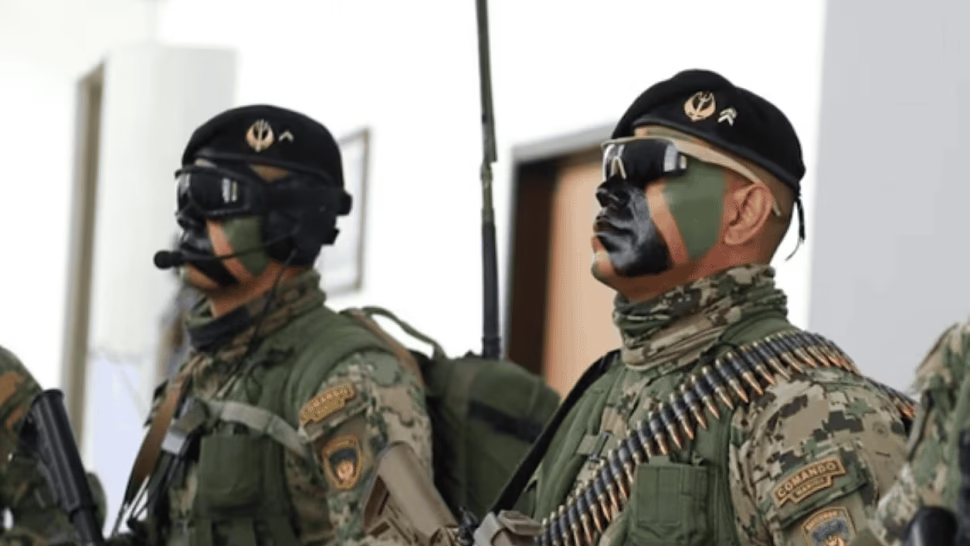
Members of the Special Forces and Amphibious Commands of the Mexican Navy commemorated their 25th Anniversary with an exhibition of their capabilities at the Heroic Naval Military School, in Veracruz. The units carried out sports activities, swimming circuits, walking with equipment, transporting the wounded, boat maneuvers and precision shooting.

Created in 2001, these units are specially organized, trained and equipped to operate in hostile or politically sensitive areas. Its staff has unique skills and competencies in their training.

Quachic Challenge and historical presentations

During the day, presentations were made on the evolution of the Special Forces and the Commandos, highlighting the quality of their preparation. A tactical gallery with specialized equipment was also set up.

The seventh edition of the national competition “Reto Quachic” was held, which included active personnel, cadets and retirees. The participants faced obstacles such as swimming 300 meters, walking 1,400 meters with 20 kilos of equipment and weapons, transporting the injured and boat, and precision shooting.

The exercises tested physical fitness, discipline and responsiveness, while fostering camaraderie and group cohesion. The commemoration not only celebrated an anniversary, but reaffirmed the importance of the continued training of these key units for national security.

Continue reading