Context and creation of the Environmental Prosecutor’s Office in Monterrey
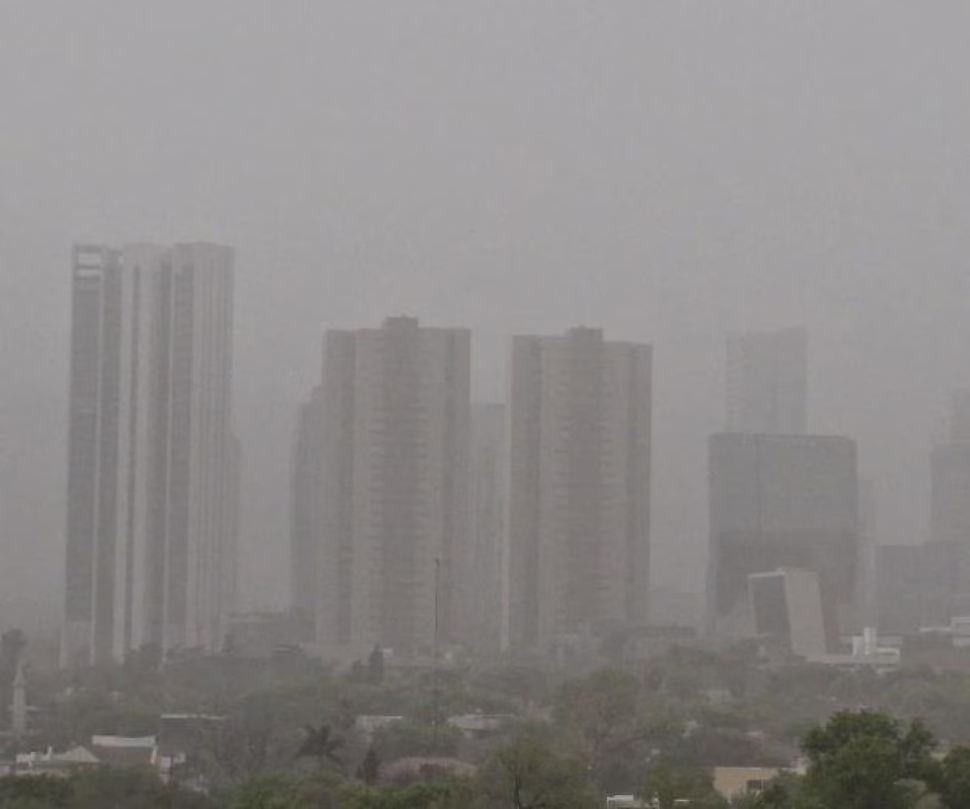
The Metropolitan Area of Monterrey, one of the most industrialized urban areas in Mexico, faces critical challenges in terms of air pollution, soil degradation and waste management. In response, the Local Congress of Nuevo León approved legal reforms to create the Specialized Prosecutor’s Office for Environmental Matters, an entity attached to the State Attorney General. This decision, published in the Official Gazette on May 10, 2025, marks a milestone in the institutional structure for ecological protection.
Institutional differentiation and legal framework
Unlike the Environment Attorney—a state entity with administrative functions—, the new prosecutor’s office will have a criminal character, focusing on investigating and prosecuting crimes such as illegal toxic emissions, illegal deforestation or irregular management of hazardous waste. The reforms modified both the State Environmental Law and the Organic Law of the Attorney General’s Office, granting operational autonomy but under the coordination of Attorney General Javier Flores Saldívar.
Implementation process and challenges
The launch of this institution requires three key stages:
- Designation of the head: Within 30 days, the first Environmental Prosecutor will be selected, whose profile must combine legal expertise and technical knowledge in ecology.
- Regulatory adaptation: In 90 days, the Internal Regulations will be reformulated to define specific competencies, such as collaboration with the Air Quality Agency or the Undersecretary of Climate Change.
- Budget allocation: The State Treasury must integrate its financing into the 2026 budget, although it will initially operate with reallocated resources.
Potential impact and regional context
This measure seeks to complement efforts of organizations such as the Metropolitan Environmental Commission, created in 2022 to coordinate policies between municipalities. According to data from the National Institute of Ecology, Monterrey registers PM2.5 levels 40% higher than the WHO limits, which underlines the urgency of more robust legal tools. However, experts warn that its success will depend on:
- The provision of technical resources (laboratories, measurement equipment).
- Coordination with federal agencies such as PROFEPA.
- Training of judges in environmental law.
Comparative analysis: Similar models in CDMX and Jalisco reduced environmental crimes by 22% in their first three years, according to figures from the INEECC. However, they required average investments of 120 million pesos annually.
Call to action
The creation of this prosecutor’s office reflects institutional progress in the face of the ecological crisis. Share this information on your social networks to make legal efforts against pollution visible and explore more content on sustainability on our portal.