ASEA launches environmental regularization program for fuel stations

An official diagnosis reveals a high percentage of facilities operate without updated environmental permits, prompting an exceptional measure.

Extraordinary procedure for the environmental regularization of the energy sector

The Security, Energy and Environment Agency (ASEA), decentralized regulatory body of the Ministry of Environment and Natural Resources (Semarnat), has implemented an extraordinary administrative procedure, of a temporary and voluntary nature. This initiative has the specific purpose of regularizing the environmental status of Liquefied Petroleum Gas (L.P.) Distribution Plants and Service Stations that sell gasoline, diesel or L.P. Gas itself, and that are already registered in the National Registry of Gasoline Facilities (Renagas). The agreement, published in the Official Gazette of the Federation (DOF), is aimed exclusively at previously registered natural or legal persons, establishing a formal channel to correct historical omissions.

The origin of this regulatory measure is found in a comprehensive diagnosis carried out by the ASEA, which yielded critical information: approximately 60% of these energy infrastructures lack a current environmental impact authorization (AIA) in accordance with their current operation. This deficiency may be due to the fact that the authorization was never managed at the time or because, obtained in the past, it has not been updated to reflect modifications, extensions or changes in the facility’s operational processes. This situation is the accumulated result of administrative processes pending over various periods and of the evolution of the environmental regulatory framework in Mexico, which has increased its demands in terms of prevention and control.

RelatedASEA investigates Pemex spill in Dos Bocas and closes beaches

Scope and objectives of the regularization mechanism

It is essential to specify that this special procedure does not constitute an amnesty or a relaxation of the regulations. Its central objective is to organize and update the panorama of existing environmental authorizations, providing a deadline and a defined methodology for operators to catch up. It does not replace ASEA’s ordinary supervision and surveillance regime, nor does it modify the legal obligations and responsibilities inherent to the safe and environmentally responsible operation of these facilities. The authority seeks, through this instrument, to generate a more accurate and reliable census, which in turn allows focusing inspection efforts and fosters a culture of proactive compliance within the hydrocarbon sector.

The implementation of this program carries significant practical implications. For operators, it represents a strategic opportunity to correct administrative irregularities without initially facing the economic sanctions that non-compliance normally entails, although the procedure details the requirements and technical studies that must be submitted. For the authority, it means moving forward in closing a massive compliance gap, raising the environmental standards of the facility park throughout the country. From a technical perspective, regularization will require stations and plants to present updated assessments on risks, hazardous waste management, atmospheric emissions and contingency prevention plans, thus aligning themselves with contemporary industrial safety and environmental protection protocols.

The success of this initiative will depend on the participation of those registered in Renagas and the capacity of ASEA to efficiently manage the procedures. Its final result should translate into a fuel distribution and sale sector that is more transparent, safe and aligned with national and international commitments regarding sustainable development and environmental management. It is an analytical and methodical step to resolve a structural problem, prioritizing regulation over immediate punitive sanctions, but without giving up on the final objectives of protection.

Was this analysis of environmental regulation in the energy sector useful to you?Share this article on your social networks to inform more people about these crucial changes and explore our content section to delve deeper into other industrial regulation and sustainability topics.

Weapons and explosives seized in Culiacán; there is a detainee

Arrested in Culiacán with weapons, explosives and stolen vehicle.

Operational in the Los Angeles sector

CULIACAN, Sin. — Elements of the National Guard detained a civilian during a patrol in the Los Angeles sector, northwest of the capital of Sinaloa. The discovery occurred near a private housing unit.

Upon noticing the presence of the authorities, the individual made an evasive maneuver. He was chased and caught up for a search.

Weapons, chargers and explosives

In the truck he was driving—a 2022 model Mazda CX-5, white, reported stolen—two automatic rifles, a pistol, nine supplied magazines and a container with improvised explosive devices, still unquantified, were found.

The detainee was placed at the disposal of the Attorney General’s Office, which will open an investigation file. The vehicle was also seized with a report of theft.

According to previous information, an anonymous call to the emergency lines alerted about armed people in a residence in the area, near the road that leads to the Imala receivership.

Continue reading

Sheinbaum announces 42 CT scanners and telemedicine to strengthen health

The president detailed investments in medical equipment, telemedicine and improvement of clinics.

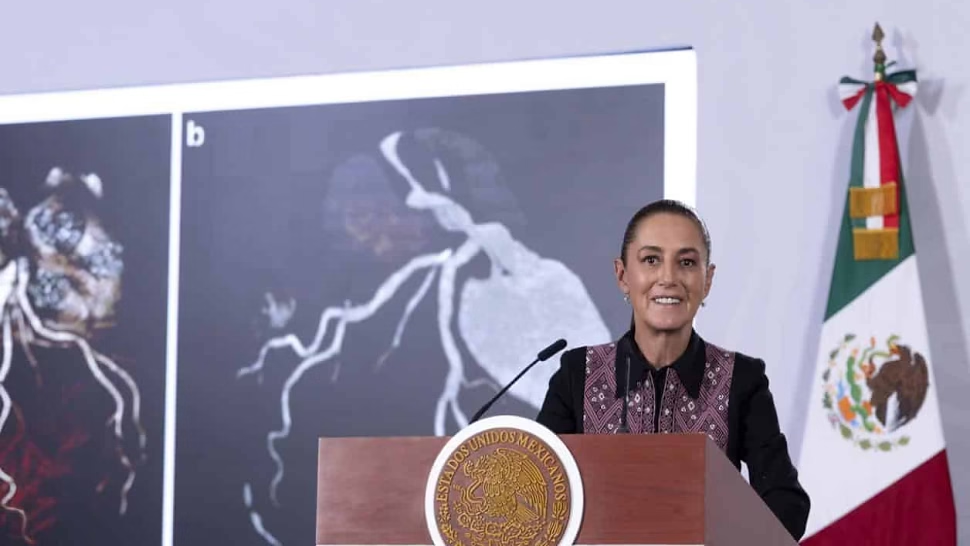
President Claudia Sheinbaum reported on advances in the public health system, with investments in equipment, telemedicine and improvement of clinics. He affirmed that the State must guarantee access to health from prevention to care for complex diseases.

“We are compensating for the profound damage that neoliberalism caused in the health system,” he said at the morning conference.

Equipment and telemedicine

The IMSS installed 42 state-of-the-art CT scanners in 40 hospitals in 19 states. Of these, 41 are from 256 cuts. They allow early detection of tumors and bleeding, perform up to 50 studies per day and reduce waiting times. They were acquired for 29 million pesos each, below the 40 million in the past.

The ISSSTE expanded telemedicine from 239 to 859 units. It offers consultations in 15 specialties, such as cardiology and dermatology, from 118 second and third level units to 741 first level.

The Clinic is Ours

The La Clínica es Nuestra program delivered 4,608 million pesos in 2025 to 8,483 medical units, with the participation of 67,864 people. 42 thousand improvement actions were carried out in infrastructure and equipment. The 2026 call will begin in July, including for the first time 153 units from Yucatán with 80 million pesos.

Sheinbaum added that progress is being made in the House to House Health program, with more than 20 million consultations with older adults and people with disabilities. Starting in August-September, you will be able to collect medications at Farmacias del Bienestar, health centers and a network of pharmacies. Next year the Universal Health Service will begin with a single credential.

Continue reading

Massive security reinforcement and alcohol ban at the Azteca

56,000 police officers and alcohol restriction for the game at the Azteca.

Measures for the Mexico-Czech Republic match

The government of Mexico City announced an unprecedented security operation for this Wednesday’s game at the Azteca stadium. 56,000 personnel will be deployed, five times more than the 11,219 employed last week.

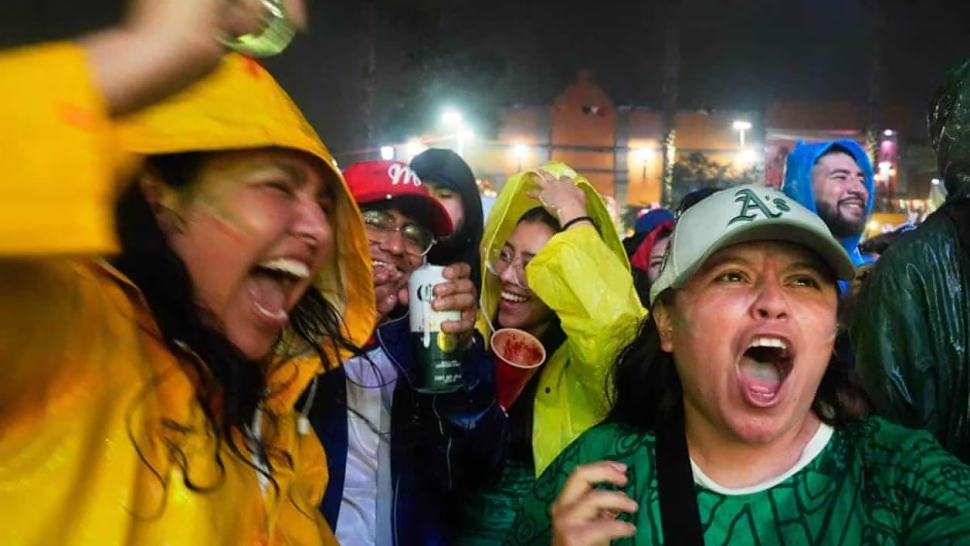
The decision responds to the celebrations of the previous Thursday, when some 700,000 people gathered in the capital after Mexico’s victory over South Korea. Although there were no injuries, nearly 40 tons of garbage were collected in the Ángel de la Independencia and the Zócalo.

The Secretary of Security, Pablo Vázquez, detailed that 7,500 police officers will guard the Azteca stadium. Another 3,275 will be in the Zócalo and 4,200 on Reforma Avenue. The objective is to protect players, referees, authorities and fans.

In addition, the Secretary of Government, César Cravioto, reported that starting at 3 p.m. on June 24, a ban on the sale of alcohol will take effect for sixteen hours. Applies to the Historic Center and five neighborhoods of Cuauhtémoc.

Sales will only be allowed in restaurants, hotels and private clubs, accompanied by food. Convenience stores and supermarkets are excluded. The fines for non-compliance amount to up to 293,275 pesos (about $17,251).

The Mexican Alliance of Transporters Organization (AMOTAC) called for mobilizations on highways in the 32 states and blockades in the capital to protest against the violence. The operation also considers these protests.

Continue reading