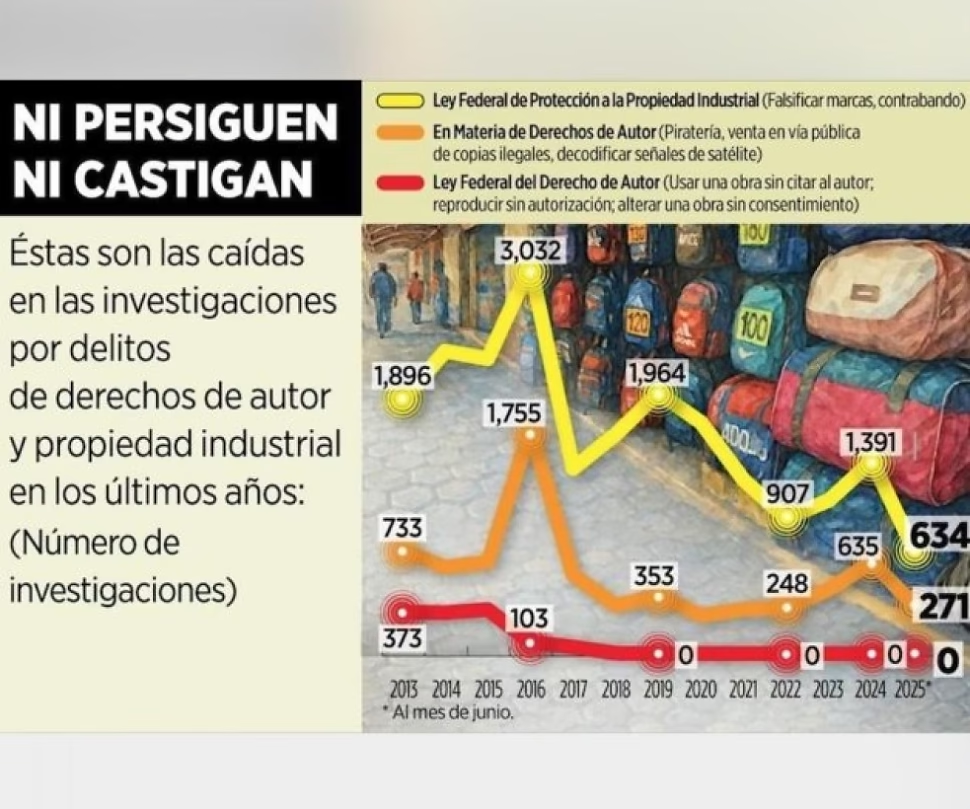
Mexican Prosecutor’s Office drastically reduces combat against piracy

Judicial inaction opens the door to an illegal market that harms innovation and the formal economy, according to experts.

Mexican Prosecutor’s Office drastically reduces the fight against piracy

The Attorney General’s Office (FGR) of Mexico has recorded a pronounced and sustained decline in the opening of investigations and in the prosecution of crimes linked to trademark counterfeiting and copyright piracy. This situation has developed despite persistent concerns and formal complaints by the United States, which identifies Mexico as a significant focus of intellectual property infringements.

The analysis of official data provided by the National Public Security System reveals an alarming trend. Since the beginning of the administration of President Andrés Manuel López Obrador, the number of investigations initiated for these crimes has plummeted by more than 50 percent compared to the previous six-year term. In certain specific categories, activity has been practically non-existent.

RelatedMexican companies see the government as slow against piracy

A statistical collapse in law enforcement

The statistics are eloquent and show a clear relaxation in the application of the law. With regard to the crimes contemplated in the Federal Copyright Law, the activity of the FGR has been non-existent. Since 2019 and until the first half of 2025, not a single research folder has been started for these concepts. The last year with activity records was 2018, with just four files, a tiny figure when contrasted with the 869 cases handled by the then Attorney General’s Office (PGR) in 2012.

The situation in the area of the Federal Law for the Protection of Industrial Property, which prosecutes crimes such as trademark counterfeiting, is no better. During the government of Enrique Peña Nieto (2013-2018), the ministerial institution opened 12,431 research folders. On the other hand, during the equivalent period of the current administration (2019-2024), that figure was reduced to 8,261 files, which represents a drop of 33.5 percent.

The setback is even more severe when examining the copyright crimes contained directly in the Federal Penal Code. In the previous six-year period, 4,512 investigations were initiated, while in the current one only 2,065 have been registered, a reduction of 54.2 percent that shows a radical change in the priorities of the crime prosecution policy.

International concern and expert justification

This inaction has not gone unnoticed on the international stage. The Office of the United States Trade Representative (USTR), in its Special 301 Report of 2025, located Mexico as one of the territories with the highest levels of piracy, including digital products such as software and video games. The report is blunt: “Mexico currently operates with reduced resources for numerous government agencies. Criminal investigations and prosecutions for trademark counterfeiting and copyright piracy appear to be non-existent, with the FGR failing to report any Intellectual Property enforcement statistics over the past five years.”

Mexican lawyers and specialists in intellectual property agree that the neighboring nation’s concern is fully justified. They point out that, beyond resources, there are legal gaps and structural problems that prevent effective protection. Arturo Rodríguez, an expert in editorial law, explained that a 2015 reform to the Penal Code, which allowed these crimes to be prosecuted without the need for a prior complaint, generated a counterproductive effect. The modification, in practice, left the Public Ministry without the institutional incentives or logistical resources necessary to carry out complex ex officio investigations.

For his part, specialist Daniel Legaspi added another fundamental legal obstacle: the lack of regulations. He recognized that, although substantial modifications to the Federal Law for the Protection of Industrial Property and the Federal Copyright Law were approved in 2020, to date the necessary regulations have not been issued to apply said reforms. This regulatory omission leaves authorities without the clear and updated procedural framework they need to act effectively, creating a vacuum that is exploited by counterfeiting and piracy networks.

The combination of diminished political will, lack of allocated resources, poorly implemented reforms and the absence of updated regulations has created an environment where impunity for intellectual property crimes is the norm. This not only affects rights holders, but weakens the formal economy, discourages national innovation and creative development, and exposes consumers to substandard and potentially dangerous products.

Do you think the protection of creativity and innovation is important? Share this analysis to raise awareness about the economic impact of piracy and explore more intellectual property rights content on our site.

CNDH exige proteger a comunicadores y garantizar libertad de expresión

CNDH pide condiciones seguras para periodistas y combate a la impunidad.

CNDH: libertad de expresión y derecho a la información

La Comisión Nacional de los Derechos Humanos (CNDH) urgió a fortalecer la libertad de expresión y garantizar el derecho de las audiencias. Ambos pilares son clave para atender las necesidades informativas de la sociedad mexicana.

En el marco del Día de la Libertad de Expresión —conmemorado cada 7 de junio— el organismo renovó su compromiso con la protección de periodistas, comunicadores y creadores de contenido. Prometió acciones de prevención, monitoreo y medidas de resguardo.

RelatedSheinbaum expands federal protection for journalists in judicial proceedings

La CNDH recordó que esta fecha se instauró en 1951. Señaló que el ejercicio periodístico ha enfrentado censura, presiones, amenazas y agresiones que dañan tanto a los medios como al derecho ciudadano a estar informado.

Propuestas para proteger a periodistas

El reto actual, según la Comisión, es construir una relación equilibrada entre medios, autoridades y audiencias, basada en la verdad, la objetividad y el respeto a los derechos humanos.

Finalmente, la CNDH exhortó a gobiernos y medios a generar entornos seguros para el trabajo periodístico. Aseguró que continuará con acciones para prevenir agresiones y combatir la impunidad contra comunicadores.

Continue reading

Boris se vuelve tormenta tropical y amenaza el Pacífico mexicano

Tormenta tropical Boris avanza con vientos de 85 km/h y afecta al menos seis estados del Pacífico mexicano.

Tormenta tropical Boris: impacto y medidas preventivas

La depresión tropical Dos-E se convirtió en la tormenta tropical “Boris” durante la madrugada de este lunes, informó el Servicio Meteorológico Nacional (SMN). A las 3:00 horas, su centro se ubicó a unos 135 kilómetros al sureste de Acapulco y a 80 km al suroeste de Punta Maldonado, Guerrero.

El sistema presenta vientos máximos sostenidos de 65 km/h y rachas de hasta 85 km/h. Su circulación provocará lluvias torrenciales de 150 a 250 mm en el oeste y la costa de Guerrero. También se esperan precipitaciones intensas en Michoacán y el suroeste de Oaxaca, así como lluvias muy fuertes en Jalisco y Colima.

RelatedTropical Storm Raymond hits Mexican Pacific coasts

Los vientos alcanzarán rachas de 70 a 90 km/h en las costas de Guerrero y el oeste de Oaxaca. En el resto de las entidades mencionadas, las ráfagas serán de 50 a 70 km/h. El oleaje será significativo: de 4 a 5 metros de altura en Guerrero y occidente de Oaxaca, y de 3 a 4 metros en Jalisco, Colima y Michoacán.

Ante este escenario, las autoridades advierten sobre el riesgo de deslaves, desbordamientos e inundaciones. Se mantiene activa la zona de prevención por vientos de tormenta tropical desde Lagunas de Chacahua, Oaxaca, hasta Técpan de Galeana, Guerrero.

El SMN señala que Boris interactuará con una vaguada en niveles medios y altos de la atmósfera, lo que mantendrá un temporal de lluvias en gran parte del país. Se prevén acumulados intensos a torrenciales en Jalisco, Colima, Michoacán, Guerrero, Oaxaca, Chiapas, Veracruz, Puebla, San Luis Potosí y Tamaulipas. En el noreste, centro, sur y sureste, incluyendo el Valle de México, las lluvias serán fuertes a muy fuertes.

La onda tropical número 5, combinada con humedad, generará lluvias fuertes en la Península de Yucatán. Pese a las precipitaciones, el ambiente caluroso persistirá en Sonora, Chihuahua, Durango, Sinaloa, Nayarit y otras entidades.

Protección Civil recomienda extremar precauciones, evitar cruzar ríos o vialidades anegadas, y mantenerse informado a través de fuentes oficiales.

Continue reading

CNTE rechaza eliminación de Usicamm como solución de fondo

El magisterio mantiene plantón y exige reforma integral, no solo cambios administrativos.

La Coordinadora Nacional de Trabajadores de la Educación (CNTE) considera insuficiente la propuesta gubernamental de desaparecer la Unidad del Sistema para la Carrera de las Maestras y los Maestros (Usicamm). Por ello, anunciaron que mantendrán y reforzarán el plantón instalado desde el 1 de junio.

Demandas que persisten

La secretaria general de la sección XIV de la CNTE, Elvira Veleces Morales, afirmó:

La eliminación de la Usicamm no representa una solución de fondo, ya que los docentes requieren una reforma integral que modifique las condiciones de ingreso, promoción y derechos laborales.

El magisterio exige también la derogación de la Ley General del ISSSTE de 2007, mejoras salariales base, la reinstalación de maestros despedidos y un sistema de jubilación digno.

RelatedSNTE demands the end of the USICAMM to guarantee labor justice

Sobre el aumento salarial del 9%, la CNTE señaló que resulta insuficiente frente a la inflación. Aseguraron que el beneficio real es menor de lo esperado y criticaron las propuestas sobre pensiones y cuentas individuales.

La organización acusó al gobierno de falta de voluntad política para alcanzar acuerdos y negó que sus movilizaciones busquen afectar el Mundial de Futbol. La CNTE informó que realizará una Asamblea Nacional para definir nuevas acciones y la continuidad de su plan de protesta.

Continue reading