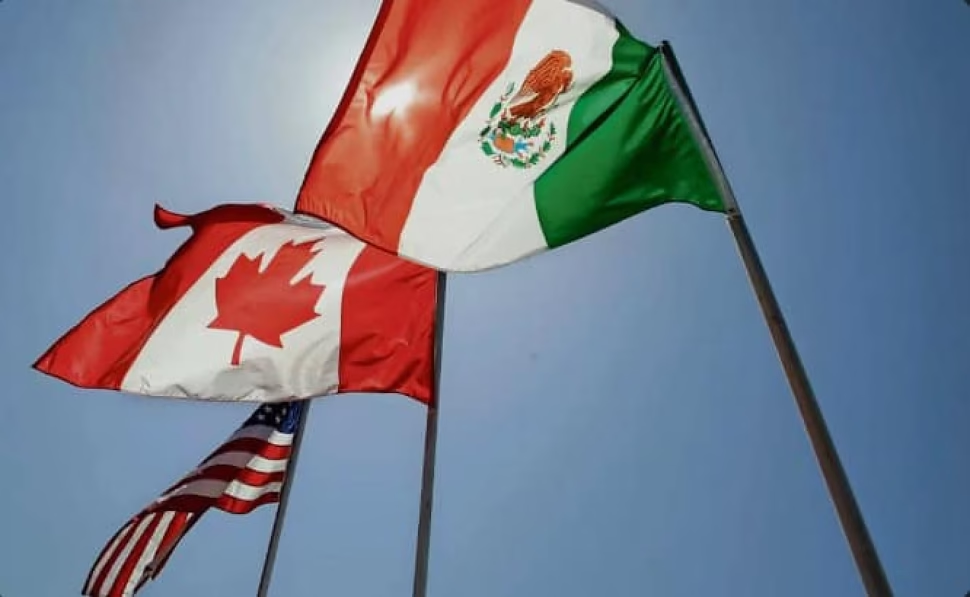
Modifications to the T-MEC require approval from the US Congress

Comce specialists warn that profound changes to the T-MEC require approval from the US Congress.

Possible modifications to the Treaty between Mexico, the United States and Canada (T-MEC) could not imply substantive changes without the authorization of the US Congress. This was pointed out by specialists from the Mexican Business Council for Foreign Trade, Investment and Technology (Comce).

Implications of the changes

Kenneth Smith Ramos, president of the Mexico-United States Bilateral Technical Committee of COMCE, indicated that the White House proposals on rules of origin and other chapters of the treaty could face resistance among Democratic legislators. For this reason, he asked not to advance concessions during the negotiation until he had guarantees regarding the reduction of tariffs.

RelatedCanada matches US tariff exemptions in the T-MEC

The specialist highlighted that the T-MEC is still in force and represents certainty for companies in the region. He considered it necessary for the US economic sectors to express their rejection of any measure that structurally affects the agreement.

Comce Actions

Smith Ramos stated that, although the United States maintains pressure through trade threats, the chances of it abandoning the treaty are practically zero. However, he acknowledged that annual reviews generate uncertainty for investors and companies that depend on stable rules.

Comce representatives pointed out that the continuity of the T-MEC until 2036 should be seen as a positive aspect. They warned that Mexico and Canada share dependence on the US market, so it will be necessary to strengthen the trade relationship and maintain a negotiation strategy that protects the economic integration of North America.

The annual reviews of the T-MEC generate uncertainty, but the extended validity until 2036 offers a horizon of stability if managed with a strategic approach.


Alert in Mexico due to outbreak of cyclosporiasis in the United States

Mexican authorities warn of an increase in cases in the US. Symptoms and prevention.

Alert for outbreak of cyclosporiasis in the United States

The Government of Mexico, through the Ministry of Health and the National Epidemiological Surveillance System, issued an alert due to the increase in cases of cyclosporiasis in the United States. It is an intestinal infection caused by the parasite Cyclospora cayetanensis, which is acquired by consuming contaminated food or water.

Since May, there has been a significant increase in infections. So far, 1,645 cases have been confirmed in 34 states of the neighboring country. The outbreak particularly affects Kentucky, Michigan, Ohio and West Virginia, where there are more than 400 infections.

The authorities indicated that the food responsible for the contagion has not yet been identified. The infection may be asymptomatic or cause symptoms such as diarrhea, loss of appetite, abdominal cramps, gas, nausea, and fatigue. In some cases vomiting, fever and respiratory symptoms also occur.

Symptoms appear between two days and more than two weeks after exposure. The parasite can remain in the environment for one or two weeks. So far, no cases of this infection have been reported in Mexican territory.

The authorities’ recommendation is to take extreme hygiene measures when handling food and washing fruits and vegetables, especially if traveling to areas with active outbreaks.

Continue reading

FGR obtains arrest warrant against former governor for huachicol

FGR arrests former governor for fuel smuggling in Baja California.

The Attorney General’s Office (FGR) executed an arrest warrant against Ernesto N, former governor of Baja California, for his alleged participation in large-scale fuel smuggling. The arrest was carried out in Ensenada by elements of the Secretariat of Security and Citizen Protection (SSPC).

As reported by the FGR on social networks:

“As a result of a highly complex investigation related to large fuel smuggling operations, carried out by a company founded by a former governor of Baja California, requested and obtained an arrest warrant for the possible commission of the crimes of organized crime and smuggling against Ernesto N, which was completed this afternoon in Ensenada, Baja California, by elements of the SSPC.”

High impact research

The investigations focused on a company linked to the former president, accused of moving fuel illegally. The FGR described the case as part of a broader strategy against organized crime in the region.

Hydrocarbon smuggling has been a persistent problem in Baja California. The arrest of a high-profile political figure could set a precedent in the fight against these illicit networks. So far, Ernesto N’s defense has not issued public statements.

Continue reading

Inegi reports a 19.2% increase in prison income during 2025

Prison admissions grow 19.2% in 2025; Baja California and Edomex lead.

The National Institute of Statistics and Geography (Inegi) revealed that in 2025, 157,457 people were admitted to penitentiary and specialized centers. The figure represents an increase of 19.2% compared to 2024, when 132,118 admissions were registered.

What does the prison census say?

Of the total, 155,579 are adults and 1,878 are adolescents. At the federal level, 2,693 people entered; in state and specialized centers, 154,764. Baja California tops the list with 21,062 admissions, followed by the State of Mexico with 18,589.

The population deprived of liberty is made up of 90.8% men and 9.2% women. Edomex and Hidalgo concentrate the highest percentages of incarcerated women: 11.9% and 11.8%, respectively. In contrast, the federal centers and Coahuila report the highest proportion of men: 98.6% and 94.2%.

A relevant fact: 76.2% of the people detained had no criminal record. Only 21.3% had any prior registration. Among women, only 12.7% had a history; in men, 22.1%.

At the end of 2025, Inegi counted 231,436 people in prison. However, only 33,714 had a sentence, equivalent to 42.2% of the total prison population.

Continue reading