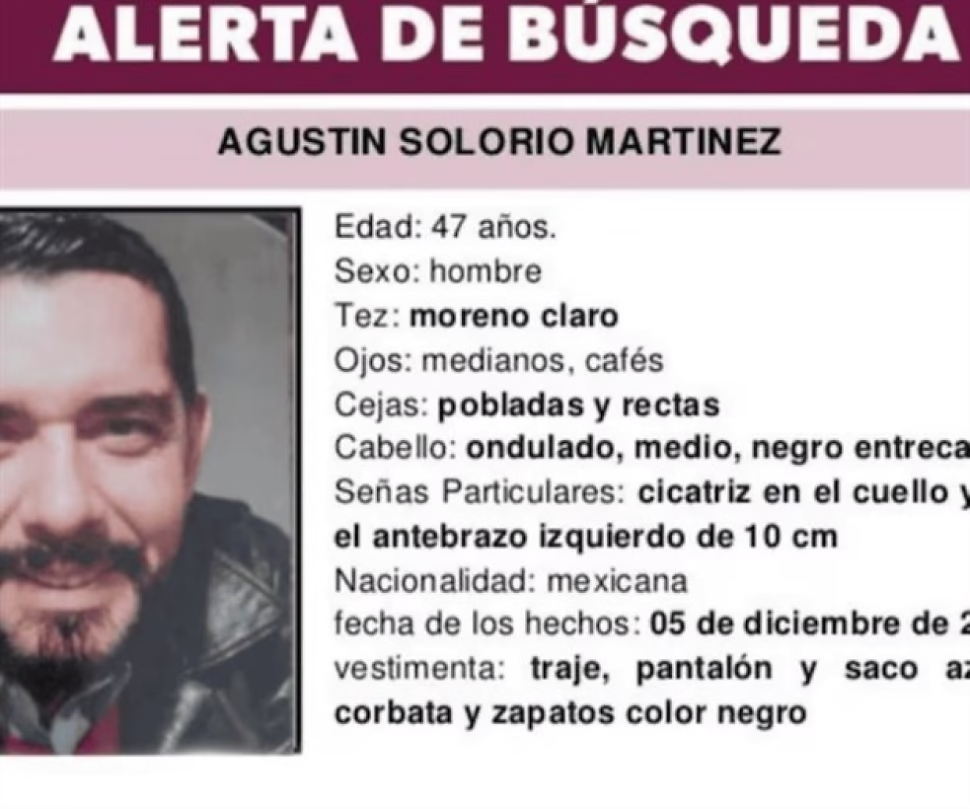
Michoacán PT delegate found dead in Guanajuato

The body of the former deputy was located inside his vehicle, after days of uncertainty and a distressing search that shocked the political sphere.

A Silence that Screamed: The Tragic Disappearance of a Leader

The cold morning in Guanajuato was split in two with a discovery that chilled the blood and confirmed the worst fears. Agustín Solorio Martínez, the district delegate of the Party of Labor in the conflictive region of Apatzingán, Michoacán, was found dead, his fate sealed by a violence that seems to know no borders. The security authorities, with serious faces, confirmed the macabre discovery, putting an end to days of anguishing uncertainty that had begun on Friday, December 5, when the former local deputy vanished without a trace, becoming one more of the alarming figures of disappearance in the country.

The trail of the political leader, a man who walked between power and service, had gone cold in Jalisco. The indications were that his destination was the metropolis of Guadalajara, but that trip never came to an end. Instead, what was found was a scene of horror: his body lay inside his own truck, a metal sarcophagus that kept the secret of his last moment. The sources consulted maintain, for now, a funereal secrecy about the exact site of the discovery and the brutal methods of his murder, leaving a blanket of questions that demand urgent answers.

RelatedThe disappearance of Blanca Yolanda a case of impunity in Jalisco

A Wave of Outrage and Demands for Justice

The news of the murder of Solorio Martínez exploded like a powder keg in the heart of the political and social establishment. A tide of unanimous condemnation emerged from all sides: local deputies of various partisan colors, senior leaders of their community, priests with trembling voices, dismayed businessmen and social organizations with their fists raised. Everyone united their voices in a single cry that resonated strongly: to demand from the authorities an exhaustive, impartial and expeditious investigation that does not rest until those intellectually and materially responsible for this atrocious crime are cornered. It is a cry for justice that seeks to prevent this act from remaining unpunished, an endemic evil that fuels the spiral of violence.

At this moment, the investigative bodies are working against the clock, scrutinizing every clue, every piece of information, every movement. The case of Agustín Solorio is not just another file; It has become a symbol, a litmus test for the State’s ability to protect its public servants and provide justice against the attacks of organized crime and political violence. Every detail that is clarified will be a crucial piece not only to give peace to his family, but to send a strong message in a territory marked by defiance of the law.

This story of loss and fight for truth impacts us all. Agustín Solorio’s story is a somber reminder of the risks faced by those who serve the community. Share this content on your social networks to keep the demand for justice alive and explore more analysis on security and politics in our national news section.
CNDH demands clarification of deaths of Mexican migrants in ICE custody

The organization asks to investigate deaths of compatriots in US detention centers.

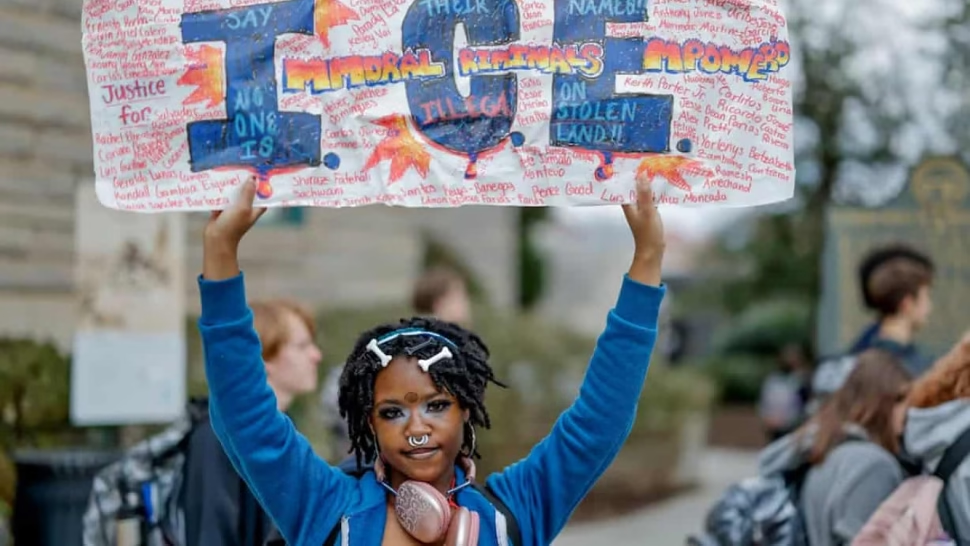
The National Human Rights Commission (CNDH) issued a condemnation for the deaths of Mexican migrants that occurred during operations and in detention centers of the United States Immigration and Customs Enforcement Service (ICE). The organization, chaired by Rosario Piedra Ibarra, demanded prompt, impartial and transparent investigations to clarify the facts and punish those responsible.

Concern about violations of fundamental rights

The CNDH described these cases as “most serious”, since they involve possible violations of the right to life, personal integrity, health, due process and dignified treatment. He expressed his concern about the immigration policies applied in the United States and recalled that the protection of human rights must be guaranteed regardless of nationality or legal status.

Consular assistance and accompaniment

The organization highlighted the need for Mexico to maintain consular assistance, legal accompaniment and humanitarian support for compatriots deprived of their liberty for immigration reasons, as well as for their families. He also reiterated that any death in state custody must be reviewed with the utmost rigor.

The CNDH requested that the investigations allow for determining responsibilities and guaranteeing truth, justice and comprehensive reparation for the victims.

Continue reading

Sheinbaum rejects accusations by the director of the DEA about links to crime

The head of the DEA pointed out an alleged alliance between authorities and cartels. Sheinbaum described it as unsupported.

Diplomatic tension due to DEA statements

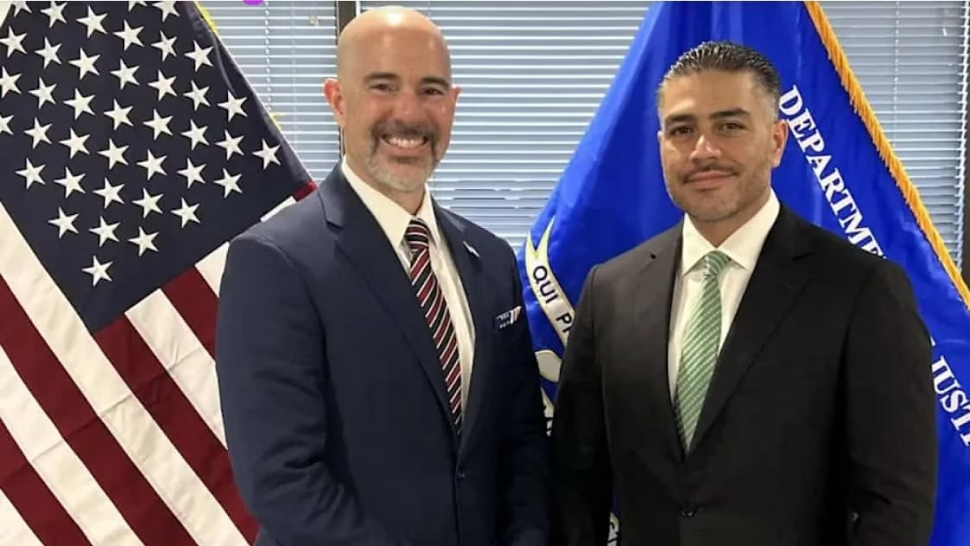
The statements of the director of the DEA, Terry Cole, have caused friction in the bilateral relationship with Mexico. The official recently stated that the Mexican government and the cartels maintain a “deadly connection.” He said that combating this alleged alliance is a priority for his agency.

President Claudia Sheinbaum rejected the accusations. He described them as “unfortunate, unsupported and baseless.”

It is not Cole’s first controversy towards Mexico. Since taking office in 2025, his appointment has been questioned. Newspaper reports link him to the leak of sensitive information in 2011 that led to the civilian tragedy in Allende, Coahuila, attributed to the criminal group Los Zetas.

Cole has also supported measures by the Trump administration. Supports classifying Mexican cartels as Foreign Terrorist Organizations. In addition, he has defended the possibility of covert operations by US agencies inside Mexico.

In his most recent statements, Cole pointed to the case of Sinaloa. He suggested that Mexican officials may have collaborated with criminal groups. Sheinbaum insisted that there is no evidence and that his statements damage bilateral cooperation.

Continue reading

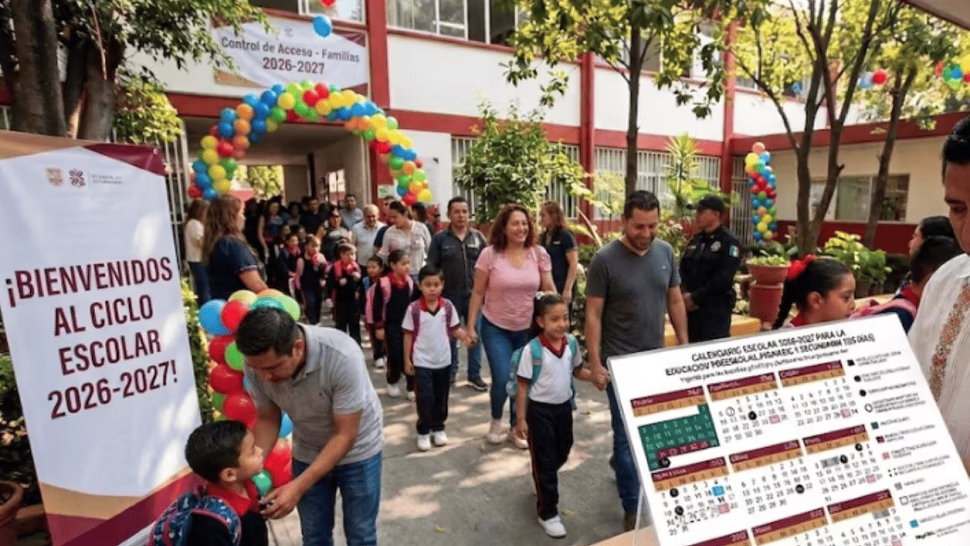
SEP publishes 2026-2027 school calendar with 185 school days

2026-2027 calendar published: 185 days of class, vacations and key dates.

Beginning and end of the school year

The Ministry of Public Education (SEP) published the calendar for the 2026-2027 cycle in the Official Gazette of the Federation. Classes will begin on August 31, 2026 and end on July 9, 2027, with 185 days effective for preschool, primary and secondary school. Normal schools will have 190 days and will end on July 13.

Relevant dates

The agreement, signed by Secretary Mario Delgado, includes an awareness day on sexual abuse and child abuse on September 7. There will be eight sessions of the School Technical Council on September 25, October 30 and November 27, 2026, in addition to January 29, February 26, March 26, May 28 and June 25, 2027.

The suspensions of teaching work will be on September 16, November 2 and 16, 2026, as well as February 1, March 15 and May 5, 2027. The winter holidays will run from December 21, 2026 to January 8, 2027. The Easter period will run from March 22 to April 2, 2027.

Pre-registration and tickets

The pre-registration process for the 2027-2028 cycle will be from February 2 to 13, 2027. The delivery of evaluation slips will occur from November 23 to 26, 2026, from March 22 to 25, 2027 and on July 12 and 13, 2027.

The agreement complies with the General Education Law, which requires between 185 and 200 class days. An additional week of recess is maintained in August for teachers, in recognition of their work and President Claudia Sheinbaum’s commitment to teaching. The SEP reiterates that only it can establish school calendars at the national level. The agreement comes into force the day after its publication and repeals the previous one, which regulated the 2025-2026 cycle.

Continue reading