Mexico will protect labor rights for the 2026 FIFA World Cup

CDMX is not only getting ready for the great goal, but also to protect the rights of those who will make the mega-event possible, with a plan that sounds ambitious but necessary.

Because a World Cup is not done with goals alone: the (somewhat ambitious) plan of CDMX

It seems that someone at the Secretary of Labor and Employment Promotion (STyFE, because government acronyms are our love language) saw the calendar and had a moment of existential panic. The 2026 World Cup is just around the corner in FIFA time! And no, it’s not just about building pretty stadiums and painting lines on the grass. It turns out that we need people who work, and work with rights, something that sounds as revolutionary as finding an avocado toast for less than a hundred pesos.

So, in a move that mixes magical realism with a touch of hope, the STyFE announced the creation of an interinstitutional coordination committee. It sounds like those project groups you put together for university where one does all the work and the others put their name in, but hopefully this one will work better. The mission: ensure that labor rights are not a fantasy during the 2026 FIFA World Cup. Basically, prevent the football party from becoming an episode of Black Mirror at work.

RelatedIMSS and SNTSS agree to salary increase and new labor benefits

This bureaucratic dream team will not be alone in its cave. It will have direct communication channels with FIFA itself (blessed are those who manage to decipher that bureaucracy) and with national and international unions. In other words, an international party where everyone, in theory, is invited to speak. The star alliance will be with the International Transport Workers Federation (ITF) and the local Secretary of Tourism (SecturCDMX), because what good is a labor right if you can’t get to work because of traffic?

The decalogue of (good) intention

The agreement is based on a strategy of ten lines of action, which sounds like those New Year’s resolutions that you write with fervor and abandon in February. But I hope this comes true. The plan includes training workers and employers in labor rights, safety standards and the operation of the event. The stated goal is as noble as it is ambitious: “avoid human trafficking in the workplace” and provide workspaces with healthy conditions. Basically, that no one ends up working in a situation that deserves a viral tweet of denunciation.

But it is not only about avoiding the bad, it also promises to promote social dialogue and labor inspection in strategic sectors such as transportation, logistics and tourism. Sectors that, let’s be honest, tend to have more drama than a reality show. And here comes the progressive plot twist: Convention 190 of the International Labor Organization will also be disseminated and applied to combat workplace violence and harassment, with special attention to women, young people and the LGBT+ community. A movement that all of us on social media are going to applaud with emojis of clapping hands, because in theory it sounds impeccable.

The final objective of the plan is to strengthen fair labor relations in all the premises and service companies contracted for the event, open employment opportunities to vulnerable groups (because inclusion should be more than a hashtag) and guarantee adequate health conditions in the workplace. In other words, the experience of working at the World Cup is not like surviving on a Discord server full of trolls.

And to top off the move, safe and accessible public transportation will also be promoted to facilitate the mobility of workers and assistants. Basically, you don’t have to get on a van that looks like it’s about to participate in Mad Max to get to your turn. And, crucially, establish measures to prevent human trafficking in the transportation industry and related sectors. Because no sporting event should be built on human exploitation, no matter how beautiful the trophy is.

The head of the STyFE, Inés González, said the phrase for the bronze: “With this agreement we must be very prepared so that the World Cup is successful before, during and after, always respecting labor rights and complying with the norm. We cannot give a bad example to the world. We want that, in addition to seeing the field, visitors recognize that in Mexico there is decent work, formal work and quality services”. Sounds good, right? Like a president’s speech in a Hollywood movie before everything goes wrong. Let’s keep our fingers crossed that this time the script is different and the legacy is not only underused stadiums, but also a precedent for decent work.

Do you think this plan will achieve its objective or will it remain just talk? Share this note and tag those who you think should be aware of these commitments. Explore more content about what’s going on behind mega sporting events in our News section.


Former director of Pemex faces criminal proceedings in Atlacholoaya

Former director of Pemex claims fruit and judge orders medical attention in Atlacholoaya.

Entry to the Atlacholoaya prison

Víctor Rodríguez Padilla, former director of Petróleos Mexicanos (Pemex), was admitted to the Observation and Classification Center of the Atlacholoaya prison after his arrest at the Benito Juárez mayor’s office in Mexico City. He is accused of family and vicarious violence, for attacking his wife in the presence of their youngest daughter.

During his first morning in the protection area for officials, he expressed dissatisfaction because they did not bring him fruit. The prison rule is that fruit is served only to those who are on a sick diet. Later they gave him pieces of melon, and other prisoners indicated that he probably paid for this benefit, a common practice in that area.

Rodríguez occupies a single cell, wears a beige uniform and plain tennis shoes. So far he has not received visits from family or friends. He also did not have companions at the accusation formulation hearing last Wednesday. Judge Consuelo Adriana Carrera Ortiz asked twice if there was any family member present, without receiving a response.

In that same hearing, the former official reported that he is undergoing treatment for a malignant tumor in the prostate. The judge ordered immediate medical attention.

“I am going to order that the corresponding letter be sent to the director of the Social Reintegration Center so that they can immediately provide medical attention and they must inform me within 24 hours,” said the judge.

Rodríguez tried to detail his medication, but the judge interrupted him: “I cannot order in this office that you be given these medications, because I am not a doctor; however, a doctor will determine if it is pertinent for you to take these medications.” Complaints have been registered in the prison about lack of medication.

Continue reading

Leak in Cereso de Sonora activates search operation

Three inmates escaped from the Hermosillo prison; Federal and state forces are looking for them.

Three people deprived of liberty escaped from the Social Reintegration Center (Cereso) Number 2, in Sonora. The incident occurred in the early hours of Saturday, July 11, and triggered a security operation in the area.

The absence of the inmates was detected around 5:30 a.m. during the roll call. The prison is located at kilometer 21 of state highway 100, on the Hermosillo-Bahía de Kino route.

Search operation

Corporations from the three levels of government reinforced surveillance in the area. Elements of the State Public Security Police, the Ministerial Criminal Investigation Agency (AMIC), the National Guard and the Mexican Army guard the main and rear entrances. They also carry out tracking tours in the surrounding area.

The Secretary of Public Security of Sonora confirmed the evasion through a statement. He noted that the State Penitentiary System immediately activated security protocols.

Investigations in progress

All authorities participate in the actions to recapture the fugitives. At the same time, investigations are being carried out to determine how the escape occurred. So far, the identity of the escapees and the exact circumstances of the escape have not been revealed.

The agency indicated that it will continue to report on the progress of the operation and the investigations.

Continue reading

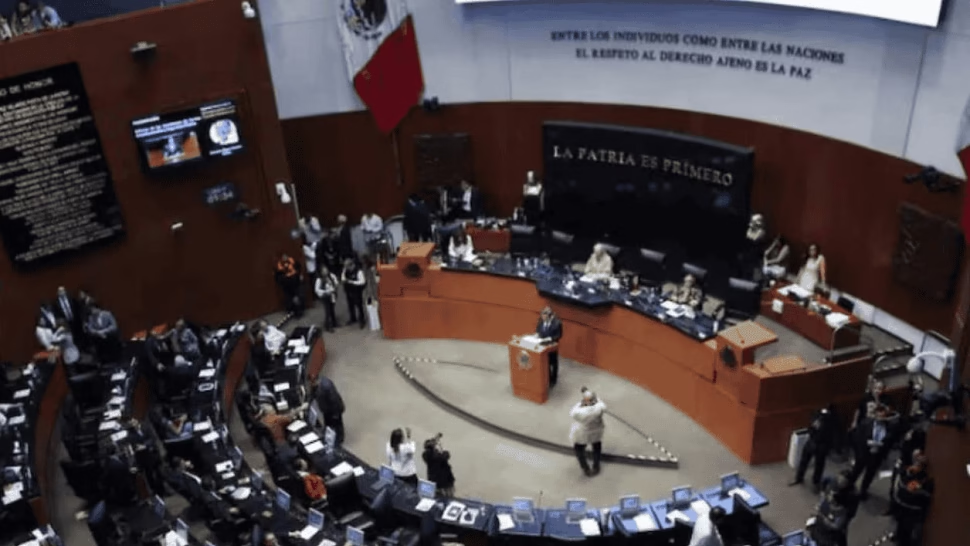
Senate seeks to strengthen municipalities with international cooperation

Senate proposes multi-stakeholder cooperation to strengthen more than 2 thousand municipalities.

The Senate of the Republic promotes a reform to strengthen the more than 2,462 municipalities of the country in security, infrastructure and local development. Historically, these entities have faced abandonment.

Discussion on multi-stakeholder cooperation

Senator Mario Vázquez, president of the Municipal Development Commission, will lead this Tuesday, July 14, the discussion “The Strategic Role of Multi-stakeholder Cooperation as a Tool to Achieve the Sustainable Development of Mexico.” The event will bring together municipal presidents, legislators, international organizations, civil society and academia.

The objective: analyze mechanisms that allow municipalities to access new financing, training and collaboration tools to promote sustainable development projects.

International cooperation as an alternative

Mario Vázquez highlighted that municipalities are the level of government closest to citizens and require greater capabilities to respond to current challenges. He pointed out that international cooperation represents a strategic alternative to strengthen its management, attract investments and improve the quality of life.

During the discussion, experiences with organizations such as the Economic Commission for Latin America and the Caribbean (ECLAC), the Japan International Cooperation Agency (JICA), the Spanish Agency for International Development Cooperation (AECID), as well as representatives of the Embassy of Chile, the Citizen Observatory of Human Rights and the Transforming Our World TODAY Network will be discussed.

The senator stressed that the Municipal Development Commission will continue to promote spaces for dialogue that strengthen the autonomy and institutional capacities of city councils, promoting a development model based on cooperation, innovation and participation of all sectors.

Continue reading