Mexico finalizes its security scheme for the 2026 World Cup

With our sights set on 196 days, the security operation and infrastructure improvements take shape to welcome millions of fans.

The master plan (or how to survive the World Cup chaos)

It seems like it was yesterday, but in reality they have been planning for three years what could be the most epic (and potentially chaotic) event that we will see in 2026. The Federal Government, in an act of optimism that reminds us of when we plan to go out on a Saturday night, assures that we will arrive at the World Cup 2026 with a security and protection scheme civilwhich sounds like a deluxe edition: “unified, approved and with a gender perspective.” In other words, version 5.0 of an operation where, in theory, all authorities – federal, state, municipal and even FIFA itself – will play on the same team. Something that, let’s be honest, has the same level of difficulty as putting together a puzzle in the middle of an earthquake.

The person in charge of releasing this information to us with a calmness that well deserves an award was Gabriela Cuevas Barrón, the coordinator of the work of the Government of Mexico for the World Cup. During the now traditional morning conference of President Claudia Sheinbaum Pardo, Cuevas told us, with the confidence of someone who already has the undersecretary’s app downloaded on their cell phone, that the country already has a consolidated strategy to protect the millions of souls (national and foreign) who will venture to this football festival. Basically, it is your “hyperfixation” of the last 36 months.

RelatedMexico advances in comprehensive preparation for the 2026 World Cup

“We are preparing to receive this great event; federal security agencies have been coordinating with all governments and with FIFA for three years. We already have a unified work plan and the approval of protocols for stadiums, public spaces and celebration areas,” he stated. Or what is the same: they already have an instruction manual so that the chaos does not overflow, from how to enter a stadium in an orderly manner to how to celebrate a goal without it ending in involuntary memes.

Security, roads and… gender perspective?

But the plan does not stop only in the surroundings of the temples of football. Things get serious on highways, logistics corridors and airports, where the Armed Forces will also play a leading role. And in a nod that seems taken from a checklist of what is politically correct in 2025, Cuevas highlighted that the scheme is developed “with a gender perspective and comprehensive protection for girls, boys and adolescents.” Hopefully that includes bathrooms with equal lines and safe areas where you can take refuge from the drunk fan who thinks he is the new Messi.

Regarding the logistics of the event, the official explained the historical dimension of this mega tournament, which for the first time will have an organizing committee for each host city. “The next World Cup in North America is innovative even in its organization. For the first time, FIFA and the stadiums organized a committee for each of the cities. In Mexico, three cities will host 13 matches: Mexico City, Guadalajara and Monterrey are consolidated as World Cup venues,” he announced. Basically, a massive and ultra-coordinated chat group between cities so that nothing fails. What could go wrong?

And as if organizing 13 matches were not enough, they also dropped the bomb: the country will receive four playoff matches. “Today we can already say it: four playoff games will be played,” Cuevas celebrated. That is, more football, more nerves and more excuses to be late for work.

Infrastructure: promises about rails and asphalt

Now, let’s talk about what affects us all: infrastructure. The pre-World Plan includes improvements in transport, public areas, airports and connectivity. The star promise is that the Train from Buenavista to Felipe Ángeles International Airport (AIFA) will be ready before the championship, along with road works on the accesses to the three host cities. In other words, the perfect excuse to justify the infernal traffic of the coming months.

“We design mobility plans, infrastructure improvements and operational adjustments in public transportation. The train from Buenavista to AIFA will soon be a reality,” he said. “Soon,” a word that in public works lexicon can mean anything from “in a few months” to “in the next decade.” Let’s keep our fingers crossed.

She also got serious to highlight the investments made in the national stadiums. “It is important to highlight the importance of the three stadiums that will host the largest World Cup in history and the large investments they have made to meet the highest soccer standards and improve the experience for fans in connectivity, sustainability and accessibility,” he stressed. Translation: Wi-Fi that doesn’t crash at minute 89 and bathrooms that don’t look like something out of a horror movie.

The final speech, as it could not be otherwise, was epic. Cuevas insisted that the objective is not only to organize a global event, but to leave permanent benefits for cities and future generations. “Mexico will once again make history as a World Cup host for the third time, transforming a global event into local well-being and building a legacy that allows our boys and girls to achieve their dreams in professional sports,” he said. A speech that almost, almost, makes us believe that the entire country will become a football utopia.

With 196 days in the countdown to the inauguration and only four months for the playoff matches, the federal government reaffirmed its commitment to arrive prepared. “We are moving forward with FIFA and the host governments in consolidating agreements that ensure shared and effective solutions… May the celebration translate into more well-being for the people,” he concluded. I hope all this planning turns out as well as it sounds and we don’t end up remembering this World Cup only because of the memes of the failed blocks. Time, and the ball, will tell.

Do you think Mexico is ready for this challenge? Share this note and tell us on your social networks if you trust the operation or if you are already practicing your escape route.
Somos México reserves 20% of candidates for activists

The new party will allocate a fifth of its spaces in Congress to seeking mothers and human rights defenders.

Nominations for activists

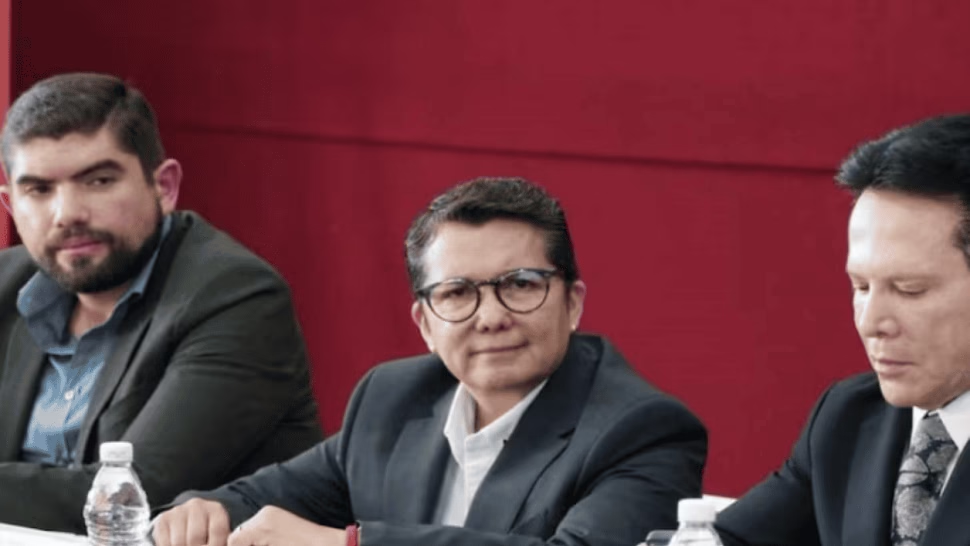
The leader of Somos México, Guadalupe Acosta Naranjo, announced that the party will allocate 20 percent of its candidacies to the Congress of the Union for seeking mothers and other social activists. None of the members of the National Executive Committee will hold a popularly elected position, he reiterated.

In the party’s first public event—approved by the INE on June 25—Acosta Naranjo pointed out that parties must serve society, not their bureaucracies.

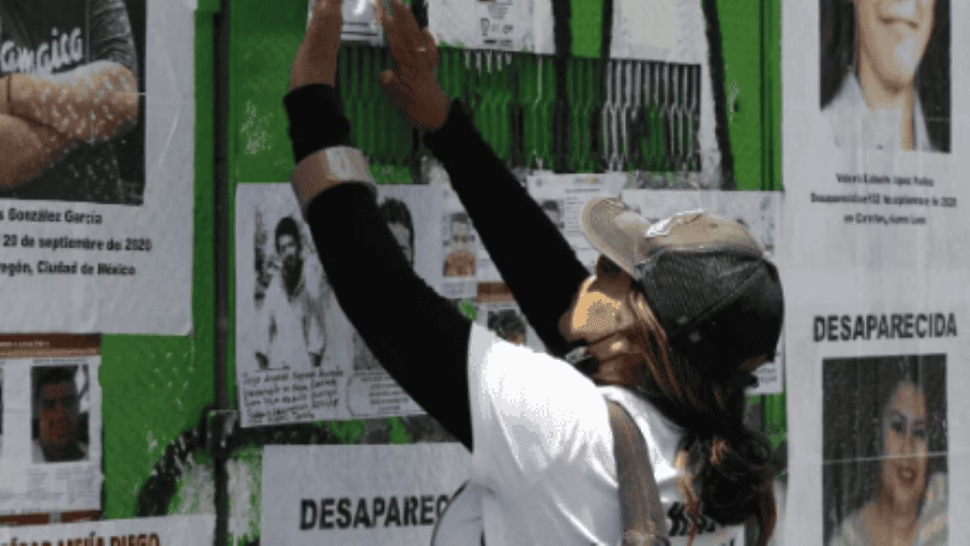
“Somos México is going to reserve 20 percent of its majority and proportional representation candidacies so that searching mothers can come to the Chamber of Deputies, so that human rights defenders can come… representatives of farmers, transporters, fishermen, environmentalists, young people. They are not going to see us,” he stated.

Open selection process

Before hundreds of supporters at the Monument to the Revolution, the leader announced that a third of the candidates will be for those under 35 years of age. No candidate will be appointed by the leadership.

“None of us is going to be a candidate using the position that was given to us today for personal gain. I am not going to be a candidate for anything… When there are two or more candidates, we are going to put ballot boxes in public squares. The citizens will choose those who represent us,” he declared.

Acosta Naranjo warned that they will defend until the last moments the name, colors and emblem of the party, approved by the INE, despite the fact that the authority today asks to modify them. He argued that being called “Mexico” is valid, since there is the Green Ecologist Party of Mexico and before Fuerza por México.

On July 25, the first session of the National Council of Somos México will be held to define its country project.

Continue reading

Edomex reinforces health prevention in eight eastern municipalities

Eight municipalities in Edomex join a health prevention strategy with a focus on obesity and teenage pregnancy.

Expanded coordination in the Eastern Zone

The Government of the State of Mexico intensified its work with eight municipalities in the Eastern Zone to strengthen health prevention. The priorities: combat overweight, obesity and reduce teenage pregnancies. The strategy is part of the Comprehensive Plan for the Eastern Zone and the national preventive medicine policy.

At a working table, state, federal and municipal authorities agreed to advance in the integration of the Mexican Network of Municipalities for Health, as well as in the certification process of Health Promoting Municipalities.

The state Secretary of Health, Celina Castañeda de la Lanza, explained that the objective is to coordinate actions between the three levels of government. This includes measures against addictions, vector-borne diseases and the aforementioned problems of weight and early pregnancy.

The Network will allow municipalities to exchange experiences to address local needs. Daniel Aceves Villagrán, general director of Public Health Policies of the Government of Mexico, highlighted that the model incorporates care for people with disabilities and those living with chronic diseases, especially in areas of high population density.

Representatives from Nezahualcóyotl, Naucalpan, Chimalhuacán, Valle de Chalco, Ixtapaluca, Ecatepec, Texcoco and Chicoloapan participated. These municipalities began the procedures to obtain certification as Health Promoting Municipalities, which will expand preventive actions throughout the region.

Continue reading

Pemex cuts investment and production deviates from the goal

Pemex reduced its investment by 5.9% in the first quarter; crude oil production is moving away from the goal.

Pemex adjusted its spending again. The exploration and production subsidiary received a 5.9% cut in its investment capital during the first quarter compared to what was scheduled.

The approved budget was 86.7 billion pesos, but the company reported to the US Securities and Exchange Commission that it invested 81.6 billion. The difference directly affects the production platform.

Currently, Pemex extracts 1.6 million barrels per day, far from the goal of 1.8 million. Gonzalo Monroy, director of GMEC, warned:

“We are flying directly and non-stop at 1.2 million barrels per day in 2027, which means that once the water is discounted, we would be at a million extraction levels during the next year.”

Drilling rigs also decreased: from 32 to 25 between January and May, according to data from the consulting firm. So far this six-year term, 10 mixed contracts have been awarded, seven in a first block (fields such as Macavil and Tamaulipas) and three recently (Rabasa, San Ramón and Cinco Presidentes). Pemex plans to produce up to 450 thousand barrels per day with these contracts, but the developments would take place beyond 2033.

Oil vocation in question

Miriam Grunstein, an academic at the Mexico Center at Rice University, said that the situation is alarming in the short term. Pemex loses income from lower exports and from privileging feeding the National Refining System, instead of extracting more crude oil.

“Sheinbaum’s government is betting on renewable electricity generation projects. Meanwhile, the budget cut in crude oil extraction indicates that the country no longer has a conviction or vocation for oil,” he said.

Grunstein added that the difference in investment between renewable energy and exploration is enormous: “At some point we are going to face a very harsh reality. The abandonment of extraction has been so much that it is alarming.”

Agreement with Petrobras, but without teeth

The Mexican government signed a collaboration agreement with the Brazilian Petrobras to acquire extraction techniques in deep waters, where Pemex has minimal activity. It includes exchange of knowledge and best practices, but the pact is non-binding, valid for two years and renewable.

Both Monroy and Grunstein agreed that the agreement was weak. Moody’s, when lowering Mexico’s rating on May 20, expressed greater concern about government debt and support for Pemex. The agency estimated that the government provided support for 35 billion dollars in 2025, equivalent to 1.9% of GDP, and budgeted another 14 billion for 2026. An improvement in the rating will depend on reducing the deficit and contingent risks of the oil company.

Continue reading