Mexico rejects OAS report on judicial election

Mexico claims sovereignty in the face of criticism from international observers about its judicial process.

The Government of Mexico is *fashionably late* in the defense of its sovereignty

Ah, the OAS. That organization that, like that friend who gives his opinion about your relationship without you asking him, decided to unleash his *hot take* on the judicial elections in Mexico. And of course, the Mexican Government, like any millennial who receives unsolicited criticism, responded with a diplomatic *”thanks, but no”* (and a bit of drama).

The diplomatic note: the equivalent of a *clapback* on Twitter

The Ministry of Foreign Affairs (SRE) did not remain silent and sent a diplomatic note to the Secretary General of the OAS, Albert Ramdin (yes, the same one who probably did not expect so much *signatures energy*). Basically, Mexico said: “We respect your opinion, but this is *unsolicited advice*”, citing Article 3 of the OAS Charter which talks about non-interference in internal affairs. That is, the classic *”to each his own fart”* but in diplomatic language.

“The organization of the electoral process and the holding of the June 1 elections strictly adhered to the constitutional norms and electoral laws in force in our country” – Ministry of Foreign Affairs, probably with a frown.

But the OAS, in its preliminary report, did not bite its tongue: it said that the process did not guarantee judicial independence and that the elected profiles had more *red flags* than a Tinder profile. He even mentioned the famous *”accordions”* (voting guides) and the low citizen participation (13%, that is, less than the likes on a politician’s tweet).

RelatedEncinas assumes representation of Mexico before the OAS

Judicial independence or *Netflix & chill* with the Executive?

The Observation Mission noted that six of the new ministers were nominated by the Executive Branch committee and three were already in the Court (appointed by AMLO). That is, more connections than an influencer on LinkedIn. “There are no guarantees that they have the technical solvency,” they warned. Translation: *”This smells like nepotism with extra steps”*.

Mexico, for its part, insisted that everything was legal and constitutional. But since when does legal equal legitimate? I’ll leave it there, like the *plot twists* of a soap opera.

The curious thing is that the OAS did not recommend that other countries copy this model. As if to say: *”Don’t do it, it’s a bad idea”*, but in a diplomatic report. Mexico, meanwhile, remains firm in its position: *”Sovereignty above all, even if the world looks at us strangely”*.

Moral? Judicial elections in Mexico are like that *”this is fine… right?”* meme where everyone agrees, but no one is sure. And the OAS, like that friend who tells you *”hey, I think they’re looking at your face”*, even though they haven’t asked him for his opinion.

Do you want more meme-flavored political analysis? Share this article and continue exploring our content. Because, in the end, politics is like gossip: everyone wants to know, but few understand the context.
PRI urges to reinforce prevention in the face of intense rains

PRI senators ask to reinforce warning and preparation for the heavy rain season.

Call from the PRI due to risks of heavy rains

PRI senators requested to strengthen prevention, monitoring and dissemination of early warning actions to face possible emergencies due to heavy rains. The request arises after the failures of federal Civil Protection during Hurricane Otis in Acapulco, where the population and tourists were not adequately alerted.

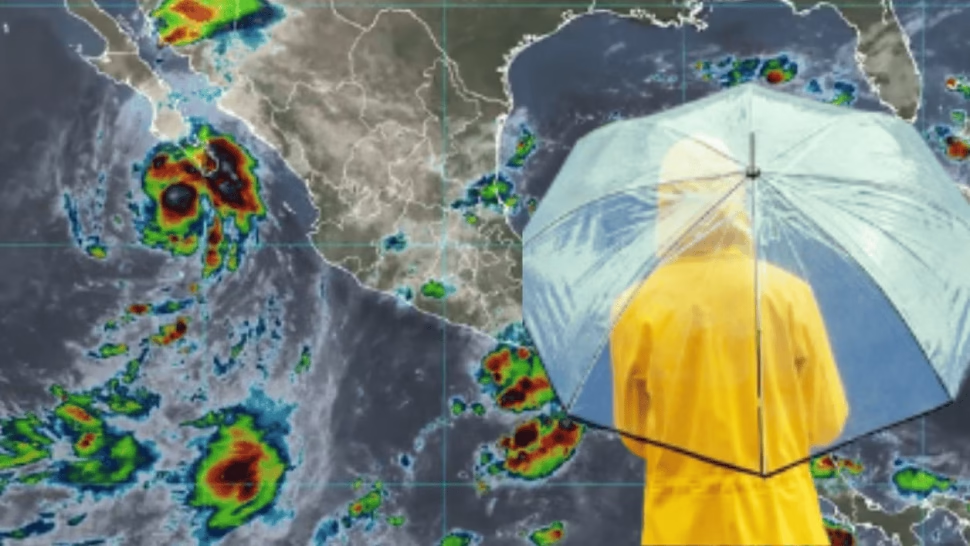
The point of agreement, published in the Gazette of July 22, is based on forecasts from the National Meteorological Service (SMN) of Conagua. For the next few days, the interaction of the Mexican monsoon, low pressure channels, humidity from the Pacific, Gulf of Mexico and Caribbean Sea is expected, in addition to the possible development of cyclonic systems.

These conditions, they warn, will favor intense rains with electric shocks, gusts of wind and high waves. The risk includes urban flooding, overflowing of rivers and streams, landslides in mountainous areas, severe flooding, falling trees and interruptions in communication routes.

Concrete actions requested

The PRI group requests that the National Civil Protection Coordination (CNPC), together with state and municipal authorities with heavy rain forecast, reinforce the identification of vulnerable areas, cleaning of channels, sewers and drainage systems. They also request to enable temporary shelters when necessary and disseminate self-protection measures.

In addition, they propose that the Ministry of Infrastructure, Communications and Transportation intensify the supervision and preventive maintenance of highways, bridges and federal roads susceptible to damage due to rain, floods, landslides or landslides.

Continue reading

Senate will review regulation of militarized schools after fatal cases

Senator promotes review of 1943 regulations after deaths of minors in private military-type schools.

Review of regulations after fatal cases

Given the death of a 13-year-old girl in a private militarized school, Senator Guadalupe Chavira announced that the Senate will review the Regulations for Private Military-Type Academies, in force since 1943. The legislator described the ordinance as anachronistic and incompatible with the current protection of children’s rights.

The regulations allow military instruction from primary to technical levels, including shooting classes in secondary school and the use of grades that grant authority to certain students over others. Chavira pointed out that these are not isolated cases; In 2025, another 13-year-old minor died at the Ollin Militarized Academy, in Morelos, after suffering serious abuse during a camp.

“The tragedy that occurred with Dafne, whose suffocation under water is being investigated, should call us to reflection and action. These schools do not have the power to organize summer camps or to authorize practices such as hazing, which ended in the death of a 13-year-old girl,” declared the senator.

The Ministry of Public Education (SEP) reported that the academy where the case occurred was operating with a 2022 incorporation agreement. After being closed for investigations, the school resumed online classes claiming the students’ right to continue their training. The agency faces at least eight additional complaints of mistreatment.

Chavira demanded a new legal framework that grants the SEP clear regulatory powers, since the 1943 regulation leaves responsibility to the Secretariat of National Defense. Specialists warn that in these private schools discipline is imposed through violence and hierarchical submission, unlike official schools where there are human rights areas and supervision of the CNDH.

Continue reading

Defense distances itself from the academy after death at a young age

The agency cited the Internal Regulations to justify its position

The Secretariat of National Defense (Sedena) disclaimed any responsibility for the “Marina Doenitz” Militarized Academy, in Ciudad Madero, Tamaulipas, after the death of the young Dafne Zapata.

Through a statement, the agency stated that it lacks the power to authorize, supervise, inspect or regulate educational institutions of this type.

“It is reported that the Secretariat of National Defense lacks the power to authorize, supervise, inspect or regulate the operation of educational institutions of this nature, in accordance with the Internal Regulations of this agency, issued by the Presidency of the Republic through its publication in the Official Gazette of the Federation, on December 29, 2008, where any administrative provision that contravenes this order was repealed,” the agency wrote.

He added that, in accordance with these regulations, Sedena “has no relationship with the aforementioned academy, nor with any other establishment of this type.”

No clear supervision

The case has put the operation of private militarized schools under scrutiny. In several states of the country they have proliferated without there being a federal body that explicitly regulates them.

To date, no state or federal authority has assumed the responsibility of supervising these schools. The Tamaulipas Prosecutor’s Office investigates the events.

Continue reading