Mexico promotes self-sufficiency in tilapia to strengthen its food security

The country is moving towards independence in tilapia production, key to the nutrition and economy of thousands of families.

Mexico is transforming its future with tilapia!

Imagine a country where every family has access to high-quality protein, where coastal and rural communities flourish thanks to a thriving industry. That future is already here! Tilapia production in Mexico not only reached an impressive value of 2,664 million pesos in 2024, but has become a pillar for food sovereignty and social well-being. Did you know that more than 45,000 people, mostly small producers, are behind this aquaculture miracle? It’s time to celebrate this achievement and keep moving forward!

Tilapia: much more than a fish

This species, famous for its adaptability and rapid growth, is a true source of opportunity. It not only nourishes millions of Mexicans, but boosts local economies and demonstrates that innovation and sustainability can go hand in hand. The Secretary of Agriculture, Julio Berdegué Sacristán, is clear: “Tilapia is key to building a stronger and more self-sufficient Mexico.” And you, are you ready to be part of this food revolution?

RelatedSheinbaum promotes food self-sufficiency and social housing in Zacatecas

The government is not far behind: with tools such as the Electric Energy Savings Trust, it seeks to further enhance this sector. The collaboration between institutions and producers is creating an unprecedented growth ecosystem! As María José Espinosa Romero from Conapesca pointed out, “each tilapia farmed is a step towards the nutritional security of our country.”

A bright future, and collective!

Forums like the Future of Tilapia in Mexico bring together brilliant minds to chart critical paths of action. Producers, specialists and authorities work hand in hand to overcome challenges and multiply opportunities. The goal? That very soon, Mexico will not only be self-sufficient, but a global benchmark in responsible aquaculture.

This is not just an economic project: it is a story of empowerment, where each tilapia farm is a seedbed of hope. And the best is yet to come! Will you join this wave of transformation? Share this news and let’s celebrate together the potential of Mexico. #TilapiaForTheFuture.

Keep exploring! Discover more inspiring content about how innovation is changing lives on our social networks. Your sharing drives change!
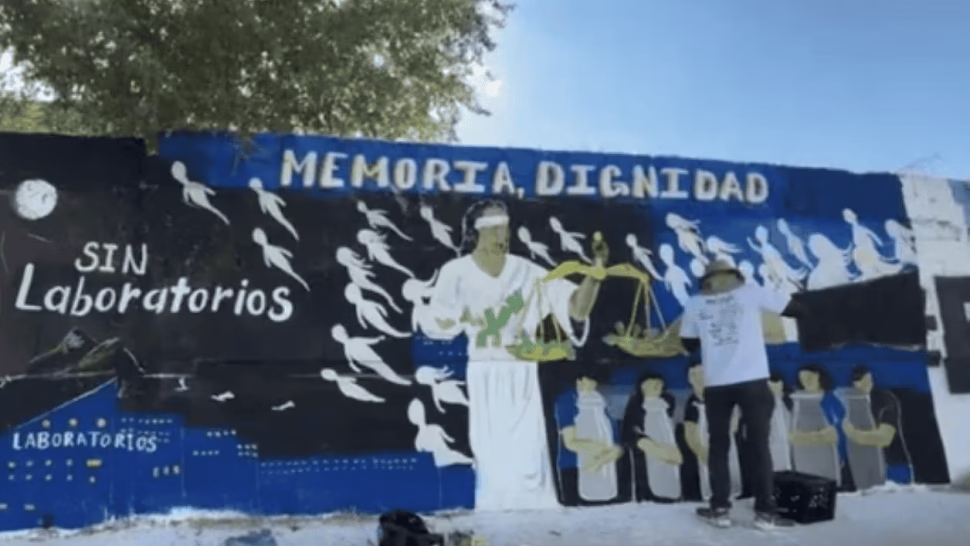

Mural demands justice for 386 people in Plenitude Crematorium

Families of victims of the Plenitude Crematorium unveil mural on Paseo de la Victoria.

The Memory, Dignity and Justice collective presented this Wednesday a commemorative mural for the Plenitude Crematorium case. On June 26, 386 uncremated bodies were found at that location. The families of the deceased led the event to unveil the work titled “Memory, Dignity and Justice for 386.”

A tribute that is also a complaint

The mural, painted on a wall on Paseo de la Victoria, seeks to honor the memory of the 386 people. But, according to the members of the group, it also symbolizes the pain and uncertainty that more than 1,500 families are experiencing. “We continue to search for answers and we hope to know with certainty the fate of our loved ones,” they noted.

The families affirmed that the investigation and justice process has not responded to the magnitude of the case. “We consider that there are still questions and irregularities that must be clarified with transparency,” they expressed.

“Behind every urn there is a story, a family and a life project.”

With this act, the families seek to keep the memory alive and prevent the case from being reduced to a figure. They demand that society know the truth and that what happened at the Plenitude Crematorium is not forgotten.

Continue reading

Loss of $127 million for Volaris in the second quarter

Despite a 24% increase in revenue, the high cost of fuel hit the airline's finances.

Mixed results for Volaris

Volaris reported a net loss of $127 million in the second quarter of the year. However, its total operating income grew by 24%, reaching $859 million. This increase was due to the increase in rates.

The cost of fuel was decisive. The average price of jet fuel increased by 70%, standing at $4.18 per gallon. The company faced one of the most challenging fuel environments in recent years.

Enrique Beltranena, president and CEO of Volaris, said:

“We acted decisively, driving strong performance across our network and cash flow generation, despite operating in one of the most challenging fuel environments in recent years.”

Beltranena highlighted that each flight operated contributed positively to cash flow. Domestic and international demand remained strong. The airline is focused on its capacity plan for the third quarter, concentrating flights in July and August to capture the peak season.

Perspectives and adjustments

Volaris expects available seat mile growth of approximately 5% for the full year. Capacity in the second quarter increased 2%. Operating expenses totaled $958 million, a significant increase compared to $715 million in the same period last year.

The company is confident in the actions taken during the first half of the year. Beltranena stated:

“Actions taken during the first half of the year are generating tangible progress, supporting stronger results in the second half and the restoration of our EBITDA margin guidance for the full year.”

Total cash, equivalents and short-term investments totaled $824 million, equivalent to 25% of trailing 12-month operating income. The projections include the compensation expected from the agreement with Pratt & Whitney, related to the inspection of GTF engines that keep some aircraft on the ground.

Continue reading

Six journalists have died in Mexico so far in 2026

Six communicators have been killed so far in 2026. Veracruz accounts for half of the cases.

Six journalists died in Mexico during 2026

At least six journalists have been killed in Mexico so far in 2026. All attacks were with firearms. Three of the cases occurred in Veracruz.

Carlos Castro was killed on January 9 in Poza Rica, Veracruz. He was 26 years old and was director of the Digital Code North portal, where he covered public security and red notice. The attack occurred in a restaurant where he was with his family.

Roxana Rivera was forcibly taken from her home in Nanchital, Veracruz, on June 2. The event was recorded on video. On July 3, authorities confirmed that remains found corresponded to his identity.

Luis Ángel López, a red note reporter for the newspaper Vanguardia, was deprived of his life on June 11 in Poza Rica. He had precautionary measures from the Commission to Protect Journalists.

Alex Serna, an environmentalist and communicator from Zihuatanejo, was reported missing and found dead on July 4. The Guerrero Prosecutor’s Office confirmed that the body showed signs of torture. He was in Semefo as unidentified.

Josué Martínez Contreras, director of the Noticias San Martín Texmelucan portal, was killed on July 16 in Puebla, in front of his 13-year-old son and his mother. Their outlet was a Facebook page with local information and security coverage.

Francisco Alejandro Leyva was killed on July 22 in San Pablo Etla, Oaxaca. Attackers on a motorcycle shot him while he was eating at a stall. He was director of Cortv and maintained his column “El Zumbido del Moscardón.”

The Mexican journalistic community faces a context of constant risk. Human rights organizations have reiterated the demand for justice and protection for those who practice journalism in the country.

Continue reading