An Earthquake in the Economy: The Coup of Authority that Changes Everything
In a dramatic turn that has shaken the foundations of national commerce, the Secretary of Economy, Marcelo Ebrard, has drawn the sword of tax justice. This Thursday, a thunderous announcement reverberated in the corridors of power: Mexico has slammed the door to the importation of finished footwear. It was not a mere suggestion, but a decree published with the full force of the law in the Official Gazette of the Federation, a bold move aimed at saving a national industry that was bleeding from the wound of a 12.8% drop from the clutches of unfair competition.
The villain of this epic story had a deceptively innocent name: the “temporary importation” regime. A lethal weapon hidden in plain sight, a Trojan horse that allowed products, mostly of Asian origin, to invade Mexican territory, evading the payment of VAT under the false promise that they were only passing through. But the betrayal was discovered. These goods, supposedly destined to be re-exported, treacherously ended up in the windows of Mexican stores, plunging local producers who were struggling to compete into misery.
The Final Battle for the Survival of a Legendary Industry
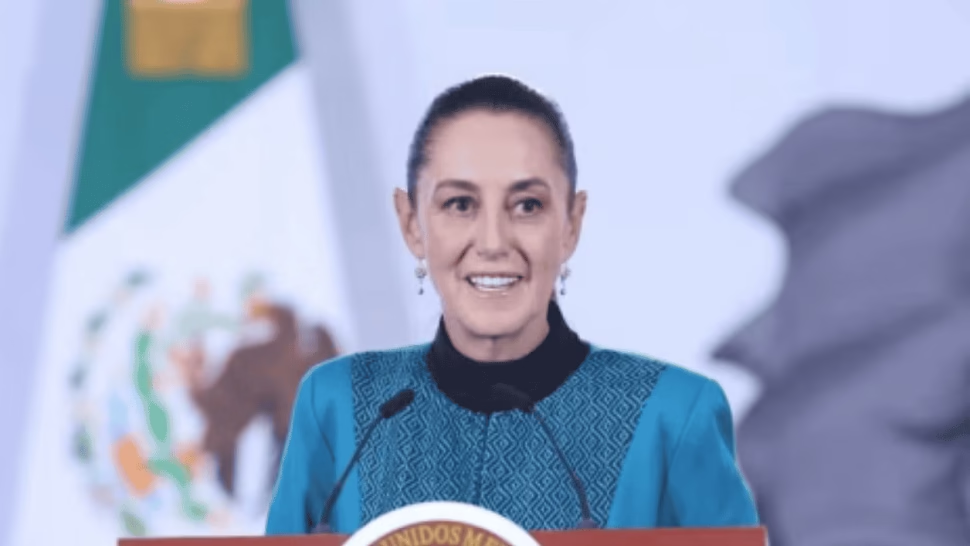
In a press conference full of the tension of a declaration of economic war, Ebrard, flanked by President Claudia Sheinbaum herself, left no room for doubt. “I was doing great damage to the footwear industry,” he declared with the forcefulness of someone who hits the table to break it in two. The initiative is not just a patch, it is a master plan with a monumental objective: reactivate national production, generate jobs, decapitate smuggling networks in one fell swoop and forge competitiveness that returns Mexican manufacturing to its throne.
Sheinbaum, with the precision of a surgeon, explained the grotesque distortion of a system designed for the maquila. The IMMEX program was a sanctuary for raw materials and components, such as auto parts, that cross the border to be assembled. But finished footwear? It was a joke! “What kind of temporary import for finished footwear? No,” he stated with implacable firmness. “Finished products do not have to have a temporary import permit. It is a definitive import if they are imported and they have to have their taxes.”
The figures reveal the magnitude of the catastrophe that prompted this historic decision. In a flash, in just three years, the trade balance collapsed in the most spectacular way. From exporting six pairs of shoes for every one it imported in 2021, Mexico was dragged into an abysmal one-to-one tie. A free fall that heralded the apocalypse for thousands of families and centuries-old traditions.
The notice of this revolution did not come from nowhere. Two weeks ago, in the very heart of the footwear empire, the Salón de la Piel y el Calzado (SAPICA) in León, Guanajuato, Ebrard issued an ultimatum that resonated like thunder before the most powerful unions in Latin America. “Enough is enough and it’s over,” he proclaimed before more than 130,000 direct workers, the backbone of a legendary industry. The message was clear and forceful: “It means that finished footwear can no longer be imported into Mexico from countries with which we do not have a free trade agreement that does not pay taxes. Do you want to import? Pay the taxes. The tariff is 25%, at least“.
This is not the end of the story. It is the climax of a first act where the heroes have stood up to the giant of tax evasion. The fate of the footwear industry in Mexico hangs in the balance, but today, that thread has been reinforced with the steel of determination. The world watches in disbelief. Will this move be enough to resurrect a sleeping giant? Only time will tell, but the battle has undoubtedly already begun.
Do you think this measure will save the national industry? Share this crucial news on your social networks and help us spread the word. Explore more analysis on the economic decisions that are shaping the future of our region.