Mexico presents complaints for deaths in ICE custody

Foreign Ministry initiates complaints to the Department of Justice and state prosecutors for 17 deaths of compatriots.

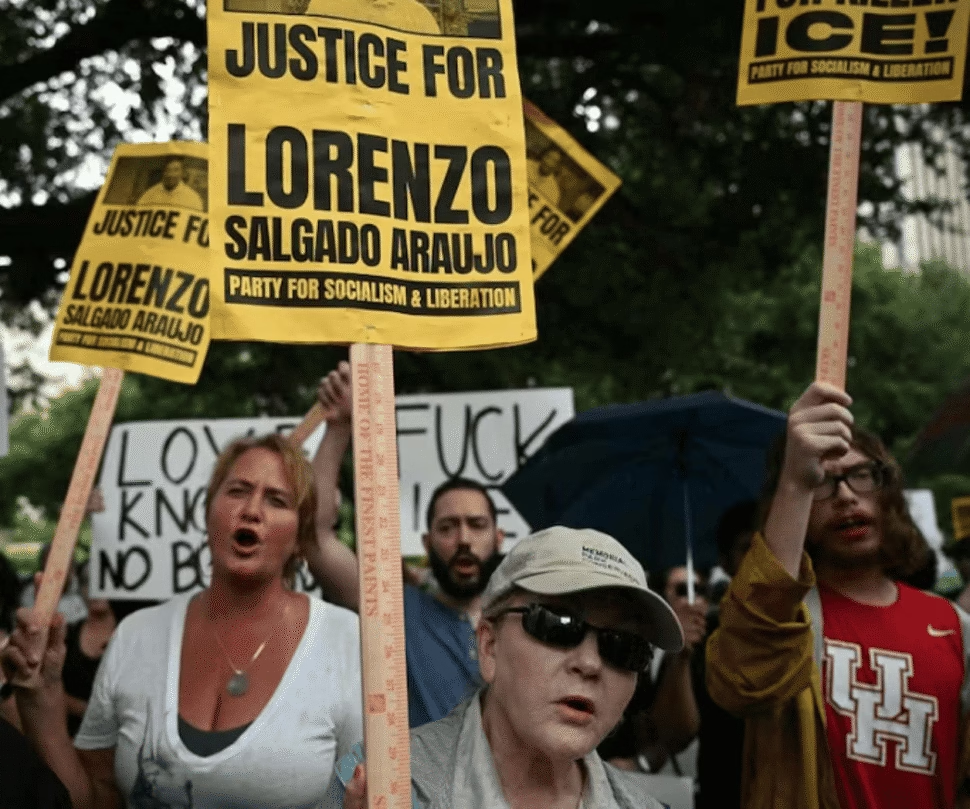
The Ministry of Foreign Affairs (SRE) launched the legal actions announced by President Claudia Sheinbaum after the death of 17 Mexicans in the custody of the Immigration and Customs Enforcement Service (ICE).

Actions in US courts and international organizations

This Monday, Foreign Minister Roberto Velasco detailed the steps taken: a formal complaint before the United States Department of Justice, complaints before state prosecutors’ offices, cease and desist letters against detention centers, and a communication to the UN High Commissioner for Human Rights.

RelatedMexico files criminal complaints against the US for migrant deaths

The Foreign Ministry indicated that, in coordination with the Attorney General’s Office (FGR), the complaint to the Department of Justice will be delivered through the Mexican Embassy. In addition, complaints have already begun before competent state prosecutors’ offices, through the consular network.

“The objective of these writings is to immediately cease the actions or omissions that led to these deaths, such as preventing access to prompt and expeditious medical care,” said the SRE regarding the first cease and desist letter, addressed to the Adelanto, California, detention center, where four Mexicans have died.

Foreign Minister Roberto Velasco also sent a letter to Volker Türk, UN High Commissioner for Human Rights, requesting that his office collect information from US authorities, analyze the compatibility of the events with international obligations and make recommendations.

The Foreign Ministry reiterated that these measures correspond to the investigation stage, “an essential prior step for the exercise of judicial actions that proceed in accordance with the law.” Likewise, he assured permanent support to the families of the victims through the consular network and confirmed that the Government of Mexico will act firmly through institutional channels.

Three minors arrested for murder of Didi driver in Mexicali

Three teenagers were arrested for the murder of a Didi driver in Mexicali.

Case details

The State Attorney General’s Office (FGE) of Baja California reported the arrest of three minors as allegedly responsible for the homicide of a Didi platform driver in Mexicali. The events occurred on July 9.

According to the official statement, a 16-year-old teenager requested the transportation service to move from the Villaverde subdivision to the Satélite neighborhood. During the journey, his 15-year-old brother and another 13-year-old teenager also boarded.

On the way, the driver was attacked with a firearm. He received a blow to the head that caused his death. The alleged perpetrators moved the body to the vicinity of the Villas del Colorado subdivision, where they set it on fire to hide the evidence.

Subsequently, they fled aboard the victim’s vehicle. Hours later, state agents located and intercepted the car near the Conjunto Urbano Universitario neighborhood.

Legal actions and evidence

The attorney general, María Elena Andrade Ramírez, reported that the young people face charges of homicide qualified with treachery and advantage, vehicle theft, and crimes related to the burial and exhumation of corpses.

The victim was a retired military man who worked as a driver to generate income. According to the prosecutor, “the motive for the crime is the theft of the vehicle,” and it is being investigated whether the weapon used is linked to other crimes.

One of the key elements is a video recorded by the minors themselves with a cell phone, which documents the events. The Prosecutor’s Office considers it compelling evidence.

The National Law of the Comprehensive Criminal Justice System for Adolescents will be applied to adolescents. The maximum sentences range from three to five years, depending on the age and participation of each person.

Continue reading

FGR was unaware that Los Chapitos pilot took Zambada to the US

FGR discovered ten months later that the Los Chapitos pilot transferred Zambada to the United States.

The Attorney General’s Office (FGR) confirmed that it did not know that Mauro Alberto Núñez Ojeda, alias “El Jando”, was the pilot who transported Ismael Zambada García to the United States after being taken by one of the sons of Joaquín “El Chapo” Guzmán.

In an information card, the institution detailed that just in June 2025, prosecutor Ernestina Godoy Ramos and her team found evidence that the detainee’s voice and fingerprints matched those of the pilot who on June 26, 2024 transported the founder of the Sinaloa Cartel and Joaquín Guzmán López from Culiacán, Sinaloa, to New Mexico.

The discovery occurred ten months after “El Jando” was handed over to US authorities along with 25 other members of organized crime, according to the same card released this Wednesday.

Detention and concealment

Núñez Ojeda was arrested in February 2025 in Jesús María, Culiacán, after an armed group traveling in an armored vehicle attacked Army and National Guard personnel. In the confrontation, one soldier died and five were injured.

When presented before the FGR, the pilot identified himself with another name. “The expert tests subsequently carried out by the Prosecutor’s Office established his true identity,” the institution noted. He was linked to proceedings for various crimes and considered a high-level member of the Sinaloa Cartel, with a risk to national security.

In August 2025, “El Jando” was handed over to the United States along with 25 other highly dangerous criminals, based on the National Security Law.

Open investigations

The FGR assured that the delivery does not extinguish the investigations. “It preserves the recordings, expert reports, interviews and other data included in the investigation folders and can request new proceedings through the legal assistance mechanisms between both countries,” he indicated.

The case shows the delays in coordination between Mexican and US agencies to identify key figures of organized crime.

Continue reading

Sheinbaum presents law against femicide with sentences of up to 70 years

Initiative seeks to standardize femicide investigations throughout the country.

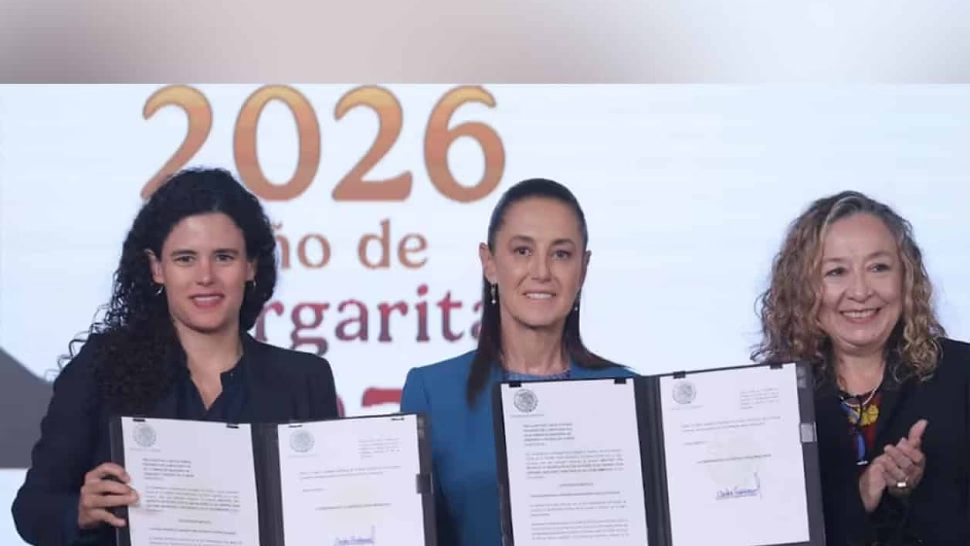
President Claudia Sheinbaum presented the General Law to Prevent, Investigate, Punish and Repair the Harm caused by the Crime of Femicide. The objective: zero impunity and a uniform investigation in all prosecutors’ offices in the country.

Details of the initiative

In her morning conference on July 15 at the National Palace, Sheinbaum stressed that this crime represents the worst form of discrimination and violence against women.

“The worst crime of violence against women… is death, feminicide, which means depriving a woman of her life for the sole reason of being a woman. It is a hate crime.”

He acknowledged that in some prosecutor’s offices it is still classified as suicide when the evidence points to a direct family member. The law seeks to avoid this misclassification and guarantee that all prosecutors’ offices work to the same standard.

Luisa María Alcalde, legal advisor to the Presidency, explained that the criminal type is homologated: “the person who deprives a woman of her life for reasons of gender commits the crime of feminicide.” 10 gender reasons are established, including signs of sexual violence, antecedents of violence and contexts of power asymmetry.

The penalty will be 50 to 70 years in prison throughout the country, with 19 aggravating circumstances that include when the victim is a child, adolescent, elderly, pregnant, disabled, journalist or human rights defender. The loss of inheritance rights, guardianship and parental authority is also contemplated, as well as dismissal and disqualification for public servants.

Sanctions and protocols

Maribel Bojorges Beltrán, head of the Special Prosecutor’s Office for Crimes of Violence against Women, indicated that the initiative establishes approved protocols with a gender perspective, reinforced due diligence and preservation of evidence. The specialized prosecutor’s offices must intervene in all stages of the criminal process.

Ingrid Gómez Saracibar, undersecretary of the Right to a Life Free of Violence, highlighted that the law guarantees victims access to truth, justice and emergency medical and psychological care. The comprehensive reparation of the damage will be transformative, adequate and rapid, with emphasis on the daughters and sons of the victims.

The initiative will be sent to Congress for discussion and approval.

Continue reading