Mexico files criminal complaints against the US for migrant deaths

The SRE announces criminal and civil legal actions for compatriots who died in immigration custody.

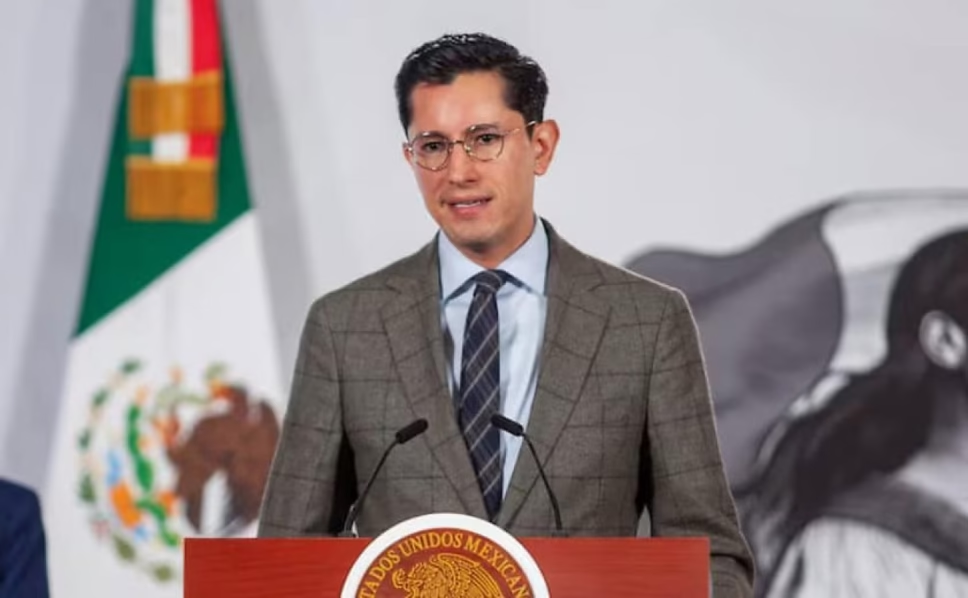
The Mexican government hardens its stance towards the United States. The Ministry of Foreign Affairs (SRE) instructed the Attorney General’s Office to file criminal complaints against those responsible for the deaths of Mexicans during immigration operations and in the custody of the Immigration and Customs Enforcement Service (ICE). In addition, it will promote civil actions against companies that manage detention centers.

Mexico’s legal actions

Foreign Minister Roberto Velasco explained that the complaints will be directed to state prosecutors and the United States Department of Justice. The objective is to carry out criminal investigations into the deaths that Mexico considers still unclarified. This decision marks a shift in Mexican strategy, which previously privileged diplomatic efforts.

RelatedDeaths of migrants in ICE custody reach historic high

Claudia Sheinbaum’s administration had sent 11 letters of diplomatic protest. In them he requested investigations into 17 deceased Mexicans: 14 in immigration detention centers and three during capture operations. Without obtaining answers considered satisfactory, Mexico raised the claim to judicial authorities.

One of the emblematic cases is that of Lorenzo Salgado Araujo. He died after being shot by ICE agents during an operation in Houston, Texas. US authorities indicated that the man tried to ram the agents with his vehicle. His family and the Mexican government questioned that version and called for an independent investigation.

Mexico will also sue private companies that operate immigration detention centers. It points out alleged irregularities in accommodation and medical care conditions. The center of Adelanto, California, is one of the main ones highlighted. Several Mexicans have died there and complaints have been filed for deficiencies in basic services.

At the same time, the SRE will request intervention from international organizations. It will appeal to the Inter-American Commission on Human Rights and the UN High Commissioner for Human Rights, demanding better conditions and guarantees for migrants.


Exit and entry of military personnel between Mexico and the US are authorized

The DOF publishes decrees that authorize movements of military personnel between Mexico and the United States for joint training.

Troop movements authorized by the DOF

The Official Gazette of the Federation (DOF) published this Tuesday decrees that authorize the exit and entry of military personnel between Mexico and the United States. The operations are part of joint cooperation and training exercises.

Departure of Mexican troops:

A first permit allows the departure of 518 soldiers from the “Anáhuac” Battalion of the Secretariat of National Defense (Sedena). They will participate in “Rotational Exercise 2026” from August 17 to September 13, 2026 at the Joint Readiness Training Center “Fort Johnson” in Louisiana, United States. The delegation will carry organic weapons, vehicles and special equipment.

Entry of US forces:

The entry of 23 elements of Team 8 of the Navy SEALs of the United States Navy was authorized, from August 1 to October 16, 2026. They will participate in the “SOF Event 4 Strengthen the capacity of Special Operations Forces” in Campeche, Hidalgo, State of Mexico and Mexico City. The transfer will be by air in a C-130 “Hércules” aircraft that will arrive and depart from the Toluca International Airport.

International competition in Paraguay:

Another decree endorses the departure of eight Sedena soldiers from the “Holkan” team for the “Commando Forces Competition 2026” in Asunción, Paraguay, from August 23 to September 5, 2026. They will travel by commercial flight.

More joint training:

A fourth decree authorizes the entry of 12 members of the seventh Special Operations group of the US Northern Special Operations Command. They will participate in the SOF3 Event “Improve the Capabilities of Special Forces Units” from July 15 to December 15, 2026. The training headquarters will be Temamatla, San Miguel de los Jagüeyes and the Santa Lucía Air Base, in the State of Mexico.

All operations were published in the DOF and seek to strengthen bilateral cooperation in defense matters.

Continue reading

Three minors arrested for murder of Didi driver in Mexicali

Three teenagers were arrested for the murder of a Didi driver in Mexicali.

Case details

The State Attorney General’s Office (FGE) of Baja California reported the arrest of three minors as allegedly responsible for the homicide of a Didi platform driver in Mexicali. The events occurred on July 9.

According to the official statement, a 16-year-old teenager requested the transportation service to move from the Villaverde subdivision to the Satélite neighborhood. During the journey, his 15-year-old brother and another 13-year-old teenager also boarded.

On the way, the driver was attacked with a firearm. He received a blow to the head that caused his death. The alleged perpetrators moved the body to the vicinity of the Villas del Colorado subdivision, where they set it on fire to hide the evidence.

Subsequently, they fled aboard the victim’s vehicle. Hours later, state agents located and intercepted the car near the Conjunto Urbano Universitario neighborhood.

Legal actions and evidence

The attorney general, María Elena Andrade Ramírez, reported that the young people face charges of homicide qualified with treachery and advantage, vehicle theft, and crimes related to the burial and exhumation of corpses.

The victim was a retired military man who worked as a driver to generate income. According to the prosecutor, “the motive for the crime is the theft of the vehicle,” and it is being investigated whether the weapon used is linked to other crimes.

One of the key elements is a video recorded by the minors themselves with a cell phone, which documents the events. The Prosecutor’s Office considers it compelling evidence.

The National Law of the Comprehensive Criminal Justice System for Adolescents will be applied to adolescents. The maximum sentences range from three to five years, depending on the age and participation of each person.

Continue reading

FGR was unaware that Los Chapitos pilot took Zambada to the US

FGR discovered ten months later that the Los Chapitos pilot transferred Zambada to the United States.

The Attorney General’s Office (FGR) confirmed that it did not know that Mauro Alberto Núñez Ojeda, alias “El Jando”, was the pilot who transported Ismael Zambada García to the United States after being taken by one of the sons of Joaquín “El Chapo” Guzmán.

In an information card, the institution detailed that just in June 2025, prosecutor Ernestina Godoy Ramos and her team found evidence that the detainee’s voice and fingerprints matched those of the pilot who on June 26, 2024 transported the founder of the Sinaloa Cartel and Joaquín Guzmán López from Culiacán, Sinaloa, to New Mexico.

The discovery occurred ten months after “El Jando” was handed over to US authorities along with 25 other members of organized crime, according to the same card released this Wednesday.

Detention and concealment

Núñez Ojeda was arrested in February 2025 in Jesús María, Culiacán, after an armed group traveling in an armored vehicle attacked Army and National Guard personnel. In the confrontation, one soldier died and five were injured.

When presented before the FGR, the pilot identified himself with another name. “The expert tests subsequently carried out by the Prosecutor’s Office established his true identity,” the institution noted. He was linked to proceedings for various crimes and considered a high-level member of the Sinaloa Cartel, with a risk to national security.

In August 2025, “El Jando” was handed over to the United States along with 25 other highly dangerous criminals, based on the National Security Law.

Open investigations

The FGR assured that the delivery does not extinguish the investigations. “It preserves the recordings, expert reports, interviews and other data included in the investigation folders and can request new proceedings through the legal assistance mechanisms between both countries,” he indicated.

The case shows the delays in coordination between Mexican and US agencies to identify key figures of organized crime.

Continue reading