Mexico negotiates with US congressmen to avoid tax on remittances

The Mexican ambassador to the US addresses with legislators the economic impact of taxing remittances and strengthens commercial ties.

Economic diplomacy in action: Mexico against the proposed tax on remittances

Esteban Moctezuma Barragán, ambassador of Mexico to the United States, held key meetings with US legislators to analyze the implications of Republican Jason Smith’s proposal, which seeks to apply a 5% tax to remittances sent by migrants. This fiscal movement, if implemented, would directly affect millions of families that depend on these resources, in addition to altering the bilateral economic flow.

Arguments and strategic alliances

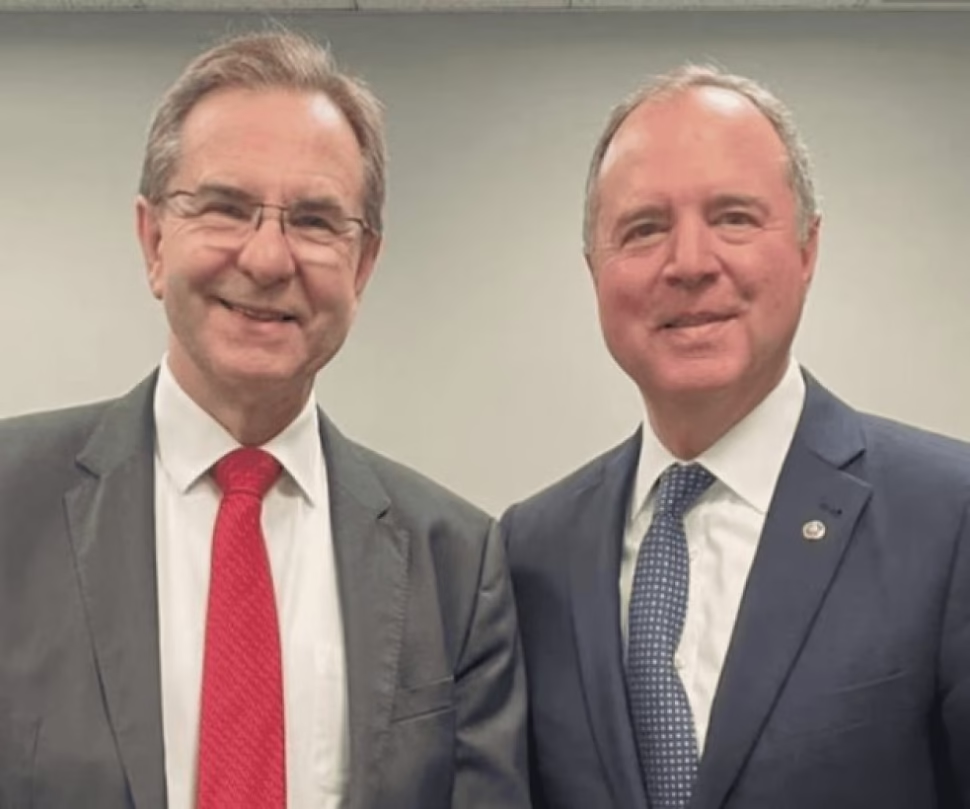
Moctezuma presented compelling data during his meeting with Democratic Senator Adam Schiff, representative of California, a state with deep ties to Mexico. “We analyze how to protect value chains in the face of trade challenges,” said the diplomat, highlighting that California and Mexico share a symbiotic relationship: more than 584,000 jobs depend on trade, with a volume that exceeds $70 billion annually.

RelatedSheinbaum rejects 5% tax on remittances as discriminatory

With Republican Senator Dave McCormick (Pennsylvania), the focus was on sectoral impact. Mexico is the second trading partner of that state, with growing automotive and agri-food exports, which support 200,000 jobs. Communication will continue to evaluate alternatives to the tax, which could reduce the purchasing power of migrant communities and curb consumption in key industries.

Context and economic repercussions

Remittances to Mexico reached historical records in 2024 ($63 billion), representing 4% of the national GDP. A 5% tax would divert approximately $3 billion annually, affecting 11 million households. Experts warn that this measure would encourage the use of informal channels, increasing the risks of money laundering and reducing the traceability of funds.

In addition, the approach contradicts previous agreements such as the T-MEC, where both countries committed to facilitating legal transactions. Analysts point out that the proposal responds to internal fiscal pressures in the US, but ignores the stabilizing role of remittances in emerging economies.

Next steps and call to action

Moctezuma anticipates dialogues with more legislators and interest groups to present impact studies. The Mexican strategy combines economic data with humanitarian appeals: 80% of remittances are destined for education, health and housing, according to the Bank of Mexico.

Are you interested in the global economy and its social effects? Share this analysis on your networks and explore more content on diplomacy and international finance. #RemittancesWithoutTaxes

Sources: Ministry of Foreign Affairs, Bank of Mexico, US Census Bureau (2024).

Sedena plans to replace F-5 aircraft and acquire new fighters by 2050

The Army updates its air fleet: it will replace the F-5 and evaluate Swedish Gripen fighters.

Short and long term Air Force plan

The head of the Secretariat of National Defense (Sedena), Ricardo Trevilla Trejo, confirmed that the Army, the Air Force and the National Guard have a development plan for aircraft. It includes short, medium and long-term acquisitions, with emphasis on cargo aircraft, personnel transport and helicopters.

“We give priority to cargo aircraft, personnel transport and helicopters. We apply them a lot in the DN-III-E Plan and in operations,” he said during the morning conference on July 16.

The plan also includes a military equipment and industry factory to supply the dependencies. In the long term, until 2050, the replacement of the F-5 aircraft, acquired in 1982, is planned. Of a fleet of 10, only three are still in operation.

Sedena began the search for replacements for the F-5. Federal sources indicated that it plans to acquire 12 new fighters before 2028 to reinforce airspace surveillance. Among the options, the Swedish Gripen E and F fighters, from the Saab company, stand out, with a cost of more than 100 million dollars per unit. The Air Force has already received a presentation of these aircraft, which offer advanced radar technology and low maintenance costs.

The acquisition takes place in a tense geopolitical context, with conflicts such as the war between Russia and Ukraine, and tensions between Israel, the United States and Iran. Sedena evaluates options in the international defense market to meet the established deadlines.

Continue reading

Defense denies link with former secretary accused of criminal ties

General Trevilla denied that the agency had designated the former secretary accused in the US.

The Defense posture

General Ricardo Trevilla Trejo rejected that the former Secretary of Security of Sinaloa, Gerardo Mérida Sánchez — singled out by the United States for alleged links to organized crime — has a working relationship with the Secretariat of National Defense (Sedena).

“General Mérida Sánchez will retire in 2022 and has no employment relationship with Sedena. Only administrative ties with the ISSFA for payment and medical service issues,” he declared during the morning conference on June 16.

Regarding the statements of the interim governor of Sinaloa, Yeraldine Bonilla, who assured that Sedena sent Mérida to the State Security Secretariat, Trevilla attributed the statement to a misinterpretation. He explained that states can request an opinion on the history of a retired military officer, but the final decision rests with the local authority.

Accusations in the United States

Mérida Sánchez is one of 10 Sinaloan officials mentioned by Washington for alleged agreements with the Sinaloa criminal group. The Department of Justice accuses him of receiving bribes of $100,000 a month from “Los Chapitos” in exchange for information about operations.

On June 1, he appeared in a New York court. Judge Katherine Polk Failla called the evidence “abundant” and set a new hearing for August 4. Mérida arrived handcuffed and handcuffed after voluntarily surrendering on May 11 in Mexico.

Trevilla stated that Sedena has no information about the case: “It is an issue handled by the FGR or US authorities.”

Continue reading

New type of extortion in Edomex: false manager and closures

García Harfuch warns about a new floor collection method with fake inspectors.

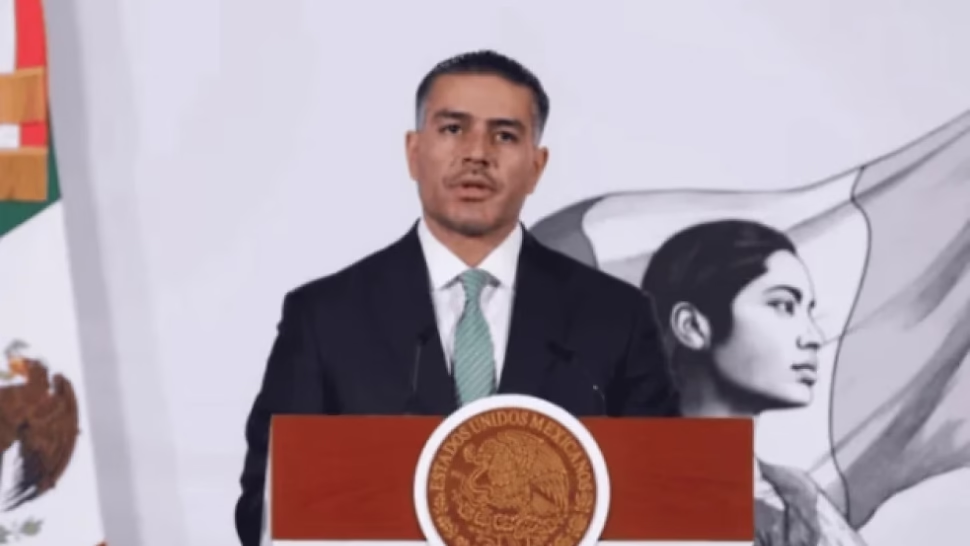
Omar García Harfuch, head of the SSPC, identified a new type of extortion in the State of Mexico. A supposed manager offers protection to merchants against legal actions by the municipality. If they don’t pay, fake inspectors close the business.

Call to report

This Tuesday morning, García Harfuch reiterated the call to report to 089. He guaranteed that there have been no leaks against the victims.

“Yes, we have already had cases and detainees of this type,” he confirmed.

Regarding confidentiality, he added:

“It is important that citizens know that when they report through the 089 mechanism, or in the institutions of the Security Cabinet, we have not had a single leak or repercussion against the victims.”

He insisted: “It is very important, please report and we will deliver results.”

Continue reading